DOI: 10.37421/2684-4923.22.06.173
Air pollution can cause diseases, allergies, and even death to humans; it can also cause harm to other living organisms such as animals and food crops, and may damage the natural environment (for example, climate change, ozone depletion or habitat degradation) or built environment (for example, acid rain). Plankton produces the oxygen we breathe every day, even every second. In addition to producing oxygen, plankton also remove carbon dioxide from the atmosphere. Blue economy is a term in economics relating to the exploitation, preservation and regeneration of the marine environment. Its scope of interpretation varies among organizations. However, the term is generally used in the scope of international development when describing a sustainable development approach to coastal resources. This can include a wide range of economic sectors, from the more conventional fisheries, aquaculture, maritime transport, coastal, marine and maritime tourism, or other traditional uses, to more emergent spaces such as coastal renewable energy, marine ecosystem services (i.e. blue carbon), seabed mining, and bioprospecting. SWOT analysis identifies internal and external factors that are prioritized by experts in the world blue economic forum domain through an Analytical hierarchy process. The prioritized SWOT factors are used in the formulation of strategies using the TOWS matrix. Regional and international competitive destinations: Local competitors are developing a competitive festival world blue economic to attract tracks of similar profiles big city, improve technology and science and education blue economic.
DOI: 10.37421/2684-4923.2024.8.229
DOI: 10.37421/2684-4923.2024.8.230
DOI: 10.37421/2684-4923.2024.8.231
DOI: 10.37421/2684-4923.2024.8.232
DOI: 10.37421/2684-4923.2024.8.233
DOI: 10.37421/2684-4923.2024.8.234
DOI: 10.37421/2684-4923.2024.8.235
DOI: 10.37421/2684-4923.2024.8.236
DOI: 10.37421/2684-4923.2024.8.237
DOI: 10.37421/2684-4923.2024.8.238
DOI: 10.37421/2684-4923.2022.6.180
DOI: 10.37421/2684-4923.2022.6.178
The amount of plastic waste that ends up in the oceans each year is estimated to be 10 million metric tons, making it a component of ocean pollution that is rapidly growing and very visible. In the oceans, mercury is the metal pollutant of greatest concern; It comes from two main sources: small-scale gold mining and combustion of coal. The extent and nature of these effects are still poorly understood. Conduct a comprehensive investigation of the known and potential health effects of ocean pollution. Make these threats known to policymakers, leaders of governments, international organizations, civil society and the general public worldwide. Prioritize interventions to control and prevent seawater pollution and protect human health.
DOI: 10.37421/2684-4923.2022.6.181
DOI: 10.37421/2684-4923.2022.6.182
DOI: 10.37421/2684-4923.2022.6.179
HPAM can be removed using a variety of chemical and thermal methods, but they are not very good for the environment and can be quite pricey. Biodegradation with the help of single or mixed microbes known as biofilms is touted as one of the various treatments that can be used to solve the problem without causing any negative side effects. In both laboratory-scale and field-scale studies, numerous researchers have investigated and reported the potential of such bioremediation technology with varying HPAM removal efficiency from oil field produced water.
DOI: 10.37421/2684-4923.2025.9.258
DOI: 10.37421/2684-4923.2025.9.249
DOI: 10.37421/2684-4923.2025.9.250
DOI: 10.37421/2684-4923.2025.9.251
DOI: 10.37421/2684-4923.2025.9.252
DOI: 10.37421/2684-4923.2025.9.253
DOI: 10.37421/2684-4923.2025.9.254
DOI: 10.37421/2684-4923.2025.9.255
DOI: 10.37421/2684-4923.2025.9.256
DOI: 10.37421/2684-4923.2025.9.257
Ahmed Alzahrani*, Mohamed Hassan and Hussain Alsalamah
DOI: 10.37421/2684-4923.2024.8.228
The purpose of this study is to promote consistency in national and international charcoal testing protocols. The methods employed for assessing volatile matter and ash content in charcoal are rooted in empirical approaches, exhibiting significant variations across different countries. Within this study, the volatile matter content was gauged under two distinct treatment conditions, namely ISO 562 and ASTM D1762, while ash content was ascertained under two distinct treatment conditions, i.e., ASTM D3174 and ASTM D1762, across varying heating rates. A comparison of various characteristics, including fixed carbon, volatile substance, gross calorific values and ash levels, was done on charcoal samples made from Deer brand charcoal, Coconut sawdust, Palm tree debris and unknown natural products. Variations in volatile matter and ash content were produced by the choice of the technique used. Each criterion demonstrates distinctive qualities that could have an impact on the results. The results indicate a strong correlation between the high volatile content of the charcoals and their low calorific values. Charcoal made from natural products, specifically Indonesian products and Deer brand charcoal have been found to have high calorific values of 31557.2 and 31403.9 KJ/Kg, low volatile matter at 6.47 and 12% and minimal ash content at 2.4 and 2.9%, according to research conducted using the ASTM D1762 technique. Based on the experimental results and different international classification of charcoal, we derived classification criteria and quality index for the quality check of charcoal samples.
DOI: 10.37421/2684-4923.2024.8.241
DOI: 10.37421/2684-4923.2024.8.242
DOI: 10.37421/2684-4923.2024.8.243
DOI: 10.37421/2684-4923.2024.8.245
DOI: 10.37421/2684-4923.2024.8.246
DOI: 10.37421/2684-4923.2024.8.247
DOI: 10.37421/2684-4923.2024.8.248
Abdullahi Kamal*, Abdullahi Shamsudden, Ladan Muhammad Auwal and Mohammed Umar Aminu
DOI: 10.37421/2684-4923.2024.8.240
Flood in Birnin-Kudu areas is a terrible catastrophe. The location of large parts of the study area is associated with river ways, one is situated along Masaya Bridge and the other along Kwanar-Huguma and many communities are at risk of flood hazard. This study is aimed at assessing the flood impact on the environment, identifying the factors responsible for flooding occurrence, determining the factors toward prevention, management and control of flooding and understanding the community’s responses on ways to arrest flooding event ; A case study of Birnin Kudu, Jigawa State. A sample size of 600 respondents were drawn for self-administered questionnaire, 425 were fully completed. Data collected were analyzed descriptively using Microsoft Excel (Version 2019). Findings revealed that, some of the factors responsible for flood occurrence were poor drainage systems (70.6%), absence of drainages systems (60.5%), lack of unimproved water system in the neighboring community (51.1%), lack of sufficient water reservoirs (50.4%) and poor farming practices (28.9%). Some of the impacts were those that affect the economy of a given geographical area (95.1%), those that affect farm outputs (93.4%) and those that cause the destruction of human settlement (92.5%), deterioration of fertile land (86.4%) and declining of biodiversity (78.4%). Majority of the respondents showed awareness and interest on factors responsible for prevention, management and control of flooding across the affected areas. However, on ways to arrest flooding across the areas, 49.6% revealed that on maintaining the available drainages there is a need for community leaders and community members involvement. It is recommended that, there is a need for provision of standard infrastructural facilities by the government, repair and construction of these drainages where necessary should be embarked on to further ease the flow of storm water, environmental sanitation program must be made compulsory and appropriate agency should be vested with the power to deal with residents who fail to adhere to the rule of sanitation and public enlightenment programmes should be organized to educate the public on the dangers of flood disaster and its causes as a result of the habit of throwing and dumping refuse in gutters, drainage paths and river channels.
DOI: 10.37421/2684-4923.2024.8.244
DOI: 10.37421/2684-4923.2025.9.258
DOI: 10.37421/2684-4923.2025.9.259
DOI: 10.37421/2684-4923.2025.9.260
DOI: 10.37421/2684-4923.2025.9.261
DOI: 10.37421/2684-4923.2025.9.262
DOI: 10.37421/2684-4923.2025.9.263
DOI: 37421/2684-4923.2025.9.264
DOI: 10.37421/2684-4923.2025.9.265
DOI: 10.37421/2684-4923.2025.9.266
DOI: 10.37421/2684-4923.2025.9.259
DOI: 10.37421/2684-4923.2025.9.268
DOI: 10.37421/2684-4923.2025.9.267
DOI: 10.37421/2684-4923.2025.9.270
DOI: 10.37421/2684-4923.2025.9.271
DOI: 10.37421/2684-4923.2025.9.274
DOI: 10.37421/2684-4923.2025.9.273
DOI: 10.37421/2684-4923.2025.9.274
DOI: 10.37421/2684-4923.2025.9.275
DOI: 10.37421/2684-4923.2025.9.276
DOI: 10.37421/2684-4923.2025.9.277
DOI: 10.37421/2684-4923.2025.9.278
DOI: : 10.37421/2684-4923.2025.9.279
DOI: I: 10.37421/2684-4923.2025.9.281
DOI: 10.37421/2684-4923.2025.9.282
DOI: 10.37421/2684-4923.2025.9.283
DOI: : 10.37421/2684-4923.2025.9.284
DOI: 10.37421/2684-4923.2025.9.285
DOI: 10.37421/2684-4923.2025.9.286
DOI: 10.37421/2684-4923.2025.9.287
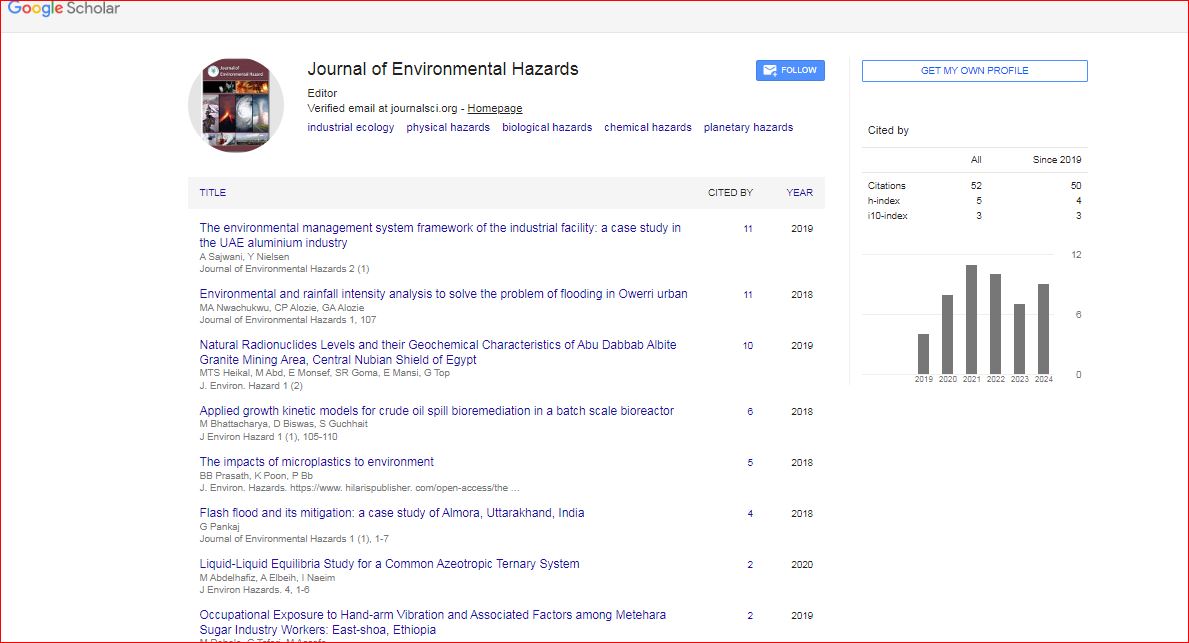
Journal of Environmental Hazards received 51 citations as per Google Scholar report
 Spanish
  Chinese
  Russian
  German
  French
  Japanese
  Portuguese
  Hindi
Hindi 