Opinion - (2025) Volume 9, Issue 4
Received: 01-Oct-2025, Manuscript No. jeh-26-180007;
Editor assigned: 03-Oct-2025, Pre QC No. P-180007;
Reviewed: 15-Oct-2025, QC No. Q-180007;
Revised: 22-Oct-2025, Manuscript No. R-180007;
Published:
05-Nov-2025
, DOI: : 10.37421/2684-4923.2025.9.284
Citation: Ivanova, Natalia. ”Noise Pollution’s Toll on Mental Wellbeing.” J Environ Hazard 09 (2025):284.
Copyright: © 2025 Ivanova N. This is an open-access article distributed under the terms of the Creative Commons Attribution License, which permits unrestricted use,
distribution and reproduction in any medium, provided the original author and source are credited.
Noise pollution represents a pervasive environmental stressor with profound implications for human health, particularly concerning mental well-being. Emerging research increasingly highlights the intricate connections between chronic exposure to environmental noise and a spectrum of psychological disturbances. This introduction aims to synthesize current understanding by examining how various forms of noise pollution contribute to adverse mental health outcomes, drawing upon recent scientific investigations. The detrimental effects of noise are not merely perceptual; they are underpinned by physiological mechanisms that can alter brain function and stress responses. Understanding these pathways is crucial for developing effective public health strategies and urban planning policies. The subsequent sections will delve deeper into specific aspects of this relationship, providing a comprehensive overview of the research landscape. One significant area of concern is the impact of general environmental noise on stress and anxiety levels. Chronic exposure to ambient noise, particularly in urban settings, has been linked to heightened physiological stress responses.
This persistent activation of the stress system can lead to a cascade of negative effects on mental health. The cumulative burden of such stressors can predispose individuals to various mood disorders and exacerbate existing conditions. The relationship between traffic-related noise and mental health is a growing area of research. The constant auditory bombardment from vehicular traffic, a hallmark of urban environments, has been associated with an increased incidence of depressive symptoms. This correlation suggests that the persistent stress induced by traffic noise plays a significant role in the onset or worsening of depression. Sleep quality is another critical factor mediating the link between noise pollution and mental health. Noise disturbances during sleep hours can lead to fragmented and insufficient rest, which is intrinsically tied to mental health. Poor sleep, a common consequence of noise, can manifest as increased irritability, impaired concentration, and a greater susceptibility to anxiety and stress. Occupational noise exposure presents a distinct but related challenge, particularly for individuals working in industrial settings. High noise levels in the workplace have been identified as a significant contributor to psychological distress and fatigue among workers. This highlights the importance of implementing robust noise control measures within industrial environments to safeguard employee mental well-being. Beyond immediate emotional responses, prolonged exposure to noise pollution can also impair cognitive functions. Studies focusing on attention and memory have revealed that chronic noise exposure can lead to deficits in sustained attention and working memory capacity. These cognitive impairments are often attributed to the stress response elicited by noise. Specific sources of noise, such as aircraft operations, also pose a considerable threat to the mental health of nearby residents. Studies examining communities located near airports have reported a significant association between high levels of aircraft noise and increased instances of stress-related symptoms, including anxiety and sleep disturbances. Delving into the underlying biological processes, neurobiological research is shedding light on the mechanisms by which noise pollution impacts mental health.
Chronic noise exposure can trigger physiological changes, including elevated stress hormone levels, inflammation, and oxidative stress within the brain, contributing to conditions like anxiety and depression. Particular attention is being paid to the effects of noise pollution on vulnerable populations, such as children. Research indicates that children exposed to elevated noise levels may experience heightened stress, behavioral issues, and compromised cognitive development. These findings underscore the necessity for targeted interventions to protect the mental health of children in noisy environments. Finally, the pervasive nature of urban noise pollution contributes to feelings of annoyance and a diminished quality of life. Continuous exposure to urban noise can significantly increase annoyance levels, which in turn negatively affects overall mental well-being and life satisfaction, demonstrating a direct psychological toll.
The impact of environmental noise pollution on mental well-being is a complex phenomenon, with research highlighting various pathways through which noise exerts its detrimental effects. A systematic review and meta-analysis has underscored the significant impact of chronic exposure to environmental noise on mental health, detailing its role in exacerbating stress, anxiety, and sleep disturbances. This study further elucidates the physiological mechanisms by which noise affects the brain and nervous system, leading to a decline in cognitive function and an increased risk of mood disorders, emphasizing the necessity for urban planning and public health interventions [1]. A cross-sectional study investigating the link between traffic-related noise and depression has found a clear association, reporting that individuals exposed to higher levels of traffic noise exhibited significantly more depressive symptoms. This research suggests that the constant stress induced by traffic noise contributes to the development or worsening of depressive conditions [2].
Further emphasizing the intricate connection, another study focuses on the impact of noise pollution on sleep quality and its subsequent effects on mental health. Poor sleep, often a consequence of noise disturbance, is directly linked to increased irritability, reduced concentration, and a higher likelihood of experiencing anxiety and stress, prompting proposals for noise reduction and sleep hygiene strategies [3]. In the realm of occupational health, research examining the relationship between noise exposure and mental health outcomes in industrial workers identifies a correlation between high noise levels and increased rates of stress, fatigue, and psychological distress. This highlights the critical importance of implementing workplace noise control measures to protect worker mental health [4]. The effects of chronic noise exposure extend to cognitive performance, specifically attention and memory. Findings indicate that prolonged exposure to noise pollution leads to deficits in sustained attention and working memory, likely due to the stress response it elicits. The implications for academic performance and daily functioning are significant [5].
Specific sources of noise, such as aircraft noise, also have a discernible impact on mental health. Studies on residents living near airports report a significant association between higher levels of aircraft noise exposure and increased prevalence of stress-related symptoms, including anxiety and sleep disturbance, advocating for stricter noise regulations and mitigation strategies [6]. Neurobiological investigations are uncovering the fundamental mechanisms by which noise pollution affects mental health. Research indicates that chronic noise exposure can lead to elevated levels of stress hormones, inflammation, and oxidative stress in the brain, contributing to conditions like anxiety and depression, thereby underscoring the physiological basis of noise-induced mental health issues [7].
Attention to vulnerable populations reveals the pronounced effects of noise pollution on children's mental development and well-being. Findings suggest that children exposed to high levels of noise pollution experience increased stress, behavioral problems, and impaired cognitive development, calling for targeted interventions to protect their mental health in noisy environments [8]. In urban settings, psychological effects of noise pollution, particularly annoyance and reduced quality of life, are also evident. Continuous exposure to urban noise significantly increases annoyance levels, which in turn negatively impacts overall mental well-being and life satisfaction [9]. Finally, research evaluating the effectiveness of interventions aimed at mitigating noise pollution and their impact on mental health suggests that a multi-faceted approach, incorporating noise barriers, urban planning modifications, and public awareness campaigns, is most effective in addressing the negative mental health consequences of noise exposure [10].
Noise pollution significantly impacts mental well-being by exacerbating stress, anxiety, and sleep disturbances through physiological pathways affecting the brain and nervous system, leading to cognitive decline and increased mood disorder risk. Traffic-related noise is linked to higher rates of depression, while poor sleep quality due to noise increases irritability and susceptibility to anxiety. Occupational noise exposure in industrial settings results in heightened stress and psychological distress. Chronic noise impairs attention and memory, and aircraft noise is associated with stress-related symptoms and sleep disruption in nearby communities. Neurobiological studies show noise increases stress hormones and brain inflammation, contributing to mental health issues. Children are particularly vulnerable, experiencing increased stress, behavioral problems, and developmental issues. Urban noise also leads to annoyance and reduced life satisfaction. Multi-faceted interventions are crucial for mitigating these detrimental effects.
None
None
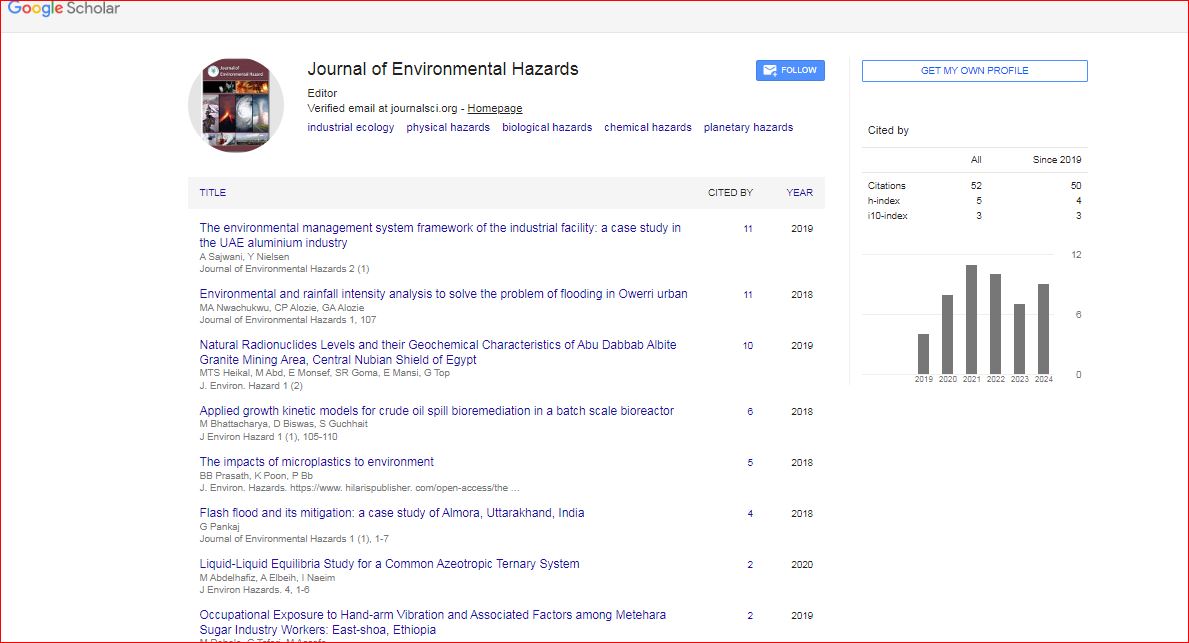
Journal of Environmental Hazards received 51 citations as per Google Scholar report