Commentary - (2025) Volume 9, Issue 2
Received: 01-May-2025, Manuscript No. jeh-26-179970;
Editor assigned: 04-May-2025, Pre QC No. P-179970;
Reviewed: 15-May-2025, QC No. Q-179970;
Revised: 22-May-2025, Manuscript No. R-179970;
Published:
29-May-2025
, DOI: 10.37421/2684-4923.2025.9.261
Citation: Thompson, Emily R.. ”Innovations Revolutionize Environmental Monitoring and Management.” J Environ Hazard 09 (2025):261.
Copyright: © 2025 Thompson R. Emily This is an open-access article distributed under the terms of the Creative Commons Attribution License, which permits unrestricted use,
distribution and reproduction in any medium, provided the original author and source are credited.
Environmental monitoring is undergoing significant transformation, driven by advanced technologies providing precise and timely insights into the planet's health. Remote sensing offers powerful tools for comprehensive environmental monitoring and management, capturing diverse spatial and temporal data crucial for understanding ecosystem health, climate change impacts, and resource distribution. Recent advancements focus on integrating multiple sensor types and data fusion for more accurate assessments [1].
Internet of Things (IoT) technology is fundamentally reshaping environmental monitoring by enabling real-time data collection from various sensors across vast areas. These systems provide critical insights into air and water quality, soil conditions, and noise levels, allowing for proactive intervention and more efficient resource management. Challenges include power consumption, data security, and interoperability of devices [2].
Advances in sensor technologies are significantly improving ambient air quality monitoring, offering more accurate, portable, and cost-effective solutions. These new sensors facilitate wider deployment and enable finer spatial and temporal resolution of air pollutants, vital for public health assessments and regulatory compliance. Key developments include miniaturization, enhanced selectivity, and integration with data analytics platforms [3].
Water quality monitoring has seen substantial advancements through the integration of novel analytical techniques, biosensors, and remote sensing. These methods provide faster, more sensitive, and comprehensive assessments of contaminants, addressing the limitations of traditional lab-based analyses. Real-time data acquisition is crucial for effective management of aquatic ecosystems and ensuring safe drinking water supplies [4].
Biosensors are emerging as a powerful tool for environmental monitoring, offering rapid, sensitive, and selective detection of various pollutants including heavy metals, pesticides, and organic compounds. Their ability to provide real-time data in situ minimizes sample handling and reduces analysis time. Overcoming challenges in stability, sensitivity, and multiplexing will further enhance their utility [5].
Artificial Intelligence (AI) and Machine Learning (ML) are revolutionizing environmental monitoring by enabling sophisticated data analysis, predictive modeling, and automated decision-making. These technologies enhance the interpretation of complex environmental datasets, improving predictions for climate change, pollution dispersion, and natural disaster risks. Challenges include data availability, model interpretability, and ethical considerations [6].
Smart urban environmental monitoring systems, often integrated into smart city frameworks, utilize diverse sensors, IoT devices, and data analytics. These provide granular insights into urban air quality, noise pollution, waste management, and traffic, aiming to enhance urban sustainability, improve public health, and optimize resource utilization through real-time data and predictive capabilities [7].
Monitoring microplastics in various environmental matrices, including water, soil, and air, is crucial for understanding their pervasive impact. The review highlights the diversity of detection and quantification methods, from spectroscopic techniques to microscopy. Standardizing these methods is essential for comparable and reliable assessment of microplastic pollution [8].
Environmental DNA (eDNA) monitoring has emerged as a revolutionary, non-invasive approach for assessing biodiversity across various ecosystems. It allows for the detection of species from trace DNA left in the environment, offering greater efficiency and sensitivity compared to traditional survey methods. This technique holds significant promise for conservation efforts, early detection of invasive species, and ecological health assessments [9].
Finally, effective monitoring of climate change impacts relies on a robust set of environmental indicators that track changes in temperature, precipitation, sea level, biodiversity, and ecosystem services. This emphasizes the importance of selecting appropriate indicators sensitive to climatic shifts, providing comprehensive insights into regional and global environmental health. Data integration and long-term monitoring strategies are crucial for understanding and mitigating climate change effects [10].
Modern environmental monitoring is being revolutionized by an array of sophisticated technologies, delivering unprecedented detail and responsiveness. Remote sensing serves as an indispensable tool for comprehensive environmental oversight, capturing diverse spatial and temporal data essential for assessing ecosystem health, understanding climate change impacts, and mapping resource distribution, particularly in difficult-to-access areas. Advancements emphasize integrating multiple sensor types and data fusion for more accurate and timely assessments [1]. Concurrently, general sensor technologies have significantly improved ambient air quality monitoring, offering more accurate, portable, and cost-effective solutions. These allow wider deployment and finer spatial and temporal resolution of air pollutants, crucial for public health and regulatory compliance. Key developments include miniaturization, enhanced selectivity, and integration with data analytics [3].
Internet of Things (IoT) technology is transforming how environmental data is collected and analyzed, enabling real-time data acquisition from widespread sensors. These systems provide critical insights into air and water quality, soil conditions, and noise levels, facilitating proactive interventions and efficient resource management [2]. In urban settings, smart environmental monitoring systems, often part of smart city frameworks, leverage diverse sensors, IoT devices, and data analytics. They furnish granular insights into urban air quality, noise pollution, waste management, and traffic, aiming to enhance urban sustainability, public health, and optimize resource utilization through real-time data and predictive capabilities [7].
Water quality monitoring has seen substantial advancements through novel analytical techniques, biosensors, and remote sensing. These modern methods provide faster, more sensitive, and comprehensive contaminant assessments, overcoming limitations of traditional lab-based analyses. Real-time data acquisition is crucial for effective aquatic ecosystem management and ensuring safe drinking water supplies [4]. Biosensors are rapidly emerging as powerful tools for environmental monitoring, offering rapid, sensitive, and selective detection of various pollutants, including heavy metals, pesticides, and organic compounds. Their ability to provide real-time data in situ minimizes sample handling and reduces analysis time. Challenges in stability, sensitivity, and multiplexing are areas for continued enhancement [5].
Artificial Intelligence (AI) and Machine Learning (ML) play a transformative role, enabling sophisticated data analysis, predictive modeling, and automated decision-making in environmental monitoring. These technologies enhance the interpretation of complex environmental datasets, improving predictions for climate change, pollution dispersion, and natural disaster risks [6]. However, challenges like data availability, model interpretability, and ethical considerations require ongoing attention.
Specialized monitoring techniques are also advancing. Precise monitoring of microplastics across various environmental matrices (water, soil, air) is vital for understanding their pervasive impact. Diverse detection and quantification methods exist, from spectroscopic techniques to microscopy, highlighting the need for standardization to ensure comparable and reliable assessments [8]. Environmental DNA (eDNA) monitoring offers a revolutionary, non-invasive approach for assessing biodiversity across ecosystems. It detects species from trace DNA, providing greater efficiency and sensitivity than traditional methods. This technique holds significant promise for conservation, early detection of invasive species, and ecological health assessments [9].
Finally, effective monitoring of climate change impacts relies on robust environmental indicators. These track changes in temperature, precipitation, sea level, biodiversity, and ecosystem services. Selecting appropriate indicators sensitive to climatic shifts, providing comprehensive insights into regional and global environmental health, is paramount. Data integration and long-term monitoring strategies are crucial for understanding and mitigating climate change effects [10].
Environmental monitoring is undergoing a rapid evolution, driven by a suite of innovative technologies that significantly enhance our ability to understand and manage ecological systems. Remote sensing provides broad, comprehensive insights into ecosystem health, climate change impacts, and resource distribution, benefiting from integrated sensor types and data fusion. The Internet of Things (IoT) is revolutionizing real-time data collection from various sensors, delivering critical information on air and water quality, soil conditions, and noise levels for proactive management, though it faces challenges in power, security, and interoperability. Advances in sensor technologies are improving ambient air quality monitoring with more accurate, portable, and cost-effective solutions, alongside substantial progress in water quality monitoring through novel analytical techniques and biosensors. Biosensors themselves offer rapid, sensitive, and selective detection of diverse pollutants directly in situ. Artificial Intelligence (AI) and Machine Learning (ML) are transforming data analysis, enabling predictive modeling for climate change, pollution, and disaster risks, despite considerations around data availability and interpretability. Smart urban monitoring systems integrate these technologies to provide granular insights into city environments for sustainability and public health. Specialized techniques like microplastic monitoring, which requires method standardization, and Environmental DNA (eDNA) monitoring for non-invasive biodiversity assessment, are also critical. Furthermore, the effective tracking of climate change impacts relies on robust environmental indicators and long-term monitoring strategies. Overall, these advancements collectively enable more precise, timely, and comprehensive environmental assessments, facilitating better management and conservation efforts worldwide.
None
None
Md. MH, Md. SR, Mohammad AI. "Advances in Remote Sensing for Environmental Monitoring and Management".Remote Sensing 14 (2022):4216.
Indexed at, Google Scholar, Crossref
Muhammad IUK, Muhammad S, Sami UK. "IoT-Based Environmental Monitoring Systems: A Review".Sensors 21 (2021):7378.
Indexed at, Google Scholar, Crossref
Amrita S, Debabrata D, Ranganathan K. "Recent advances in sensor technologies for ambient air quality monitoring".Environmental Science and Pollution Research 30 (2023):104278â??104297.
Indexed at, Google Scholar, Crossref
Junpeng G, Xueqin W, Xin Z. "Advanced techniques for water quality monitoring and assessment: a review".Critical Reviews in Environmental Science and Technology 52 (2022):2133-2169.
Indexed at, Google Scholar, Crossref
Nivedita P, Saurav K, Rajni S. "Biosensors for environmental monitoring: Current status, challenges and future prospects".Chemosphere 317 (2023):137887.
Indexed at, Google Scholar, Crossref
Muhammad U, Junaid BZ, Asif R. "Artificial intelligence for environmental monitoring and management: a review of applications and challenges".Environmental Science and Pollution Research 29 (2022):70884â??70903.
Indexed at, Google Scholar, Crossref
Alireza M, Ehsan P, Mohammad MS. "Smart Urban Environmental Monitoring: A Review on Current Technologies and Future Trends".Sustainable Cities and Society 74 (2021):103233.
Indexed at, Google Scholar, Crossref
Meysam K, Alireza P, Seyed AAM. "Microplastics in the environment: A critical review of monitoring methods and their application".Environmental Pollution 310 (2022):119864.
Indexed at, Google Scholar, Crossref
Kuan-Yu C, Chun-Wei C, Ming-Hsien L. "Environmental DNA (eDNA) as a tool for biodiversity monitoring: Opportunities and challenges".Environmental Science and Pollution Research 30 (2023):39535â??39548.
Indexed at, Google Scholar, Crossref
Muhammad J, Sana B, Saima S. "Environmental indicators for monitoring and assessing climate change impacts: A review".Environmental Science and Pollution Research 28 (2021):26369â??26391.
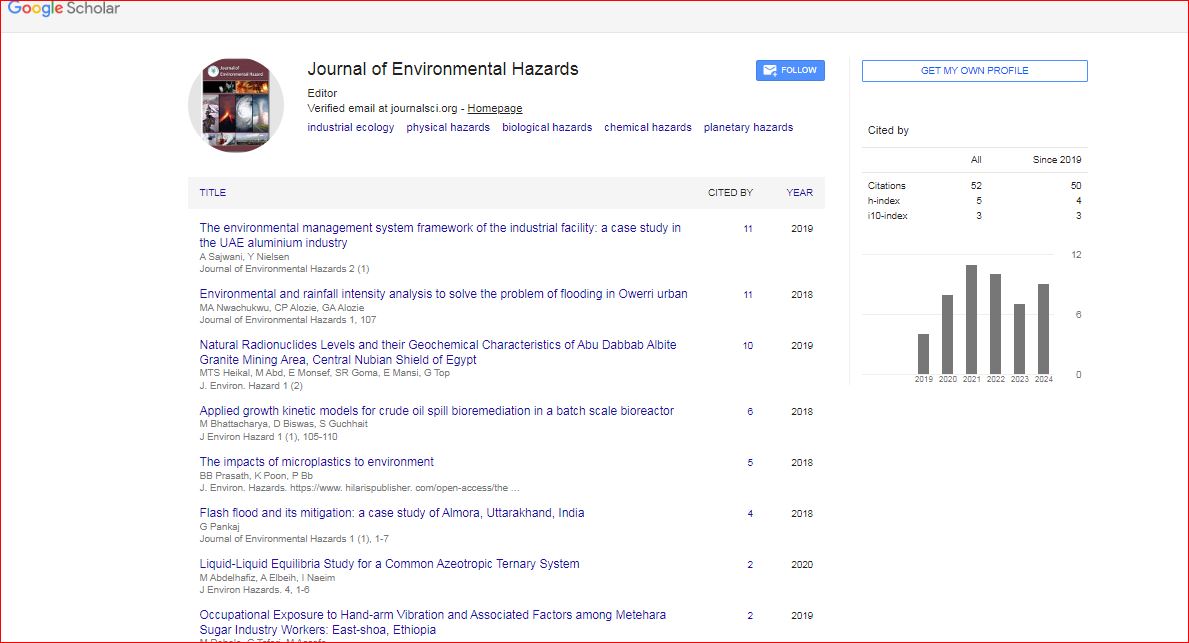
Journal of Environmental Hazards received 51 citations as per Google Scholar report