Commentary - (2025) Volume 9, Issue 4
Received: 01-Oct-2025, Manuscript No. jeh-26-180003;
Editor assigned: 03-Oct-2025, Pre QC No. P-180003;
Reviewed: 15-Oct-2025, QC No. Q-180003;
Revised: 22-Oct-2025, Manuscript No. R-180003;
Published:
05-Nov-2025
, DOI: I: 10.37421/2684-4923.2025.9.281
Citation: Alvarez, Miguel. ”Combating Irrigation Salinity: A Multifaceted Approach.” J Environ Hazard 09 (2025):281.
Copyright: © 2025 Alvarez M. This is an open-access article distributed under the terms of the Creative Commons Attribution License, which permits unrestricted use,
distribution and reproduction in any medium, provided the original author and source are credited.
Irrigation-induced salinity poses a significant threat to global agriculture, leading to the accumulation of salts in the soil, which degrades land quality and reduces crop yields. This phenomenon is particularly prevalent in arid and semi-arid regions where water resources are scarce and evaporation rates are high, exacerbating salt buildup in agricultural lands. The detrimental effects on soil productivity necessitate a thorough understanding of the underlying mechanisms and the development of effective management strategies to ensure long-term agricultural viability and food security. This introduction will explore the multifaceted aspects of irrigation-induced salinity, drawing upon recent research to highlight its impacts, underlying causes, and potential solutions. The detrimental effects of irrigation-induced salinity on soil productivity are profound, leading to decreased crop yields and potential land degradation. Increased salt accumulation in agricultural lands directly hinders plant growth by disrupting water uptake and causing ion toxicity. This necessitates a critical examination of current irrigation practices and the implementation of sustainable methods to mitigate these impacts and preserve agricultural lands for future generations. Climate change further exacerbates the challenges associated with irrigation-induced salinity, especially in water-scarce areas. Reduced rainfall and increased evaporation rates intensify salt concentrations in soils, posing significant threats to agricultural sustainability and global food security. Addressing this growing threat requires an integrated approach to water resource management and the adoption of climate-resilient agricultural practices. The effectiveness of various soil amendments and management techniques in ameliorating salt-affected soils is crucial for restoring agricultural productivity. Strategies such as the application of gypsum, incorporation of organic matter, and implementation of improved drainage systems can significantly reduce soil salinity and enhance the physical and chemical properties of the soil, offering practical solutions for farmers. The quality of irrigation water plays a critical role in the buildup of soil salinity and its subsequent impact on crop growth and yield. Quantifying the relationship between irrigation water salinity levels and crop performance is essential for effective water quality management. Preventing soil salinization through careful water selection and management is paramount to maintaining agricultural productivity. A spatially distributed modeling approach can effectively predict and assess the extent and severity of irrigation-induced salinity within river basins. By integrating hydrological and soil data, these models aid in identifying high-risk areas and informing land-use planning and water management decisions to mitigate salinity impacts on agricultural lands.
The economic consequences of irrigation-induced salinity can be severe, leading to reduced farm income, increased production costs, and even land abandonment. Farming systems in affected regions often exhibit significant socio-economic vulnerability to salinity, underscoring the need for policy interventions and support mechanisms for affected farmers. Managing salinity in the context of sustainable agriculture presents both challenges and opportunities, particularly in regions heavily reliant on irrigation. Exploring innovative irrigation technologies, developing salt-tolerant crop varieties, and implementing integrated land and water management frameworks are vital pathways to combat soil salinization and enhance agricultural resilience. The role of subsurface drainage in mitigating irrigation-induced salinity and improving soil health is well-documented. Effective drainage systems can lower water tables, facilitate salt leaching, and enhance soil aeration, thereby promoting healthier root development and increased crop productivity, which is essential for agricultural sustainability. Cropping patterns and crop rotations significantly influence the development and management of irrigation-induced salinity. The choice of crops and their sequence can affect soil water dynamics, nutrient cycling, and salt accumulation, providing valuable insights for optimizing agricultural practices in saline environments to achieve sustainable outcomes.
Irrigation-induced salinity is a major challenge impacting soil productivity and crop yields globally, particularly in arid and semi-arid regions. The accumulation of salts in agricultural lands due to irrigation practices directly affects plant physiology, leading to reduced crop performance and long-term land degradation. Muhammad Waqas et al. [1] highlight how increased salt accumulation in agricultural lands leads to reduced crop yields and potential land degradation, emphasizing the need for sustainable irrigation practices and effective soil management strategies to mitigate these impacts and ensure long-term agricultural viability. Climate change acts as a significant catalyst, exacerbating irrigation-induced salinity, especially in areas with limited water resources. Maria Garcia-Lopez et al. [2] discuss how reduced rainfall and increased evaporation rates intensify salt concentration in soils, posing significant challenges to agricultural sustainability and food security. This necessitates integrated water resource management and the adoption of drought-tolerant crop varieties. Restoring the productivity of salt-affected soils requires effective amelioration strategies. Chen Li et al. [3] examine the effectiveness of various soil amendments, such as gypsum and organic matter, along with improved drainage systems, in reducing soil salinity and improving soil properties. These findings offer practical solutions for farmers grappling with salinity issues. The quality of irrigation water is a critical factor in the development of soil salinity. Ahmed Al-Mansoori et al. [4] investigate the impact of different irrigation water qualities on soil salinity buildup and its subsequent effect on crop growth and yield. They emphasize the crucial role of water quality management in preventing soil salinization and maintaining productivity. Predicting and assessing the extent of irrigation-induced salinity is vital for effective land and water management. David Smith et al. [5] present a modeling approach that integrates hydrological and soil data to identify high-risk areas and inform land-use planning.
Such models are instrumental in developing targeted interventions to mitigate salinity impacts. The economic implications of irrigation-induced salinity are substantial, affecting agricultural communities through reduced farm income and increased production costs. Sarah Miller et al. [6] evaluate these economic consequences, highlighting the socio-economic vulnerability of farming systems and the need for policy interventions and support mechanisms for affected farmers. Achieving sustainable agriculture in the face of irrigation-induced salinity requires innovative approaches. Carlos Silva et al. [7] discuss challenges and opportunities in managing salinity, exploring advanced irrigation technologies, salt-tolerant crop breeding, and integrated land and water management frameworks to enhance agricultural resilience. Improving soil health and mitigating salinity can be achieved through effective drainage systems. Li Zhang et al. [8] investigate the role of subsurface drainage in lowering water tables, facilitating salt leaching, and enhancing aeration. This leads to healthier root development and increased crop productivity. Cropping patterns play a significant role in managing soil salinity dynamics. Javier Fernandez et al. [9] examine how different cropping systems and rotations can influence soil water dynamics, nutrient cycling, and salt accumulation. This information is crucial for optimizing agricultural practices in saline environments. Monitoring and mapping soil salinity across large agricultural landscapes can be enhanced through the application of remote sensing and GIS technologies. Anna Petrova et al. [10] demonstrate how these tools provide timely and spatially explicit information, aiding in early detection and targeted management interventions for irrigation-induced soil salinity.
Irrigation-induced salinity is a pressing issue, leading to soil degradation and reduced crop yields, particularly in arid regions. Climate change exacerbates this problem by intensifying salt concentrations. Research highlights the effectiveness of soil amendments, improved drainage, and careful irrigation water quality management in mitigating salinity. Predictive modeling and remote sensing technologies aid in identifying and managing high-risk areas. The economic and socio-economic impacts on farming communities are significant, necessitating policy interventions. Sustainable agriculture requires innovative irrigation techniques, salt-tolerant crops, and integrated land and water management. Cropping patterns also play a role in salinity dynamics. Overall, a multi-faceted approach involving technological advancements, strategic management, and policy support is crucial to combat irrigation-induced salinity and ensure agricultural sustainability.
None
None
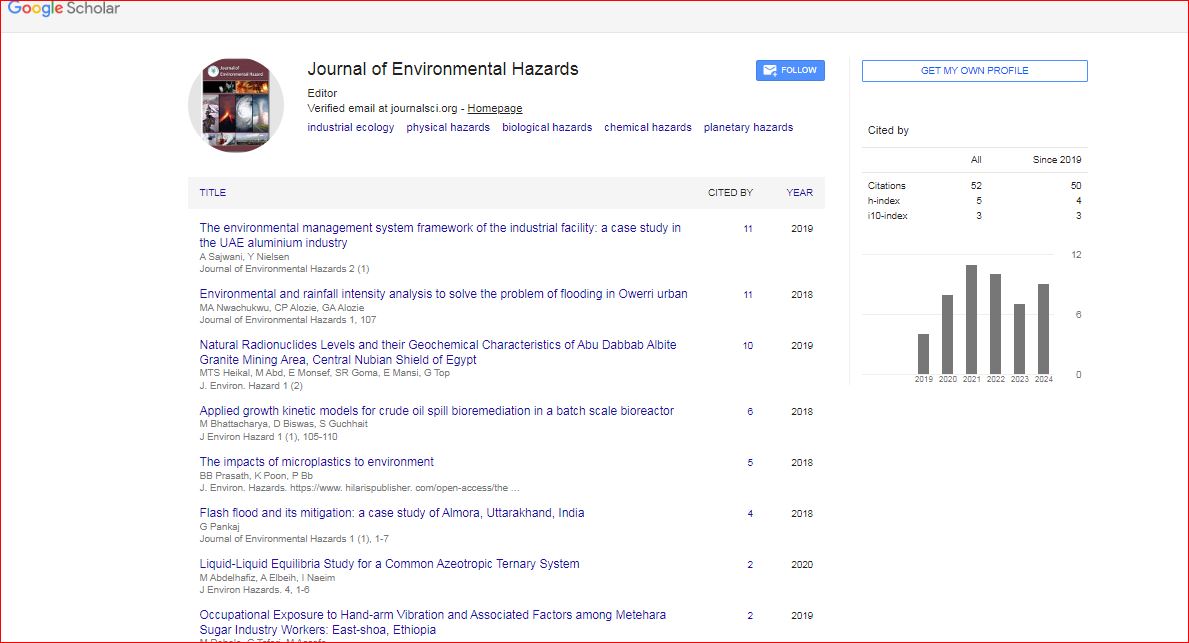
Journal of Environmental Hazards received 51 citations as per Google Scholar report