Short Communication - (2025) Volume 9, Issue 4
Received: 01-Oct-2025, Manuscript No. jeh-26-180012;
Editor assigned: 03-Oct-2025, Pre QC No. P-180012;
Reviewed: 15-Oct-2025, QC No. Q-180012;
Revised: 22-Oct-2025, Manuscript No. R-180012;
Published:
05-Nov-2025
, DOI: 10.37421/2684-4923.2025.9.287
Citation: Rossi, Sofia. ”Urban Sanitation: Challenges, Solutions, and Sustainable Futures.” J Environ Hazard 09 (2025):287.
Copyright: © 2025 Rossi S. This is an open-access article distributed under the terms of the Creative Commons Attribution License, which permits unrestricted use, distribution
and reproduction in any medium, provided the original author and source are credited.
Urban sanitation systems are confronting significant strain due to escalating population densities and the resultant surge in wastewater generation, leading to system overloads, service interruptions, and environmental degradation. This article delves into the complex challenges inherent in these overloaded systems, encompassing aging infrastructure, insufficient treatment capacities, and the escalating impact of climate change on precipitation patterns, which in turn worsen flooding and overflow events. It underscores the critical imperative for integrated solutions that marry infrastructure enhancements, sophisticated treatment technologies, and robust management frameworks to safeguard public health and ecological sustainability. The aging of existing infrastructure poses a substantial threat to the operational integrity and resilience of urban sanitation networks. Deterioration in components such as pipes, pumps, and treatment facilities directly contributes to system failures, an increase in overflows, and a diminished capacity for effective treatment.
Addressing this necessitates a strong emphasis on comprehensive asset management, which includes routine inspections, diligent maintenance, and the timely replacement of aging components to avert cascading failures and ensure uninterrupted service provision. Decentralized wastewater treatment systems are emerging as a viable strategy for alleviating the pressure on large, centralized urban sanitation infrastructure. An examination of their technical feasibility, economic viability, and environmental advantages reveals their potential, particularly in peri-urban and rapidly expanding urban areas. These systems can effectively complement existing centralized networks, leading to improvements in local water quality and an overall enhancement of the sanitation system's resilience. The pervasive phenomenon of urban sprawl, coupled with increasing population density, exerts considerable pressure on sanitation systems. As cities expand spatially and population concentrations intensify, existing wastewater collection and treatment capacities are stretched to their limits. Analyzing the interplay between urban morphology and sanitation service efficiency is crucial, and implementing strategic spatial planning interventions can help manage growth and mitigate the strain on infrastructure. Combined sewer overflows (CSOs) represent a frequent consequence of overloaded urban sanitation systems, particularly during periods of intense rainfall. The environmental and public health risks stemming from CSO discharges are substantial. Therefore, a thorough review of control and mitigation strategies, including the implementation of green infrastructure and advanced real-time control systems, is essential to reduce the frequency and impact of these events. The economic ramifications of inadequately functioning urban sanitation systems are far-reaching, extending to significant financial burdens and social disparities. System failures incur substantial costs related to infrastructure repair, public health crises, and environmental remediation. Furthermore, existing social inequities are often amplified by the lack of adequate sanitation services. Consequently, increased investment in sustainable sanitation infrastructure and equitable service delivery models is strongly advocated.
The integration of smart technologies and advanced data analytics offers promising avenues for enhancing the management and optimization of urban sanitation systems. The deployment of sensors, real-time monitoring capabilities, and sophisticated predictive modeling can effectively identify system bottlenecks, detect leaks, and forecast potential overflows, thereby improving operational efficiency and bolstering resilience against overload conditions. Industrial wastewater, with its increasing volume and complex composition, presents a formidable challenge to urban sanitation infrastructure. The impact of these discharges on municipal wastewater treatment plants, particularly concerning toxicity, high organic loads, and the presence of persistent pollutants, requires careful assessment. This highlights the critical need for more stringent industrial pre-treatment regulations and the adoption of advanced treatment solutions. Nature-based solutions, such as constructed wetlands and green roofs, hold significant potential for managing stormwater runoff and subsequently reducing the burden on urban sewer systems. Evaluating their efficacy in improving water quality, decreasing runoff volumes, and enhancing urban resilience, especially in the face of intensified rainfall events, is of paramount importance. Effective policy and governance frameworks are indispensable for addressing the multifaceted challenges of urban sanitation system overload. A critical analysis of existing policies and their effectiveness in fostering sustainable sanitation practices, encouraging infrastructure investment, and integrating climate change adaptation measures is required. Identifying policy gaps and formulating recommendations for more robust governance within the sanitation sector is crucial for progress. The challenges presented by rapid population growth and increased wastewater generation are placing immense pressure on urban sanitation systems, leading to overloads, service disruptions, and environmental contamination. Understanding these multifaceted issues, from aging infrastructure to the impacts of climate change, is vital for developing effective solutions. The influence of climate change, particularly altered precipitation patterns, exacerbates existing problems by increasing the frequency and severity of flooding and overflow events within urban sanitation networks. This necessitates proactive adaptation strategies and resilient infrastructure design.
Aging infrastructure represents a significant vulnerability in urban sanitation systems, contributing to reduced performance, increased failures, and diminished treatment efficacy. Effective asset management is key to mitigating these risks. Decentralized wastewater treatment systems offer a flexible and potentially more resilient approach to sanitation, particularly in areas experiencing rapid growth or lacking extensive centralized infrastructure. Their integration can improve local water quality and reduce the load on larger systems. Urban sprawl and increasing population densities directly impact the efficiency of sanitation services, straining both collection and treatment capacities. Strategic urban planning is essential to manage these pressures. Combined sewer overflows (CSOs) are a direct consequence of overloaded systems, posing significant environmental and public health risks that require effective mitigation strategies. The economic and social costs associated with inadequate urban sanitation are substantial, highlighting the need for greater investment and a focus on equitable service provision. The adoption of smart technologies and data-driven approaches can significantly improve the operational efficiency and responsiveness of urban sanitation systems. Industrial wastewater presents unique challenges due to its volume and contaminant load, requiring specific pre-treatment and advanced treatment solutions. Nature-based solutions offer an environmentally sound approach to stormwater management, helping to reduce runoff and improve water quality, thereby alleviating pressure on conventional systems. Robust policy and governance frameworks are fundamental to driving progress in urban sanitation, ensuring sustainable practices, adequate investment, and effective integration of climate change considerations. These foundational elements guide the development and implementation of solutions to the complex problems facing urban sanitation. The overarching challenge of urban sanitation overload requires a holistic approach, integrating technological advancements, infrastructural improvements, policy reforms, and community engagement to ensure public health and environmental protection.
Addressing the complex interplay of these factors is critical for achieving sustainable and resilient urban sanitation systems for the future. The continuous evolution of urban landscapes and environmental conditions demands adaptive and forward-thinking strategies in sanitation management. Ultimately, the goal is to build systems that are not only functional but also environmentally responsible and socially equitable, serving the needs of growing urban populations effectively. The ongoing research and development in this field offer promising avenues for innovative solutions. The commitment to addressing these challenges is paramount for the well-being of urban communities and the planet. The integration of diverse approaches is essential for a comprehensive and effective response to these pressing issues. Recognizing the interconnectedness of urban development and sanitation is key to sustainable urban planning. The future of urban sanitation hinges on our ability to adapt and innovate in response to these critical pressures. The pursuit of efficient and sustainable sanitation is a continuous endeavor.
Urban sanitation systems are experiencing immense pressure due to rapid population growth and increased wastewater generation, resulting in overloads, service disruptions, and environmental contamination. This article examines the multifaceted challenges associated with these overloaded systems, including aging infrastructure, inadequate treatment capacity, and the impact of climate change on precipitation patterns, which exacerbate flooding and overflow events. It highlights the urgent need for integrated solutions that combine infrastructure upgrades, advanced treatment technologies, and robust management strategies to ensure public health and environmental sustainability. The aging of existing infrastructure significantly impacts the performance and resilience of urban sanitation networks. Deterioration in pipes, pumps, and treatment facilities directly contributes to system failures, overflows, and reduced treatment efficiency.
Emphasis is placed on the importance of comprehensive asset management, encompassing regular inspection, maintenance, and timely replacement, to prevent cascading failures and ensure continuous service delivery. Decentralized wastewater treatment systems are being explored as a viable strategy to alleviate the burden on centralized urban sanitation infrastructure. An analysis of their technical feasibility, economic viability, and environmental benefits suggests that well-designed decentralized systems can complement centralized networks, improve local water quality, and enhance overall system resilience. The influence of urban sprawl and population density on sanitation system overload is a significant factor. This paper analyzes how the spatial expansion of cities and increasing population concentrations strain existing wastewater collection and treatment capacities. It examines the correlation between urban morphology and the efficiency of sanitation services, proposing spatial planning interventions to manage growth and reduce pressure on infrastructure. The issue of combined sewer overflows (CSOs) in urban environments, a common consequence of sanitation system overload, particularly during storm events, is addressed. The article evaluates the environmental and public health risks associated with CSO discharges and reviews various control and mitigation strategies, including green infrastructure and real-time control systems, to reduce their frequency and impact. The economic and social implications of overloaded urban sanitation systems are profound.
This study analyzes the costs associated with system failures, such as infrastructure repair, public health crises, and environmental remediation, alongside the social inequities often exacerbated by poor sanitation services. It advocates for increased investment in sustainable sanitation infrastructure and equitable service provision. The role of smart technologies and data analytics in managing and optimizing urban sanitation systems is investigated. It explores how sensors, real-time monitoring, and predictive modeling can help identify bottlenecks, detect leaks, and predict potential overflows, thereby improving operational efficiency and resilience against overload. The increasing volume and complexity of industrial wastewater pose a significant challenge to urban sanitation systems. This paper assesses the impact of industrial discharges on municipal wastewater treatment plants, examining issues of toxicity, high organic loads, and the presence of recalcitrant pollutants. It discusses the need for stricter industrial pre-treatment regulations and advanced treatment solutions. The potential of nature-based solutions, such as constructed wetlands and green roofs, for managing stormwater and reducing the load on urban sewer systems is explored. It evaluates their effectiveness in improving water quality, reducing runoff volume, and enhancing urban resilience, particularly in the context of increased rainfall intensity. Policy and governance frameworks play a crucial role in addressing urban sanitation system overload. This paper analyzes existing policies and their effectiveness in promoting sustainable sanitation practices, investment in infrastructure, and the integration of climate change adaptation measures. It identifies key policy gaps and proposes recommendations for more effective governance in the sanitation sector. The core of the problem lies in the inability of current systems to cope with the demands placed upon them by urbanization and environmental changes. Addressing these issues requires a multifaceted approach, encompassing technological innovation, infrastructural development, and effective policy implementation. The interconnectedness of these factors is paramount for designing and managing sustainable urban sanitation. The continuous evolution of urban dynamics necessitates adaptive strategies that can respond to emerging challenges and opportunities in sanitation management. The aim is to foster systems that are not only resilient and efficient but also environmentally sound and socially equitable, meeting the needs of a growing global urban population. The ongoing advancements in research and development provide a fertile ground for the emergence of novel and effective solutions. Committing to tackling these challenges is essential for the well-being of urban communities and the health of the planet. The integration of a diverse array of approaches is vital for a comprehensive and impactful response to these pressing matters. Recognizing the intrinsic link between urban development and sanitation is fundamental to sustainable urban planning practices. The future trajectory of urban sanitation is contingent upon our capacity for adaptation and innovation in the face of these critical pressures. The pursuit of sanitation systems that are both efficient and sustainable remains a continuous and evolving objective. Therefore, a concerted effort across all these domains is imperative for achieving resilient and healthy urban environments. This comprehensive understanding is crucial for developing effective strategies.
The synergy between different approaches will lead to more robust outcomes. Ensuring accessibility and affordability of sanitation services is also a key consideration in policy development. The long-term sustainability of urban areas depends heavily on the effectiveness of their sanitation infrastructure. Proactive measures are more cost-effective than reactive responses to crises. The ongoing dialogue and collaboration among stakeholders are vital for progress. The commitment to a cleaner and safer urban environment should be a collective responsibility. This strategic vision guides the path towards improved urban sanitation. The global challenge of urban sanitation requires localized solutions tailored to specific contexts. This detailed examination provides a roadmap for future interventions. The overarching goal is to create cities that are healthier and more livable for all their inhabitants. The integration of these elements forms the backbone of effective sanitation management.
Urban sanitation systems are under immense pressure from population growth and increased wastewater, leading to overloads and environmental contamination. Key challenges include aging infrastructure, inadequate treatment capacity, and climate change impacts like increased flooding. Solutions require integrated approaches: infrastructure upgrades, advanced treatment technologies, and robust management strategies are essential for public health and environmental sustainability. Asset management for aging infrastructure is critical, involving regular inspections and timely replacements. Decentralized systems offer an alternative or complement to centralized ones, improving local water quality. Urban sprawl and population density strain existing capacities, necessitating strategic spatial planning. Combined sewer overflows (CSOs) pose environmental and health risks, requiring mitigation through green infrastructure and real-time controls. Economic and social impacts of poor sanitation are significant, calling for increased investment and equitable service provision. Smart technologies and data analytics can optimize system management, improving efficiency and resilience. Industrial wastewater presents unique challenges, demanding stricter pre-treatment and advanced solutions. Nature-based solutions for stormwater management can reduce load and improve water quality. Effective policy and governance frameworks are crucial for promoting sustainable practices and infrastructure investment. Addressing these interconnected issues is vital for creating resilient and healthy urban environments.
None
None
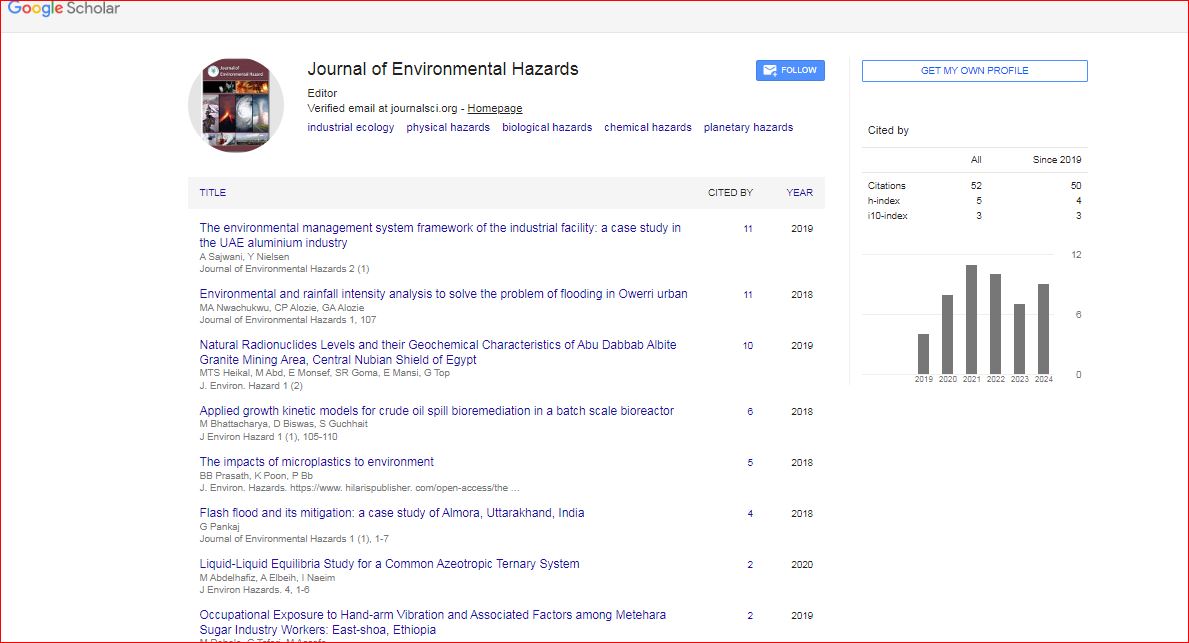
Journal of Environmental Hazards received 51 citations as per Google Scholar report