Short Communication - (2025) Volume 9, Issue 3
Received: 01-Aug-2025, Manuscript No. jeh-26;
Editor assigned: 04-Aug-2025, Pre QC No. P-179994;
Reviewed: 15-Aug-2025, QC No. Q-179994;
Revised: 22-Aug-2025, Manuscript No. R-179994;
Published:
29-Aug-2025
, DOI: 10.37421/2684-4923.2025.9.275
Citation: Conti, Isabella. ”Coastal Aquifers: Saltwater Intrusion, Impacts, and Management.” J Environ Hazard 09 (2025):275.
Copyright: © 2025 Conti I. This is an open-access article distributed under the terms of the Creative Commons Attribution License, which permits unrestricted use, distribution
and reproduction in any medium, provided the original author and source are credited.
The escalating threat of saltwater intrusion into coastal freshwater resources presents a critical environmental and societal challenge, necessitating a comprehensive understanding of its causes and impacts [1]. This phenomenon, characterized by the movement of saline water into freshwater aquifers, poses a significant danger to potable water availability, agricultural productivity, and the overall health of coastal ecosystems. The interlinked pressures of rising sea levels, driven by global climate change, and the relentless over-extraction of groundwater by human activities have amplified the vulnerability of these vital resources [1].
Within specific geographical contexts, such as the Mediterranean region, the dynamics of saltwater intrusion are profoundly influenced by a combination of climatic shifts and direct anthropogenic interventions. Advanced computational modeling techniques are proving indispensable in predicting the spatial and temporal progression of this intrusion and its subsequent effects on the delicate balance of coastal freshwater supplies [2]. The findings consistently underscore the inherent vulnerability of these interconnected ecosystems, thereby emphasizing the urgent need for integrated and holistic coastal zone management strategies to effectively mitigate future losses [2]. A fundamental aspect of understanding saltwater intrusion lies in its hydrogeological underpinnings. Research has delved into the intricate interplay of geological formations and hydrological processes that govern the propagation of saltwater intrusion fronts within porous underground media [3]. The heterogeneity of aquifer structures, variations in hydraulic conductivity, and the intensity of pumping activities are key factors that dictate the interface between saline and freshwater reserves, offering critical insights for protective measures [3].
The societal ramifications of saltwater intrusion extend far beyond the immediate environmental impacts, directly affecting the well-being and economic stability of coastal communities. Assessing the socio-economic consequences, particularly concerning drinking water quality, agricultural viability, and the resilience of local economies, reveals the profound and often disproportionate burden placed on vulnerable populations [4]. This necessitates the implementation of targeted policy interventions and the fostering of community-driven adaptation strategies [4]. In response to the growing threat, a concerted effort has been directed towards evaluating and refining groundwater management techniques aimed at mitigating saltwater intrusion. Strategies such as managed aquifer recharge and the optimization of pumping regimes are being rigorously assessed through a combination of numerical simulations and empirical field observations [5]. This comparative analysis provides invaluable practical guidance for hydrogeologists and water resource managers tasked with safeguarding these critical resources [5].
The direct impact of sea-level rise on the dynamics of saltwater intrusion in coastal aquifers is a subject of intense study. Quantifying the projected increase in saline water contamination under various future emission scenarios, using coupled hydrological and sea-level rise models, highlights the escalating urgency of adapting current groundwater management practices to account for predicted climatic changes [6]. This proactive approach is essential for long-term water security [6]. Complementing hydrological studies, geophysical methods are emerging as powerful tools for the monitoring and delineation of saltwater intrusion fronts. Techniques such as electrical resistivity tomography (ERT) and induced polarization (IP) offer non-invasive means to map the complex saline-freshwater interface in near real-time, thereby supporting informed decision-making processes in coastal groundwater management [7]. The efficacy of these methods is crucial for timely intervention [7].
Furthermore, the intricate relationship between agricultural practices and the exacerbation of saltwater intrusion is a critical area of investigation, especially in regions heavily reliant on irrigation. Analyzing the influence of water use efficiency, irrigation methodologies, and fertilizer application on groundwater levels and salinization extent allows for the proposition of more sustainable agricultural strategies designed to minimize freshwater resource depletion [8]. Addressing the multifaceted challenges of managing freshwater resources under persistent saltwater intrusion pressure requires innovative solutions beyond conventional approaches. The exploration of advanced water treatment technologies, desalination, and the development of resilient water supply systems are paramount [9].
This pursuit of novel strategies emphasizes the indispensable need for adaptive management frameworks that can respond effectively to evolving environmental conditions [9]. Finally, a holistic understanding of saltwater intrusion necessitates an examination of the complex interactions between surface water and groundwater systems in coastal zones. Investigating how fluctuating river flows, tidal influences, and groundwater abstraction patterns collectively impact the salinity of both interconnected water bodies provides a comprehensive perspective essential for sustainable resource management in deltaic and coastal environments [10].
The critical issue of saltwater intrusion fronts and their detrimental impact on freshwater resources, particularly within coastal aquifers, is investigated. The article highlights how the synergistic effects of rising sea levels and excessive groundwater extraction exacerbate this problem, leading to substantial losses in potable water availability and agricultural productivity. Consequently, the research underscores the imperative for implementing effective management strategies, which include adopting sustainable groundwater abstraction practices and developing robust early warning systems to anticipate and respond to intrusion events [1]. Focusing on the specific context of the Mediterranean region, this study meticulously examines the spatial and temporal dynamics of saltwater intrusion, driven by the combined forces of climate change and anthropogenic pressures. By employing sophisticated modeling techniques, the research aims to accurately predict the rate at which intrusion progresses and to assess its resultant impact on vital coastal freshwater supplies. The findings unequivocally underscore the inherent vulnerability of these sensitive ecosystems, thereby issuing a strong call for the adoption of integrated coastal zone management approaches to effectively mitigate future water resource losses [2].
This research undertakes a detailed exploration of the multifaceted geological and hydrogeological factors that significantly influence the propagation of saltwater intrusion fronts within porous subsurface media. A thorough analysis is conducted on the pivotal role played by aquifer heterogeneity, variations in hydraulic conductivity, and the intensity of pumping rates in precisely controlling the dynamic interface between saline and freshwater zones. The study ultimately provides invaluable insights crucial for the design of effective barrier systems and the strategic management of groundwater extraction initiatives aimed at safeguarding coastal aquifers [3]. The paper undertakes a comprehensive assessment of the profound socio-economic consequences stemming from saltwater intrusion, specifically focusing on its repercussions for coastal communities. The assessment meticulously examines impacts on the quality of drinking water, the viability of agricultural operations, and the overall health of local economies. It quantifies the considerable financial losses incurred due to salinization and critically highlights the disproportionate burden often placed upon vulnerable populations, advocating strongly for decisive policy interventions and the implementation of community-based adaptation strategies [4].
This scholarly work meticulously examines the efficacy of various groundwater management techniques specifically employed to mitigate the pervasive problem of saltwater intrusion. Among these techniques are managed aquifer recharge and the optimization of pumping strategies, which are subjected to a rigorous comparative analysis utilizing both advanced numerical simulations and empirical field observations. The research ultimately furnishes practical and actionable guidance for hydrogeologists and water resource managers engaged in the critical task of protecting coastal aquifers [5]. The study rigorously investigates the specific impact of accelerating sea-level rise on the complex dynamics of saltwater intrusion within a heavily exploited coastal aquifer system. Employing coupled hydrological and sea-level rise models, the research quantifies the projected increase in the geographical extent of saline water contamination under a range of plausible future emission scenarios. This research crucially highlights the pressing urgency of adapting current groundwater management strategies to proactively account for anticipated climatic changes [6].
This pivotal paper addresses the practical application of advanced geophysical methods for the precise monitoring and accurate delineation of saltwater intrusion fronts. It thoroughly explores the utility of techniques such as electrical resistivity tomography (ERT) and induced polarization (IP) in effectively mapping the complex saline-freshwater interface in real-time. The study compellingly demonstrates the significant value of these non-invasive methods in facilitating informed and timely decision-making processes within the domain of coastal groundwater management [7]. The research thoroughly examines the intricate impact of diverse agricultural practices on the exacerbation of saltwater intrusion, particularly in those coastal areas that are heavily reliant on irrigation for their sustenance. It critically analyzes how factors such as water use efficiency, the adoption of specific irrigation techniques, and the application of fertilizers collectively influence groundwater levels and the overall extent of salinization. The study proactively proposes the adoption of sustainable agricultural strategies aimed at minimizing the loss of precious freshwater resources [8].
This article delves deeply into the multifaceted challenges associated with effectively managing freshwater resources in the face of persistently advancing saltwater intrusion. It critically discusses the inherent limitations of conventional water management approaches and proactively explores innovative solutions, including advanced desalination technologies, sophisticated water treatment processes, and the development of resilient and adaptable water supply systems. The paper strongly emphasizes the fundamental need for adaptive management strategies in direct response to evolving environmental conditions [9]. The study undertakes a detailed analysis of the intricate interaction between surface water and groundwater systems within coastal environments and critically evaluates its significant role in the phenomenon of saltwater intrusion. It meticulously investigates how alterations in river flows, the influence of tidal cycles, and the intensity of groundwater abstraction collectively affect the salinity of both surface and subsurface water bodies. The research provides a holistic and integrated perspective essential for the effective management of interconnected water resources in sensitive deltaic and coastal environments [10].
This collection of research addresses the critical issue of saltwater intrusion in coastal aquifers, a growing threat to freshwater resources. Studies highlight the exacerbating factors of rising sea levels and over-extraction of groundwater, leading to losses in potable water and agricultural productivity. The research emphasizes the need for effective management strategies, including sustainable groundwater abstraction and early warning systems. Specific studies focus on the Mediterranean region, employing modeling techniques to predict intrusion dynamics under climate change scenarios. Hydrogeological controls, such as aquifer heterogeneity and pumping rates, are analyzed. The socio-economic impacts on coastal communities, including financial losses and burdens on vulnerable populations, are assessed, advocating for policy interventions. Various groundwater management techniques like managed aquifer recharge and optimized pumping are evaluated for their effectiveness. The impact of sea-level rise and agricultural practices on intrusion is investigated, alongside the application of geophysical methods for monitoring. The need for adaptive management and innovative solutions like desalination is stressed, along with the importance of understanding surface-groundwater interactions.
None
None
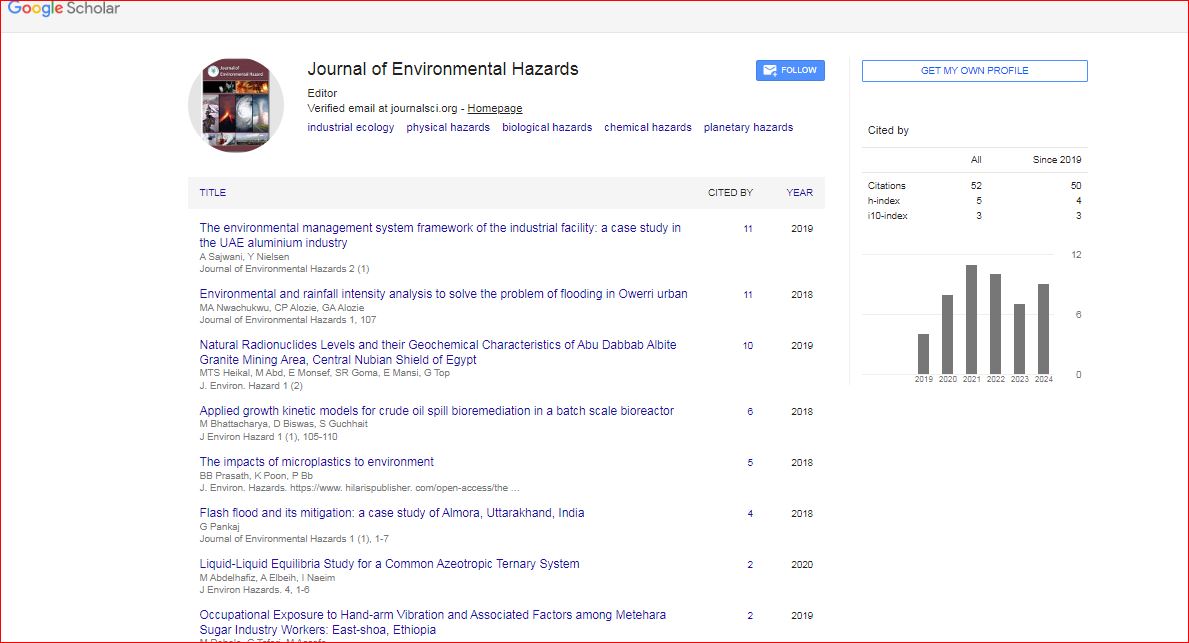
Journal of Environmental Hazards received 51 citations as per Google Scholar report