Short Communication - (2025) Volume 9, Issue 4
Received: 01-Oct-2025, Manuscript No. jeh-26-180011;
Editor assigned: 03-Oct-2025, Pre QC No. P-180011;
Reviewed: 15-Oct-2025, QC No. Q-180011;
Revised: 22-Oct-2025, Manuscript No. R-180011;
Published:
05-Nov-2025
, DOI: 10.37421/2684-4923.2025.9.286
Citation: Müller, Johan. ”Climate Change Drives Vector-Borne Disease Expansion.” J Environ Hazard 09 (2025):286.
Copyright: © 2025 Müller J. This is an open-access article distributed under the terms of the Creative Commons Attribution License, which permits unrestricted use, distribution
and reproduction in any medium, provided the original author and source are credited.
Climate change is demonstrably expanding the geographic range and transmission seasons of vector-borne diseases like malaria, dengue, and Lyme disease, presenting a substantial public health challenge. Rising temperatures and altered precipitation patterns are creating more hospitable environments for vectors such as mosquitoes and ticks. This, in turn, leads to increased human exposure and disease incidence, particularly in regions previously unaffected by these illnesses. The trend necessitates adaptive strategies for disease surveillance and control in affected areas [1]. The increased frequency and intensity of extreme weather events, a direct consequence of climate change, are profoundly impacting the life cycles and distribution of disease vectors. Floods, for instance, can create new breeding sites for mosquitoes, thereby facilitating disease transmission. Conversely, droughts can lead to the concentration of vectors and hosts around limited water sources, further enhancing the potential for outbreaks. Understanding these complex environmental interactions is crucial for accurate prediction and effective mitigation of disease spread [2]. Geographic shifts in the distribution of tick-borne diseases, including Lyme disease and tick-borne encephalitis, are strongly correlated with warming temperatures. These climatic changes allow ticks, the primary vectors, to survive and reproduce in previously unsuitable areas. Furthermore, longer warm seasons extend the period during which humans are at risk of exposure to infected ticks, demanding enhanced public awareness and prevention measures in newly affected regions [3].
Mosquito-borne diseases, such as dengue, Zika, and chikungunya, are progressively expanding their reach into temperate zones due to the ongoing effects of climate change. Warmer average temperatures are enabling the survival and proliferation of Aedes mosquito species, which are the principal vectors for these viral infections, in areas that were previously too cold to support them. This global expansion represents a significant and growing threat to public health systems worldwide [4]. Projected increases in global temperatures and alterations in rainfall patterns are anticipated to significantly expand the endemicity of malaria to novel regions. This expansion is particularly expected in areas at higher altitudes and latitudes, presenting a complex challenge for existing malaria control programs. Consequently, adaptive strategies and intensified surveillance are required in vulnerable populations to combat this spread [5].
Changes in temperature and humidity are demonstrably altering the extrinsic incubation period of various pathogens within their respective vectors. This phenomenon leads to more rapid pathogen development and an increased potential for transmission. The effect is particularly pronounced for arboviruses, where warmer environmental conditions accelerate viral replication within mosquito vectors, thereby heightening transmission risk [6]. Urbanization, often intensified by climate-induced migration, interacts significantly with climate change to influence the dynamics of vector-borne diseases. Densely populated urban areas, especially those with inadequate sanitation infrastructure, can become prime breeding grounds for disease vectors. Simultaneously, changing weather patterns can exacerbate the spread of diseases within these concentrated human environments [7]. The increasing prevalence of antibiotic-resistant pathogens, compounded by the expanded geographic range of vectors that carry these pathogens, constitutes a formidable dual threat to global health security. Climate change is likely to accelerate the dissemination of not only the vectors themselves but also the antibiotic resistance genes they harbor, creating a more complex epidemiological landscape [8].
The adaptation of public health systems is paramount to effectively address the escalating threat posed by vector-borne diseases driven by climate change. This adaptation encompasses the development of robust early warning systems, the enhancement of comprehensive surveillance networks, and the implementation of integrated vector management strategies. These strategies must be specifically tailored to account for changing environmental conditions and disease transmission patterns [9]. Long-term climate projections consistently indicate a continued and potentially accelerating expansion of regions suitable for the survival and proliferation of disease vectors and their associated pathogens. This trend poses a persistent and evolving challenge to global health security, underscoring the vital importance of understanding these projections for proactive public health planning and strategic resource allocation to prevent widespread disease outbreaks [10].
Climate change is demonstrably expanding the geographic range and transmission seasons of vector-borne diseases, including prominent examples like malaria, dengue, and Lyme disease. This phenomenon is driven by rising temperatures and altered precipitation patterns that foster more hospitable environments for vectors such as mosquitoes and ticks. Consequently, human exposure and disease incidence are on the rise, with notable increases occurring in regions previously unaffected by these illnesses, thereby posing a significant and growing public health challenge that demands adaptive strategies for disease surveillance and control [1]. The escalating frequency and intensity of extreme weather events, a direct manifestation of climate change, are exerting a profound impact on the life cycles and geographical distribution of disease vectors. Events such as floods can create ideal breeding sites for mosquitoes, thereby amplifying disease transmission potential, while droughts can paradoxically lead to the concentration of vectors and their hosts around scarce water sources, facilitating disease spread. A thorough understanding of these intricate environmental interactions is fundamental for accurate prediction and effective mitigation of disease outbreaks [2].
Observable geographic shifts in the distribution of tick-borne diseases, including well-known examples like Lyme disease and tick-borne encephalitis, are intrinsically linked to observed warming temperatures. These climatic changes enable ticks, the primary vectors for these diseases, to survive and reproduce in areas previously considered too cold, expanding their ecological niche. Furthermore, extended warm seasons increase the duration of human vulnerability to exposure to infected ticks, necessitating enhanced public awareness campaigns and robust prevention measures in newly affected territories [3]. Mosquito-borne diseases, encompassing viral infections such as dengue, Zika, and chikungunya, are increasingly extending their reach into temperate geographical zones as a direct result of climate change. Warmer average temperatures are facilitating the survival and prolific reproduction of Aedes mosquito species, which are the principal vectors responsible for transmitting these viruses, in areas that were historically too cold to sustain them. This global expansion presents a significant and escalating threat to the resilience of public health systems worldwide [4].
Projected increases in global average temperatures, coupled with significant alterations in regional rainfall patterns, are strongly anticipated to expand the endemic zones of malaria into new territories. This expansion is predicted to be particularly pronounced in higher altitude and higher latitude regions, presenting a formidable and complex challenge for existing malaria control programs. The situation necessitates the development and implementation of adaptive strategies and intensified surveillance efforts in vulnerable populations to effectively counter this projected spread [5]. Alterations in ambient temperature and humidity levels are demonstrably affecting the extrinsic incubation period (EIP) of various pathogens within their arthropod vectors. This modification leads to a shortened EIP, resulting in more rapid pathogen development and a consequent increase in transmission potential. This effect is especially pronounced for arboviruses, where warmer conditions accelerate viral replication within mosquito vectors, thereby enhancing the likelihood of disease transmission to humans [6].
Urbanization processes, often exacerbated by climate-induced human migration, interact synergistically with broader climate change trends to shape the dynamics of vector-borne diseases. Densely populated urban environments, particularly those characterized by inadequate sanitation infrastructure, can become fertile breeding grounds for disease vectors. Concurrently, changing weather patterns can significantly influence the spatial and temporal spread of diseases within these concentrated human populations [7]. The escalating prevalence of antibiotic-resistant pathogens, when combined with the expanding geographic range of vectors that transmit these pathogens, creates a critical dual threat to global health security. Climate change has the potential to accelerate the dissemination of not only the vectors themselves but also the antibiotic resistance genes they carry, leading to a more complex and challenging epidemiological landscape [8].
Effective adaptation of public health systems is an indispensable requirement for confronting the escalating threat posed by vector-borne diseases that are being amplified by climate change. This crucial adaptation involves the development of sophisticated early warning systems, the strengthening of comprehensive disease surveillance networks, and the implementation of integrated vector management strategies. These strategies must be meticulously tailored to accommodate the dynamic shifts in environmental conditions and evolving disease transmission patterns [9]. Long-term climate projections consistently indicate a continued and potentially accelerated expansion of geographical regions that are becoming suitable for the survival, reproduction, and transmission activities of disease vectors and their associated pathogens. This ongoing trend presents a persistent and evolving challenge to global health security, highlighting the paramount importance of understanding these projections for proactive public health planning and the strategic allocation of resources aimed at preventing widespread disease outbreaks [10].
Climate change is a significant driver in the expansion of vector-borne diseases, altering the geographic range and transmission seasons of illnesses like malaria, dengue, and Lyme disease. Rising temperatures and changing precipitation patterns create favorable conditions for vectors such as mosquitoes and ticks, leading to increased human exposure and disease incidence, particularly in new regions. Extreme weather events further disrupt vector life cycles and distribution, while urbanization and climate-induced migration create conducive environments for disease spread. The acceleration of pathogen development within vectors and the rise of antibiotic-resistant pathogens carried by these vectors add further complexity. Public health systems must adapt through enhanced surveillance, early warning systems, and integrated vector management to address these evolving threats, which are projected to continue expanding under future climate scenarios.
None
None
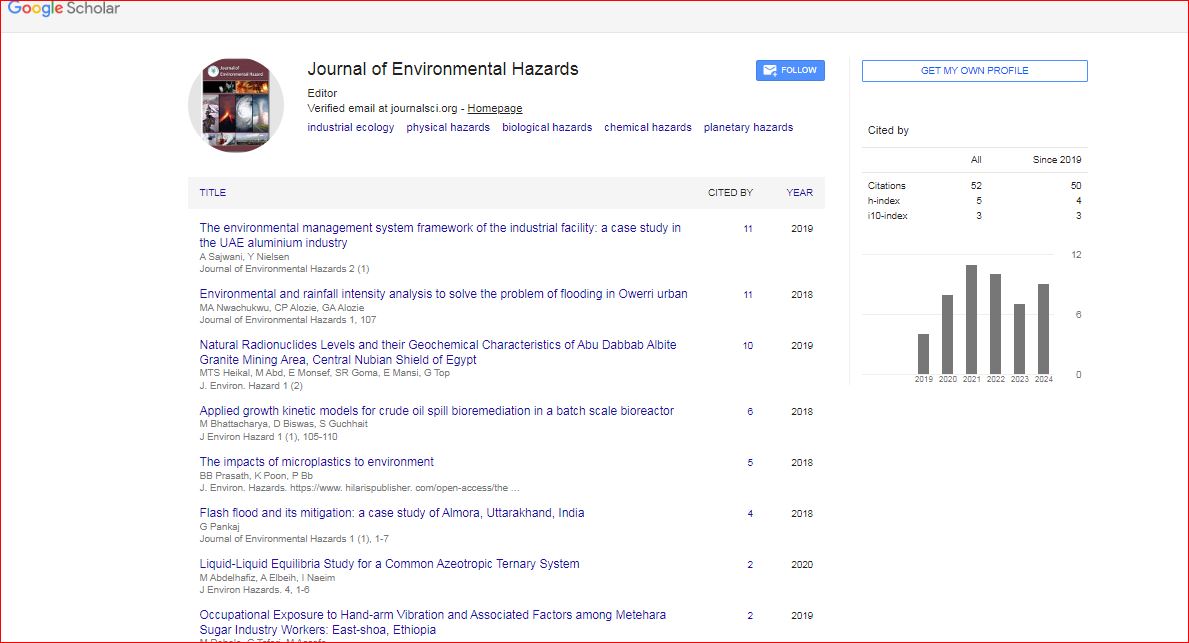
Journal of Environmental Hazards received 51 citations as per Google Scholar report