Brief Report - (2025) Volume 9, Issue 2
Received: 01-May-2025, Manuscript No. jeh-26-179966;
Editor assigned: 04-May-2025, Pre QC No. P-179966;
Reviewed: 15-May-2025, QC No. Q-179966;
Revised: 22-May-2025, Manuscript No. R-179966;
Published:
29-May-2025
, DOI: 10.37421/2684-4923.2025.9.259
Citation: Martinez, Sofia. ”Climate Threat: Urgent Health, Food, Water Action.” J Environ Hazard 09 (2025):259.
Copyright: © 2025 Martinez S. This is an open-access article distributed under the terms of the Creative Commons Attribution License, which permits unrestricted use,
distribution and reproduction in any medium, provided the original author and source are credited.
This study highlights how global climate change severely threatens food security, exacerbated by significant food loss and waste across the supply chain. It emphasizes that reducing this loss and waste is a crucial, often overlooked, strategy to bolster resilience against climate impacts and ensure enough food for a growing population[1].
This report from The Lancet Countdown emphasizes the escalating health crisis driven by climate change, aggravated by current global challenges. It argues for an urgent, health-centered approach to climate action, highlighting the severe and widespread impacts on human well-being, from heat-related illnesses to infectious diseases, and stressing the need for systemic change[2].
This synthesis reviews the latest findings on how climate change affects global biodiversity, detailing shifts in species distributions, phenology, and interactions. It underscores the urgency of understanding these complex, cascading effects on ecosystems and the critical need for effective conservation strategies in the face of rapid environmental changes[3].
This review examines how climate change profoundly alters global water resources, affecting availability, distribution, and quality. It discusses the challenges posed by increased droughts, floods, and glacial melt, and explores various adaptation strategies essential for sustainable water management in a changing climate[4].
This overview synthesizes the scientific progress in attributing extreme weather and climate events to human-induced climate change. It explains how specific heatwaves, droughts, and heavy rainfall events are now demonstrably more likely or intense due to anthropogenic warming, refining our understanding of direct climate impacts[5].
This review assesses the latest understanding of climate change impacts on coastal regions, focusing on sea-level rise, increased storm intensity, and coastal erosion. It highlights the growing threats to infrastructure, ecosystems, and human populations, pointing to critical research gaps and adaptive management strategies for building resilient coastal communities[6].
This systematic review provides an updated synthesis of the global economic impacts of climate change, revealing consistent findings of substantial costs across various sectors and regions. It highlights the complex interplay of direct damages, adaptation expenses, and indirect effects on productivity and well-being, emphasizing the urgency of economic assessments for policy-making[7].
This review explores the complex linkages between climate change and human displacement, examining how environmental degradation and extreme weather events force communities to migrate or resettle. It highlights the social vulnerabilities exacerbated by these movements and the ethical, legal, and policy challenges in addressing climate-induced migration on a global scale[8].
This study details the profound and rapid impacts of climate change on the Arctic Ocean, outlining critical physical, biogeochemical, and biological responses. It covers accelerated ice melt, ocean acidification, and shifts in marine ecosystems, highlighting the global implications of these dramatic changes for climate feedback loops and biodiversity[9].
This global review systematically analyzes the multifaceted impacts of climate change on urban infrastructure, covering critical areas like transportation, energy, and water systems. It highlights vulnerabilities to extreme weather events, sea-level rise, and heat stress, and discusses the urgent need for resilient urban planning and adaptive measures to protect crucial services[10].
Here's the thing, climate change presents an escalating global health crisis, driven by current challenges. An urgent, health-centered approach to climate action is critical, given the widespread impacts on human well-being, ranging from heat-related illnesses to infectious diseases, demanding systemic change [2]. What this really means is, the scientific community has made significant progress in attributing extreme weather and climate events directly to human-induced climate change. Specific heatwaves, droughts, and heavy rainfall events are now demonstrably more likely or intense due to anthropogenic warming, refining our understanding of these direct climate impacts [5].
Looking at our natural world, we see profound alterations. Climate change significantly affects global biodiversity, causing shifts in species distributions, phenology, and ecological interactions. Understanding these complex, cascading effects on ecosystems is urgent, alongside the critical need for effective conservation strategies in the face of rapid environmental changes [3]. Furthermore, global water resources are profoundly altered, impacting availability, distribution, and quality. Challenges stem from increased droughts, floods, and glacial melt, making various adaptation strategies essential for sustainable water management in a changing climate [4]. This is particularly evident in the Arctic Ocean, which is experiencing rapid physical, biogeochemical, and biological responses. This includes accelerated ice melt, ocean acidification, and shifts in marine ecosystems, all with significant global implications for climate feedback loops and biodiversity [9].
Let's break down the socio-economic effects. Global climate change severely threatens food security, a situation worsened by significant food loss and waste throughout the supply chain. Reducing this loss and waste is a crucial, often overlooked, strategy to bolster resilience against climate impacts and ensure enough food for a growing population [1]. Economically, the impacts are substantial; a systematic review reveals consistent findings of considerable costs across various sectors and regions. This highlights the complex interplay of direct damages, adaptation expenses, and indirect effects on productivity and well-being, emphasizing the urgency of economic assessments for policy-making [7]. A related concern is human displacement. Climate change and environmental degradation, often through extreme weather, compel communities to migrate or resettle. This exacerbates social vulnerabilities and presents significant ethical, legal, and policy challenges in managing climate-induced migration globally [8].
Finally, consider infrastructure. Coastal regions face significant climate change impacts, including sea-level rise, increased storm intensity, and coastal erosion. These pose growing threats to infrastructure, ecosystems, and human populations, pointing to critical research gaps and adaptive management strategies vital for building resilient coastal communities [6]. On a broader scale, urban infrastructure, covering transportation, energy, and water systems, is also subject to multifaceted impacts. Vulnerabilities arise from extreme weather events, sea-level rise, and heat stress, emphasizing the urgent need for resilient urban planning and adaptive measures to protect crucial services [10].
Global climate change presents a severe and escalating threat across numerous sectors, demanding urgent, health-centered action. It profoundly impacts food security, with significant food loss and waste exacerbating the challenge of feeding a growing population; reducing this waste is a crucial, often overlooked strategy to bolster resilience against climate impacts. The health crisis driven by climate change is evident in heat-related illnesses and infectious diseases, necessitating systemic change. Beyond human well-being, climate change profoundly alters global biodiversity, leading to shifts in species distributions and ecosystem dynamics. Water resources face immense pressure from increased droughts, floods, and glacial melt, requiring robust adaptation strategies for sustainable management. Attribution science increasingly links extreme weather events, like heatwaves and heavy rainfall, directly to human-induced warming, refining our understanding of direct climate impacts. Coastal regions are particularly vulnerable to sea-level rise and intensified storms, threatening infrastructure and communities. Economically, climate change imposes substantial costs, encompassing direct damages and adaptation expenses, emphasizing the need for comprehensive assessments. Furthermore, environmental degradation and extreme weather drive human displacement, creating complex social vulnerabilities and policy challenges. The Arctic Ocean experiences rapid ice melt, ocean acidification, and ecosystem shifts, with global implications. Urban infrastructure, including transportation and energy systems, is increasingly vulnerable to extreme weather and heat stress, underscoring the necessity for resilient urban planning.
None
None
Bhawana A, Basanta P, Suman P. "Global climate change and food security: the role of food loss and waste".Environ Sci Pollut Res Int 30 (2023):122703-122718.
Indexed at, Google Scholar, Crossref
Marina R, Claudia DN, Paul D. "The 2023 report of The Lancet Countdown on health and climate change: the imperative for a health-centred response in a world of compounding crises".Lancet 402 (2023):1955-2014.
Indexed at, Google Scholar, Crossref
Elvira SP, Michael TB, Christopher JB. "Climate change impacts on biodiversity: a synthesis of recent advances".Glob Change Biol 27 (2021):292-313.
Indexed at, Google Scholar, Crossref
Asrat M, Bula G, Wondimagegn A. "Impact of climate change on water resources and its management: a review".Environ Monit Assess 194 (2022):873.
Indexed at, Google Scholar, Crossref
Friederike ELO, Karin vdW, Geert JvO. "Attribution of extreme weather and climate events to anthropogenic climate change: an overview of the current state of knowledge".Environ Res Lett 15 (2020):094073.
Indexed at, Google Scholar, Crossref
Paul PW, Mina S, Bin L. "Coastal climate change impacts: a review of recent advances and future challenges".J Environ Manage 329 (2023):117079.
Indexed at, Google Scholar, Crossref
Xiaowei Z, Xuejie G, Xiaolu L. "Global economic impact of climate change: a systematic review".Int J Environ Res Public Health 19 (2022):17013.
Indexed at, Google Scholar, Crossref
Ingrid B, Koko W, Leonardo Z. "Climate change and displacement: The effects of climate change on human migration and resettlement".Nat Rev Earth Environ 4 (2023):451-463.
Indexed at, Google Scholar, Crossref
Jacqueline MG, Sue EM, John AH. "The Arctic Ocean in a time of climate change: key physical, biogeochemical, and biological responses".Oceanography 35 (2022):180-205.
Indexed at, Google Scholar, Crossref
M AS, M QA, M AH. "Climate change impacts on urban infrastructure: A global review".Sustain Cities Soc 94 (2023):104555.
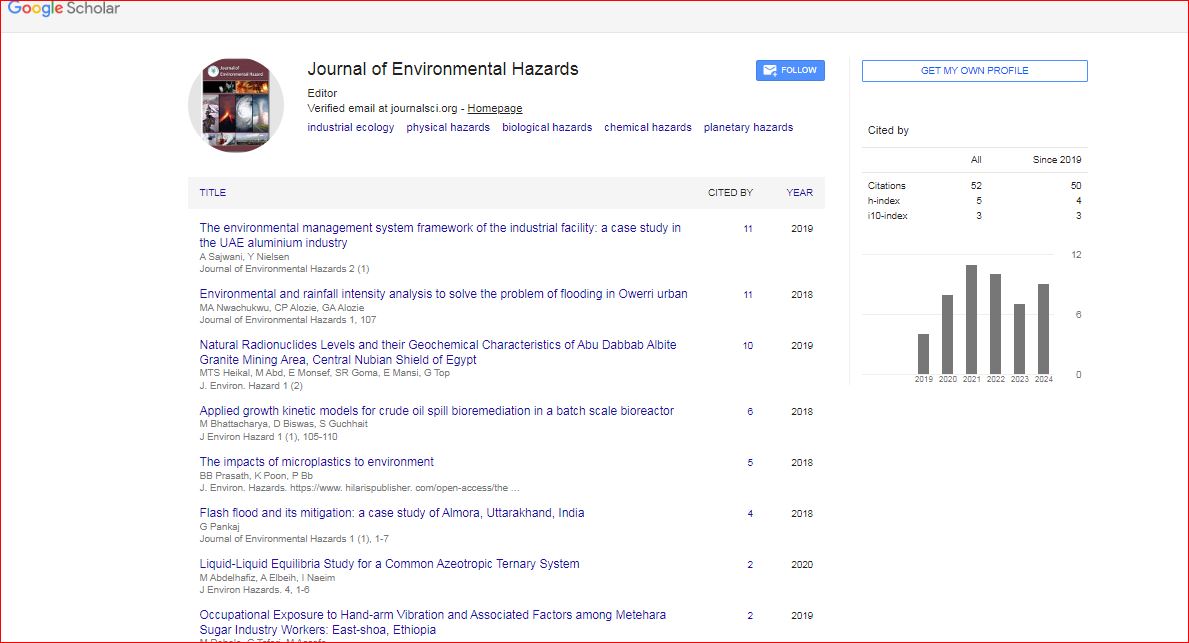
Journal of Environmental Hazards received 51 citations as per Google Scholar report