Commentary - (2025) Volume 9, Issue 3
Received: 01-Aug-2025, Manuscript No. jeh-26-179995;
Editor assigned: 04-Aug-2025, Pre QC No. P-179995;
Reviewed: 15-Aug-2025, QC No. Q-179995;
Revised: 22-Aug-2025, Manuscript No. R-179995;
Published:
29-Aug-2025
, DOI: 10.37421/2684-4923.2025.9.276
Citation: Novotny, Peter. ”Combating Pesticide Resistance: A Global Imperative.” J Environ Hazard 09 (2025):276.
Copyright: © 2025 Novotny P. This is an open-access article distributed under the terms of the Creative Commons Attribution License, which permits unrestricted use,
distribution and reproduction in any medium, provided the original author and source are credited.
Pesticide resistance represents a profound and escalating challenge in contemporary agricultural systems, stemming primarily from the pervasive overuse of these chemicals and the inherent genetic selection pressures they impose. This growing impediment significantly jeopardizes crop yields and, by extension, global food security, thus underscoring the critical need for the adoption of integrated pest management (IPM) strategies that synergistically combine biological controls, crop rotation practices, and judicious pesticide application [1]. The accumulation of resistance in insect pest populations is a direct and inevitable consequence of the intense selection pressures exerted within intensive agricultural environments. This phenomenon critically undermines the efficacy of conventionally employed insecticides, frequently leading to escalating application rates and perpetuating a detrimental cycle of further resistance development [2]. Modern agricultural methodologies, often characterized by monoculture systems and a heavy reliance on chemical pesticides, inadvertently cultivate an environment that is exceptionally conducive to the rapid evolution of pesticide resistance. Consequently, a fundamental shift towards more ecological approaches is imperative to effectively disrupt this resistance cycle [3].
The genetic underpinnings of pesticide resistance are inherently complex, typically involving the interplay of multiple genes and various mutations that collectively confer differing degrees of resistance. A thorough understanding of these intricate genetic mechanisms is paramount for the formulation of effective resistance management plans [4]. The economic ramifications of pesticide resistance are substantial and far-reaching, manifesting as reduced crop yields, augmented production costs, and the potential imposition of stringent trade restrictions. Farmers frequently confront arduous decisions concerning pesticide selection and application timing, often operating with incomplete data regarding the prevalence of resistance [5]. Effectively addressing the multifaceted issue of pesticide resistance necessitates a comprehensive strategy that encompasses the education of farmers on optimal practices, the development and implementation of robust resistance management strategies, and sustained investment in research dedicated to novel pest control technologies [6].
The diminishing effectiveness of pesticides due to widespread resistance in agricultural pests unequivocally calls for a transition away from an over-reliance on chemical controls and towards the widespread adoption of integrated pest management (IPM) strategies [7]. The development and proliferation of resistance in target organisms pose a significant and growing threat to the sustained efficacy of pesticides in modern agricultural practices. This challenge is further amplified by the extensive utilization of a limited spectrum of pesticide classes [8]. The relentless selection pressure continuously imposed by pesticide application within agricultural settings inexorably drives the genetic evolution of resistance in pest populations. This adaptive genetic change fundamentally diminishes the effectiveness of existing control measures and poses a serious threat to crop yields [9]. Pesticide resistance stands as a formidable obstacle to modern farming endeavors, directly impacting crop protection efficacy and the overall sustainability of food production. The excessive and often inappropriate use of pesticides has demonstrably accelerated the evolutionary trajectory of resistance in target pests [10].
Pesticide resistance is a significant challenge in modern agriculture, primarily driven by the overuse of pesticides and the genetic selection process they induce. This escalating problem threatens crop yields and global food security, highlighting the urgent need for integrated pest management (IPM) strategies that combine biological controls, crop rotation, and careful pesticide application [1]. The increase in pesticide resistance within insect pest populations is a direct outcome of the intense selection pressures present in agricultural systems. This phenomenon compromises the effectiveness of commonly used insecticides, leading to increased application rates and further development of resistance. Innovative solutions such as RNA interference (RNAi) and gene drives are being investigated as potential tools to manage or overcome this issue [2]. Contemporary farming practices, often characterized by monoculture and a high dependence on pesticides, create an environment that promotes the rapid evolution of pesticide resistance. This situation necessitates a shift towards ecological approaches designed to interrupt the resistance cycle. Strategies including intercropping, cover cropping, and the use of pest-resistant crop varieties can substantially reduce the reliance on chemical pesticides and slow down the buildup of resistance [3].
The genetic basis for pesticide resistance is intricate, frequently involving multiple genes and mutations that confer varying levels of resistance. Understanding these genetic mechanisms is crucial for developing efficient resistance management plans. Genomic tools and advanced molecular techniques are increasingly utilized to identify resistance genes and predict their spread within pest populations [4]. The economic consequences of pesticide resistance are considerable, resulting in diminished crop yields, higher production costs, and potential trade limitations. Farmers face difficult choices regarding pesticide selection and timing, often with incomplete information about resistance prevalence. IPM programs are vital for mitigating these economic losses and fostering sustainable agriculture [5]. Addressing pesticide resistance requires a comprehensive strategy that includes educating farmers on best practices, developing and implementing resistance management plans, and investing in research for new pest control technologies. Policy and regulatory frameworks also play a critical role in promoting sustainable pesticide use and preventing widespread resistance [6].
The declining effectiveness of pesticides due to widespread resistance in agricultural pests necessitates a move away from sole reliance on chemical controls towards integrated pest management (IPM) strategies. These strategies involve biological controls, cultural practices, and judicious pesticide use, aiming to keep pest populations below economic damage thresholds while minimizing resistance development [7]. The emergence of resistance in target organisms poses a significant challenge to the efficacy of pesticides in modern agriculture. This problem is exacerbated by the broad application of a limited number of pesticide classes. Research into novel modes of action and alternative pest control methods is essential to stay ahead of evolving resistance [8]. The continuous selection pressure exerted by pesticides in agricultural settings drives the evolution of resistance in pest populations. This genetic adaptation reduces the effectiveness of control measures and threatens crop yields. Understanding the molecular mechanisms of resistance is crucial for designing effective management strategies and developing new pest control agents [9]. Pesticide resistance presents a major challenge for modern farming, affecting crop protection and the sustainability of food production. The overuse and misuse of pesticides have accelerated resistance evolution in pests, leading to reduced control efficacy and increased economic losses. Innovative approaches like precision agriculture, biological control, and pest-resistant crop breeding are crucial for addressing this issue [10].
Pesticide resistance is a significant global challenge in agriculture, driven by overuse and genetic selection, threatening crop yields and food security. This phenomenon compromises pesticide efficacy, leading to increased application rates and economic losses. Addressing this requires a multifaceted approach including integrated pest management (IPM) strategies, ecological methods, understanding genetic mechanisms, farmer education, policy frameworks, and research into novel pest control technologies. Sustainable agricultural practices and innovative solutions are crucial to mitigate resistance and ensure long-term crop protection.
None
None
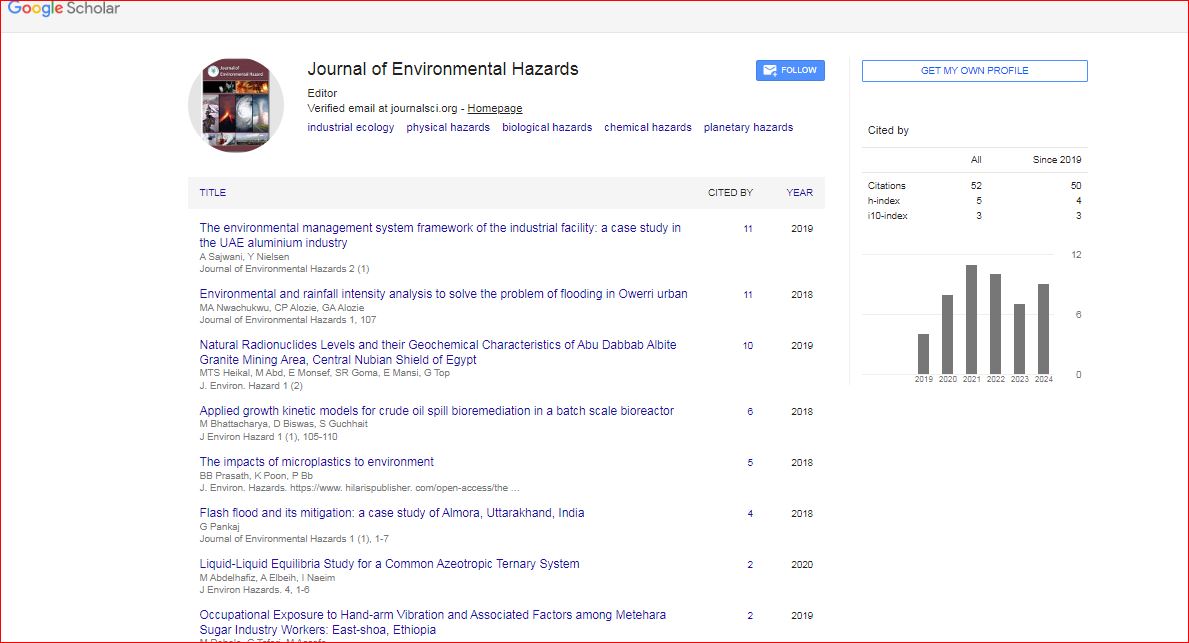
Journal of Environmental Hazards received 51 citations as per Google Scholar report