Commentary - (2025) Volume 9, Issue 3
Received: 01-Aug-2025, Manuscript No. jeh-26-179986;
Editor assigned: 04-Aug-2025, Pre QC No. P-179986;
Reviewed: 15-Aug-2025, QC No. Q-179986;
Revised: 22-Aug-2025, Manuscript No. R-179986;
Published:
29-Aug-2025
, DOI: 10.37421/2684-4923.2025.9.270
Citation: Ruiz, Alejandro. ”Toxic Sludge: A Growing Environmental And Health Crisis.” J Environ Hazard 09 (2025):270.
Copyright: © 2025 Ruiz A. This is an open-access article distributed under the terms of the Creative Commons Attribution License, which permits unrestricted use, distribution
and reproduction in any medium, provided the original author and source are credited.
This article delves into the pervasive and often underestimated threat posed by toxic sludge accumulation. It highlights how industrial processes, wastewater treatment, and agricultural runoff contribute to the formation and spread of sludge laden with hazardous chemicals. The research emphasizes the long-term environmental degradation, potential health risks to ecosystems and human populations, and the challenges associated with effective remediation and management strategies. The Journal of Environmental Hazards and the Department of Environmental Hazards & Coastal Risk, Mexico, provide a strong institutional backing for this critical environmental concern [1].
Focusing on the chemical composition and ecotoxicity of industrial sludge, this study quantifies the presence of heavy metals and persistent organic pollutants. It details the adverse effects of these contaminants on soil and aquatic life, demonstrating how sludge acts as a vector for widespread pollution. The work underscores the need for stricter regulatory frameworks to control industrial discharge and promote responsible sludge disposal [2].
This research explores the migratory pathways of contaminants from accumulated toxic sludge into groundwater and surface water systems. It utilizes advanced modeling techniques to predict the spread of pollutants, highlighting the long-term risks to drinking water sources and aquatic ecosystems. The findings emphasize the importance of proactive containment and treatment measures to prevent hydrological contamination [3].
Investigating the bioaccumulation of toxic metals in organisms exposed to sludge-contaminated environments, this paper reveals how pollutants move up the food chain. It identifies specific species that are particularly vulnerable and serves as a stark warning about the potential for human exposure through contaminated seafood and agricultural products. The study advocates for stricter environmental monitoring and remediation efforts [4].
This review synthesizes current knowledge on remediation technologies for toxic sludge, evaluating their effectiveness and economic feasibility. It discusses methods such as solidification, stabilization, bioremediation, and thermal treatment, highlighting the challenges associated with treating large volumes of complex sludge. The paper calls for innovative and sustainable solutions to manage this growing environmental burden [5].
Examining the health impacts of exposure to toxic sludge, this research connects specific contaminants found in sludge to a range of adverse human health outcomes, including respiratory issues, skin conditions, and potential carcinogenic effects. It emphasizes the occupational risks for workers involved in sludge handling and the risks to communities living near contaminated sites. The study urges stronger public health advisories and protective measures [6].
This paper investigates the role of agricultural practices in the generation and exacerbation of toxic sludge. It details how the overuse of fertilizers, pesticides, and animal waste can lead to the accumulation of hazardous substances in soil and water, ultimately contributing to sludge formation. The research advocates for sustainable agricultural techniques to mitigate this environmental threat [7].
This study focuses on the management of sludge from wastewater treatment plants, a significant source of toxic sludge. It examines the current treatment processes and their limitations in removing hazardous constituents, proposing improvements in sludge dewatering and stabilization techniques. The paper highlights the need for integrated sludge management strategies to reduce environmental risks [8].
This article provides a global perspective on the economic costs associated with toxic sludge accumulation, including remediation expenses, healthcare burdens, and lost economic opportunities due to environmental degradation. It argues for increased investment in preventative measures and sustainable industrial practices to mitigate these escalating costs. The paper underscores the financial imperative of addressing this environmental threat [9].
This research explores innovative policy frameworks and regulatory approaches for managing toxic sludge. It analyzes successful strategies from different regions, emphasizing the importance of stakeholder engagement, public awareness campaigns, and international cooperation. The paper calls for adaptive and robust policies to effectively combat the growing problem of toxic sludge accumulation [10].
Toxic sludge accumulation is identified as a pervasive and often underestimated environmental threat, stemming from industrial processes, wastewater treatment, and agricultural runoff, leading to the spread of hazardous chemicals. This accumulation results in long-term environmental degradation and poses significant health risks to both ecosystems and human populations, while effective remediation and management present considerable challenges [1].
The chemical composition and ecotoxicity of industrial sludge are critically examined, with quantification of heavy metals and persistent organic pollutants. The adverse effects of these contaminants on soil and aquatic life are detailed, illustrating how sludge serves as a vector for widespread pollution. This highlights the imperative for more stringent regulatory frameworks governing industrial discharge and promoting responsible sludge disposal practices [2].
Research into the migratory pathways of contaminants from toxic sludge into groundwater and surface water systems utilizes advanced modeling techniques to predict pollutant spread. This underscores the long-term risks to drinking water sources and aquatic ecosystems, emphasizing the necessity of proactive containment and treatment measures to prevent hydrological contamination [3].
The bioaccumulation of toxic metals in organisms within sludge-contaminated environments is investigated, revealing the transfer of pollutants up the food chain. Vulnerable species are identified, serving as a critical warning regarding potential human exposure through contaminated food sources. The study strongly advocates for enhanced environmental monitoring and intensified remediation efforts [4].
A comprehensive review synthesizes current knowledge on remediation technologies for toxic sludge, evaluating their effectiveness and economic viability. Various methods, including solidification, stabilization, bioremediation, and thermal treatment, are discussed, along with the inherent challenges of treating large volumes of complex sludge. The review calls for the development of innovative and sustainable solutions [5].
The health impacts associated with exposure to toxic sludge contaminants are explored, linking specific sludge components to adverse human health outcomes such as respiratory problems, skin conditions, and potential carcinogenicity. Occupational risks for sludge handlers and risks to nearby communities are highlighted, urging the implementation of stronger public health advisories and protective measures [6].
Agricultural practices are examined for their contribution to the generation and exacerbation of toxic sludge. The detrimental effects of excessive fertilizer, pesticide, and animal waste use on soil and water quality are detailed, contributing to sludge formation. Sustainable agricultural techniques are promoted as a means to mitigate this environmental challenge [7].
Sludge management from wastewater treatment plants, a primary source of toxic sludge, is addressed. Current treatment processes and their limitations in removing hazardous constituents are scrutinized, with proposals for improvements in dewatering and stabilization. The need for integrated sludge management strategies to diminish environmental risks is emphasized [8].
The global economic repercussions of toxic sludge accumulation are presented, encompassing remediation costs, healthcare burdens, and economic losses from environmental degradation. Increased investment in preventative measures and sustainable industrial practices is advocated to manage these escalating expenses, highlighting the financial rationale for addressing this environmental issue [9].
Innovative policy frameworks and regulatory approaches for toxic sludge management are explored, analyzing successful strategies from diverse regions. The importance of stakeholder engagement, public awareness campaigns, and international cooperation is stressed. The paper advocates for adaptive and robust policies to effectively manage the growing problem of toxic sludge accumulation [10].
Toxic sludge accumulation presents a significant environmental and health challenge, driven by industrial activities, wastewater treatment, and agricultural runoff. This sludge contains hazardous chemicals, heavy metals, and persistent organic pollutants that contaminate soil and water, impacting ecosystems and potentially human health through bioaccumulation in food chains. Research highlights the migratory pathways of these contaminants into water sources and the need for effective remediation technologies, ranging from solidification to bioremediation. Addressing this issue requires stricter regulations, sustainable agricultural practices, integrated sludge management strategies, and robust policy frameworks. The economic burden of toxic sludge is substantial, emphasizing the financial imperative for preventative measures and innovative solutions to mitigate its escalating costs and protect public health and the environment.
None
None
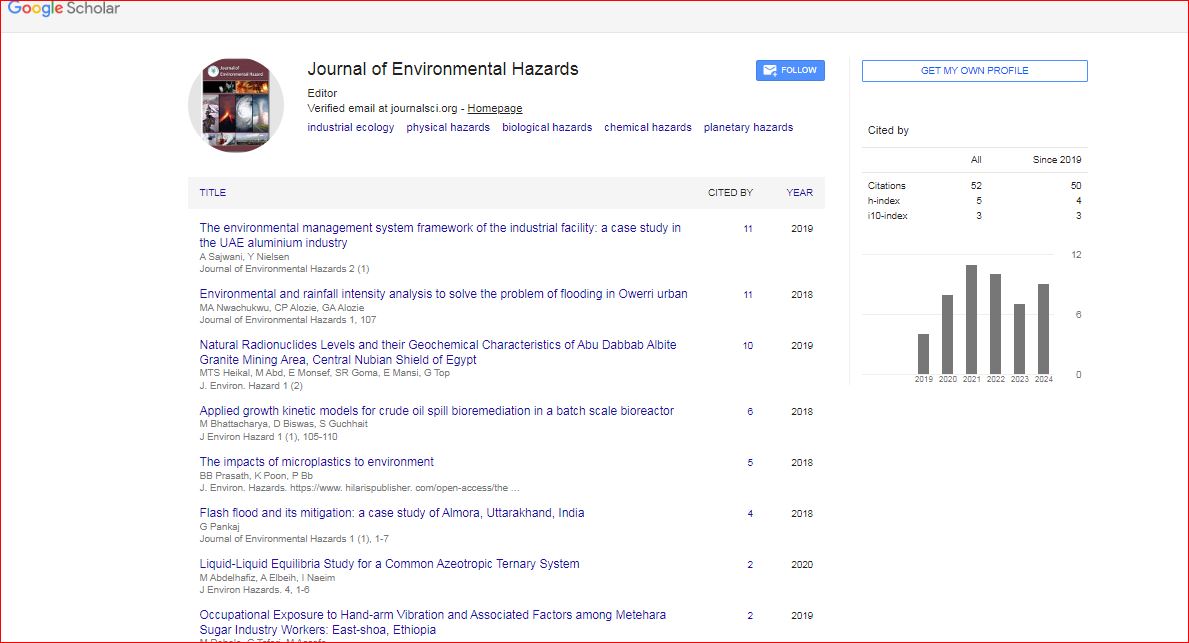
Journal of Environmental Hazards received 51 citations as per Google Scholar report