Short Communication - (2025) Volume 9, Issue 2
Received: 01-May-2025, Manuscript No. jeh-26-179981;
Editor assigned: 04-May-2025, Pre QC No. P-179981;
Reviewed: 15-May-2025, QC No. Q-179981;
Revised: 22-May-2025, Manuscript No. R-179981;
Published:
29-May-2025
, DOI: 10.37421/2684-4923.2025.9.266
Citation: Beaumont, Claire. ”Ozone Depletion: Ecosystems, Health, and Climate Risks.” J Environ Hazard 09 (2025):266.
Copyright: © 2025 Beaumont C. This is an open-access article distributed under the terms of the Creative Commons Attribution License, which permits unrestricted use,
distribution and reproduction in any medium, provided the original author and source are credited.
The escalating thinning of the ozone layer has precipitated a series of detrimental effects on both terrestrial and aquatic ecosystems. On land, this phenomenon inflicts damage upon plant DNA, impedes the vital process of photosynthesis, and consequently diminishes crop yields, thereby jeopardizing global food security. Concurrently, for human health, elevated levels of ultraviolet B (UVB) radiation significantly amplify the risk of developing skin cancers, cataracts, and immune system suppression. In the delicate balance of aquatic environments, phytoplankton, the foundational organisms of many food webs, are exceptionally vulnerable, leading to widespread repercussions for marine life [1]. The degradation of the ozone layer further intensifies the adverse impacts of climate change by influencing atmospheric circulation patterns and contributing to rising surface temperatures. Although the Montreal Protocol has demonstrated efficacy in phasing out ozone-depleting substances, residual consequences and potential future challenges, such as the influence of greenhouse gases on the trajectory of ozone recovery, necessitate ongoing surveillance and thorough research. A comprehensive understanding of these intricate atmospheric interactions is paramount for accurately forecasting future environmental trajectories and formulating effective mitigation strategies [2].
Beyond ecological concerns, ozone depletion exerts a direct and profound impact on human skin health, escalating the incidence of sunburn, accelerating premature aging, and increasing the prevalence of various forms of skin cancer, including melanoma. The cumulative effect of lifelong UVB exposure represents a significant public health concern. Furthermore, the thinning of the ozone layer can compromise the immune system, rendering individuals more susceptible to infectious diseases. These demonstrable health consequences underscore the urgent need for sustained public health initiatives and widespread awareness campaigns to educate and protect vulnerable populations [3]. Within aquatic ecosystems, phytoplankton, the microscopic flora forming the base of marine food webs, exhibit a pronounced sensitivity to the augmented UVB radiation resulting from ozone depletion. Damage inflicted upon these vital organisms can disrupt oceanic primary productivity, with cascading effects that impact fish populations and the entirety of the marine ecosystem. This disruption carries substantial economic and ecological ramifications for coastal communities and the global fishing industry, highlighting the interconnectedness of atmospheric changes and marine life [4].
The far-reaching consequences of ozone layer thinning extend to agricultural productivity, notably affecting staple crops such as rice and wheat. The increased intensity of UVB radiation can impair photosynthetic efficiency, disrupt plant growth rates, and ultimately lead to reduced seed yields. This presents a significant threat to global food security, particularly in regions that are heavily reliant on agricultural output for sustenance and economic stability [5]. In addition to direct health effects, the thinning of the ozone layer can indirectly influence the patterns of infectious diseases by affecting insect populations and their capacity to transmit pathogens. Alterations in UV radiation levels can modify the behavior and survival rates of disease vectors, potentially leading to shifts in the geographical distribution of certain vector-borne illnesses. This indirect impact adds another layer of complexity to the public health challenges posed by ozone depletion [6].
The ongoing recovery of the ozone layer, while a source of optimism, is intricately linked to the continuous emission of greenhouse gases. These emissions can significantly influence stratospheric temperatures and the complex chemistry governing ozone. Current research suggests that while the ozone hole is projected to close, the precise timeline and potential for regional ozone variations remain complex, contingent upon future emission scenarios. This intricate relationship emphasizes the interconnected nature of various atmospheric issues [7]. Ozone layer thinning has discernible implications for global biodiversity, with particularly vulnerable species inhabiting polar and high-altitude environments facing heightened risks. Elevated UVB radiation can induce DNA damage, trigger developmental abnormalities, and reduce reproductive success across a spectrum of organisms. These adverse effects contribute to population declines and can destabilize entire ecosystems, underscoring the broad ecological reach of ozone depletion [8].
The spectral composition of solar radiation reaching the Earth's surface is demonstrably altered by the thinning of the ozone layer, characterized by a significant increase in biologically damaging UVB wavelengths. This spectral shift not only affects living organisms but also plays a role in photochemical reactions within the troposphere, potentially influencing air quality and the formation of secondary pollutants. This atmospheric alteration has broad environmental implications [9]. Ozone layer thinning poses a direct and significant threat to human vision, primarily through an increased incidence of cataracts. The damaging effects of UVB radiation on the lens of the eye lead to clouding and subsequent visual impairment. The long-term implications of this phenomenon include a greater demand for comprehensive eye care services and a potential increase in visual impairment within affected populations globally [10].
The depletion of the ozone layer triggers a cascade of adverse effects across terrestrial and aquatic environments. On land, plants suffer DNA damage and reduced photosynthetic capacity, leading to lower crop yields and a compromised food supply. Human health is also significantly impacted, with increased risks of skin cancers, cataracts, and weakened immune systems due to elevated UVB radiation. Aquatic ecosystems face disruption as phytoplankton, the base of the food web, are damaged, affecting marine life. This interconnectedness of environmental systems highlights the critical role of the ozone layer [1]. Climate change is exacerbated by ozone layer thinning, which alters atmospheric circulation and increases surface temperatures. While the Montreal Protocol has been successful in phasing out ozone-depleting substances, the influence of greenhouse gases on ozone recovery presents ongoing challenges. Continuous monitoring and research are essential to understand these complex interactions and predict future environmental scenarios effectively. The interplay between ozone depletion and climate change demands a holistic approach to atmospheric research and policy [2].
Human skin is directly affected by ozone thinning, leading to more sunburns, premature aging, and a higher incidence of skin cancers like melanoma. The cumulative effect of UVB exposure over a lifetime is a major concern. Furthermore, a weakened immune system makes individuals more susceptible to infections. These health consequences emphasize the importance of public health campaigns and awareness programs to mitigate these risks and promote protective behaviors [3]. Marine phytoplankton, vital to oceanic food webs, are highly sensitive to increased UVB radiation from ozone depletion. Damage to these microscopic plants can reduce oceanic primary productivity, impacting fish populations and the entire marine ecosystem. This has significant economic and ecological consequences for coastal communities and global fisheries, underscoring the vulnerability of marine life to atmospheric changes [4].
The agricultural sector is also affected by ozone layer thinning, with staple crops like rice and wheat experiencing reduced photosynthetic efficiency and yield due to increased UVB radiation. This poses a substantial threat to global food security, particularly in regions heavily dependent on agriculture. Ensuring stable crop production requires addressing the impacts of ozone depletion on plant physiology [5]. Ozone depletion can indirectly affect disease patterns by influencing insect populations and their ability to transmit diseases. Changes in UV radiation can alter the behavior and survival of disease vectors, potentially leading to the spread of infectious diseases into new areas. This indirect impact adds another layer of complexity to understanding the public health implications of ozone depletion [6]. The recovery of the ozone layer is influenced by ongoing greenhouse gas emissions, which can alter stratospheric temperatures and ozone chemistry. While the ozone hole is expected to mend, the pace and regional variations of recovery are complex and depend on future emission trends. This highlights the interconnectedness of atmospheric issues and the need for coordinated global action on emissions [7].
Biodiversity is threatened by ozone layer thinning, especially in polar and high-altitude regions. Increased UVB radiation can cause DNA damage, developmental problems, and reduced reproductive success in various species, leading to population declines and ecosystem instability. Protecting vulnerable species and habitats is crucial in mitigating the ecological impacts of ozone depletion [8]. Changes in the spectral composition of solar radiation reaching the Earth due to ozone depletion, with increased UVB wavelengths, affect living organisms and atmospheric chemistry. This shift can influence air quality and the formation of secondary pollutants. Understanding these changes is important for assessing the broader environmental implications beyond direct biological impacts [9]. Ozone layer thinning directly contributes to an increased incidence of cataracts by damaging the eye's lens with UVB radiation. This leads to clouding and impaired vision, necessitating greater eye care and potentially causing long-term visual impairment in affected populations. Protecting vision from excessive UV exposure is a critical health concern associated with ozone depletion [10].
The thinning of the ozone layer has widespread negative consequences for both ecosystems and human health. Increased UVB radiation damages plant DNA, impairs photosynthesis, and reduces crop yields, threatening food security. Human health is at risk from increased rates of skin cancer, cataracts, and immune suppression. Aquatic ecosystems are impacted as phytoplankton, the base of marine food webs, are harmed, affecting fish populations and marine life. Climate change is exacerbated by ozone depletion, altering atmospheric circulation and temperatures. While efforts like the Montreal Protocol have been effective, ongoing challenges remain, including the influence of greenhouse gases on ozone recovery. Biodiversity is also threatened, particularly in sensitive regions, with DNA damage and reproductive issues affecting various species. Indirectly, ozone depletion can influence disease patterns by affecting insect vectors. The alteration of solar radiation spectrum and its impact on atmospheric chemistry is another concern. Ultimately, the interconnectedness of these issues highlights the need for continued research and global cooperation to address the multifaceted challenges posed by ozone layer depletion.
None
None
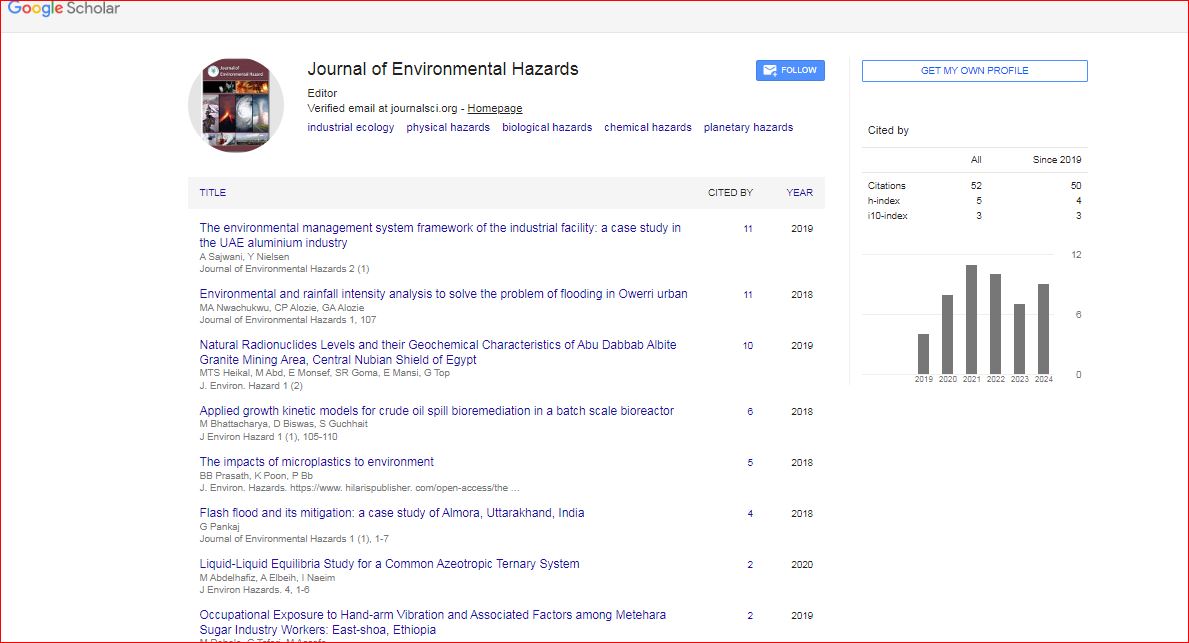
Journal of Environmental Hazards received 51 citations as per Google Scholar report