Opinion - (2025) Volume 9, Issue 2
Received: 01-May-2025, Manuscript No. jeh-26-179977;
Editor assigned: 04-May-2025, Pre QC No. P-179977;
Reviewed: 15-May-2025, QC No. Q-179977;
Revised: 22-May-2025, Manuscript No. R-179977;
Published:
29-May-2025
, DOI: 37421/2684-4923.2025.9.264
Citation: Alvarez, Mateo. ”Urban Chemical Dispersion: Safety, Modeling, and Mitigation.” J Environ Hazard 09 (2025):264.
Copyright: © 2025 Alvarez M. This is an open-access article distributed under the terms of the Creative Commons Attribution License, which permits unrestricted use,
distribution and reproduction in any medium, provided the original author and source are credited.
The critical issue of volatile chemical dispersion in urban environments presents significant implications for public safety, necessitating a comprehensive understanding of the factors influencing its spread. Atmospheric conditions, the unique topography of urban areas, and the intrinsic properties of released chemicals interact to form hazardous zones, directly impacting the effectiveness of emergency response and the planning of evacuation strategies. Research in this field underscores the imperative for advanced modeling and monitoring systems to predict and mitigate risks associated with accidental or intentional releases of hazardous volatile compounds, thereby enhancing urban resilience [1]. The intricate interplay of meteorological factors and urban morphology plays a crucial role in shaping the dispersion patterns of airborne contaminants within complex urban settings. Sophisticated computational fluid dynamics (CFD) are employed to simulate how variables such as wind speed, direction, and the arrangement of buildings influence plume spread. The findings consistently highlight the importance of integrating localized weather data with high-resolution urban models for achieving accurate risk assessments in areas susceptible to volatile chemical releases [2].
The development and validation of real-time monitoring systems are paramount for detecting and tracking the dispersion of hazardous volatile organic compounds (VOCs) in urban areas. These systems involve advanced sensor technology, sophisticated data assimilation techniques, and seamless integration into public alert mechanisms. Such systems have the potential to significantly reduce exposure risks and bolster the effectiveness of emergency response operations when hazardous substances are released [3]. Geospatial data and robust risk assessment tools offer a powerful means to map urban areas that are particularly vulnerable to volatile chemical releases. By integrating demographic information, detailed infrastructure data, and atmospheric dispersion models, it becomes possible to precisely identify high-risk zones. This proactive approach supports urban planning and infrastructure development initiatives aimed at minimizing the impact of such events on city populations and essential facilities [4].
An assessment of various urban planning strategies is essential for mitigating the consequences of chemical spills and accidental releases. The effectiveness of measures such as green infrastructure, the strategic placement of buffer zones, and thoughtful building design in containing and diluting volatile chemical plumes warrants thorough examination. Such studies provide crucial recommendations for city planners and emergency managers seeking to enhance urban safety through integrated risk management [5]. The atmospheric dispersion of specific industrial volatile chemicals within urban canyons, and their consequent health impacts, demand detailed investigation. Advanced sensor networks and sophisticated modeling techniques are employed to elucidate how street geometry influences pollutant concentration and subsequent exposure levels. This research identifies critical areas requiring public health intervention and improved emergency preparedness, especially in densely populated urban districts [6].
Developing effective public warning systems for chemical emergencies in large urban areas presents both challenges and opportunities. A critical review of diverse communication strategies, available technologies, and the vital role of community engagement is necessary to ensure timely and accurate dissemination of critical information during hazardous events. Identifying best practices is key to enhancing public safety and overall urban resilience [7]. The influence of urban heat islands on the dispersion and transformation of volatile chemical pollutants is a growing concern. Elevated urban temperatures can significantly alter atmospheric chemistry and the transport of hazardous substances, introducing unique complexities for risk assessment and control strategies within cities. This necessitates the consideration of climate-related factors in urban safety planning [8].
The development of advanced computational models for simulating the dispersion of dense gas clouds in urban environments is crucial. Incorporating realistic building geometries and detailed atmospheric stability conditions allows for more accurate predictions of hazard zones. The findings derived from such models are indispensable for emergency responders to make well-informed decisions during chemical release incidents [9]. Remote sensing technologies offer significant potential for monitoring and assessing the dispersion of airborne pollutants, including volatile chemicals, within urban settings. The application of satellite and drone-based sensors enables real-time data acquisition and analysis, thereby enhancing situational awareness and improving response effectiveness during hazardous events [10].
The dispersion of volatile chemicals in urban settings poses a significant threat to public safety, influenced by a complex interplay of atmospheric conditions, urban topography, and the nature of the released substances. These factors collectively define hazardous zones, which in turn dictate the efficiency of emergency response operations and the strategic planning of evacuations. Consequently, there is a pressing need for the development and implementation of sophisticated modeling and monitoring systems capable of predicting and mitigating the risks associated with both accidental and intentional releases of hazardous volatile compounds, thereby bolstering the overall resilience of urban environments [1]. Within the intricate fabric of urban environments, meteorological factors and the specific morphology of the city profoundly affect how airborne contaminants disperse. Advanced computational fluid dynamics (CFD) modeling is instrumental in simulating these processes, illustrating how variables like wind speed, direction, and the physical arrangement of buildings collectively influence the spread of pollutant plumes. The findings from such simulations consistently underscore the critical necessity of integrating hyper-local weather data with high-resolution urban terrain models to achieve precise risk assessments, particularly in areas prone to the release of volatile chemicals [2].
A key development in managing urban chemical hazards is the creation and validation of real-time monitoring systems designed for the detection and tracking of hazardous volatile organic compounds (VOCs). These systems integrate cutting-edge sensor technologies with advanced data assimilation techniques, ensuring that information is seamlessly fed into public alert systems. The successful implementation of such systems has been shown to markedly reduce exposure risks and significantly enhance the operational effectiveness of emergency response efforts during chemical incidents [3]. Leveraging geospatial data alongside comprehensive risk assessment tools provides a robust framework for identifying and mapping urban areas that are particularly susceptible to the impacts of volatile chemical releases. This approach involves the synergistic integration of demographic data, detailed infrastructure information, and sophisticated atmospheric dispersion models to pinpoint high-risk zones with a high degree of accuracy. The insights gained from such mapping are vital for informing proactive urban planning and guiding infrastructure development strategies aimed at minimizing the potential harm to urban populations and critical facilities [4].
Evaluating the efficacy of diverse urban planning strategies is a crucial step in mitigating the potentially severe consequences of chemical spills and accidental releases. This evaluation necessitates a close examination of how elements such as green infrastructure, the establishment of buffer zones, and specific building designs contribute to either containing or diluting volatile chemical plumes. The outcomes of such research offer actionable recommendations for city planners and emergency managers, guiding them in the adoption of integrated risk management approaches to enhance urban safety [5]. Investigating the atmospheric dispersion of specific volatile industrial chemicals within the confines of urban canyons and assessing their associated health risks are critical research objectives. The utilization of advanced sensor networks coupled with predictive modeling allows for a detailed understanding of how the unique geometric characteristics of streets can influence pollutant concentrations and subsequently, human exposure levels. This line of inquiry is crucial for identifying specific areas that require targeted public health interventions and for bolstering emergency preparedness, especially within densely populated urban districts [6].
Addressing the challenges and capitalizing on the opportunities presented by effective public warning systems for chemical emergencies in extensive urban areas is a complex undertaking. This involves a thorough review of various communication strategies, the technological infrastructure available, and the indispensable role of community engagement in ensuring that critical information is disseminated accurately and promptly during hazardous events. Identifying and promoting best practices are fundamental to enhancing public safety and fostering greater urban resilience [7]. The impact of urban heat islands on the dispersion and chemical transformation of volatile pollutants is an area of growing research interest. Elevated temperatures within urban cores can significantly alter atmospheric chemistry and influence the transport pathways of hazardous substances, thereby introducing unique and complex challenges for risk assessment and control efforts in cities. This highlights the imperative to incorporate climate-related factors into all aspects of urban safety planning [8].
The advancement of sophisticated computational models for the simulation of dense gas cloud dispersion within urban environments is of paramount importance. By integrating realistic representations of building geometries and detailed atmospheric stability conditions, these models can predict the extent of hazard zones with enhanced accuracy. The predictive capabilities of these models are essential for empowering emergency responders with the critical information needed to make timely and effective decisions during chemical release incidents [9]. Remote sensing technologies represent a powerful and evolving tool for the monitoring and assessment of airborne pollutant dispersion, including volatile chemicals, in urban settings. The application of satellite imagery and drone-mounted sensors facilitates real-time data acquisition and analysis, significantly improving situational awareness and the overall effectiveness of response operations during hazardous events [10].
This collection of research addresses the critical issue of volatile chemical dispersion in urban environments, focusing on its impact on public safety and the development of mitigation strategies. Studies explore how atmospheric conditions, urban morphology, and chemical properties influence dispersion patterns, utilizing advanced modeling techniques like CFD and dense gas dispersion simulations. The research highlights the importance of real-time monitoring systems, geospatial risk assessment, and effective public warning systems to enhance urban resilience. It also examines the role of urban planning strategies, such as green infrastructure, and the influence of factors like urban heat islands and urban canyons on pollutant behavior. Remote sensing technologies are recognized for their potential in monitoring and assessment, ultimately aiming to improve emergency response and reduce public exposure risks.
None
None
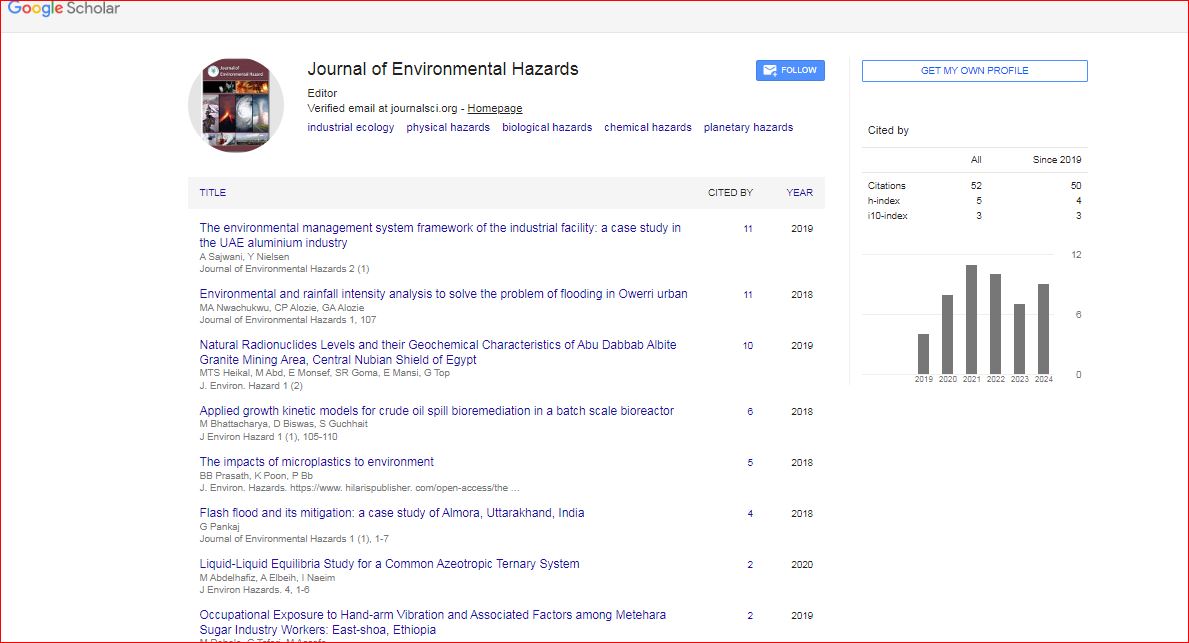
Journal of Environmental Hazards received 51 citations as per Google Scholar report