Commentary - (2025) Volume 9, Issue 2
Received: 01-May-2025, Manuscript No. jeh-26-179968;
Editor assigned: 04-May-2025, Pre QC No. P-179968;
Reviewed: 15-May-2025, QC No. Q-179968;
Revised: 22-May-2025, Manuscript No. R-179968;
Published:
29-May-2025
, DOI: 10.37421/2684-4923.2025.9.260
Citation: Jensen, Lars H. ”Global Hazardous Emissions: Diverse Threats, Integrated Solutions.” J Environ Hazard 09 (2025):260.
Copyright: © 2025 Jensen H. Lars This is an open-access article distributed under the terms of the Creative Commons Attribution License, which permits unrestricted use,
distribution and reproduction in any medium, provided the original author and source are credited.
The persistent global emissions of carbon tetrachloride (CCl4), a significant ozone-depleting substance, are a critical environmental concern, especially since its supposed phase-out under the Montreal Protocol. Studies have tracked these emissions from 2000 to 2020, revealing previously unaccounted and persistent sources [1].
Understanding these rogue emissions is paramount for accurate ozone layer recovery projections and for refining global atmospheric monitoring efforts to ensure full compliance with international environmental treaties [1].
Industrial activities are major contributors to air pollution, with comprehensive systematic reviews assessing the profound health impacts. These reviews synthesize findings from numerous studies, identifying specific pollutants and their associated health risks, which span from respiratory and cardiovascular diseases to severe neurological disorders [2].
The insights gathered from such research are vital for informing public health policies and for developing targeted interventions, ultimately protecting communities living near industrial areas from hazardous emissions [2].
Environmental regulations, particularly those focused on hazardous waste management, play a crucial role in shaping firm innovation and overall performance. Research indicates that well-designed environmental policies can actively stimulate innovation, compelling companies to develop cleaner technologies and more efficient processes [3].
This perspective challenges the notion that environmental protection and economic growth are mutually exclusive, proposing instead that they can be complementary through thoughtfully structured regulatory frameworks [3].
Recent advancements in catalytic oxidation technologies offer promising solutions for the removal of volatile organic compounds (VOCs), which are widely recognized as hazardous air pollutants with significant environmental and health implications. Review articles in this area highlight diverse catalytic systems and mechanisms, discussing their effectiveness and limitations in mitigating VOC emissions from various industrial processes [4].
Such overviews are invaluable resources for researchers and engineers dedicated to cleaner production methods and improved air quality control [4].
Microplastics represent a newly recognized category of hazardous emissions, drawing attention to their pervasive sources, complex environmental fate, and broad ecological impacts. Studies emphasize how these micro-sized particles, originating from various human activities, traverse air, water, and soil, consequently posing significant risks to ecosystems and potentially to human health [5].
Acknowledging microplastics as emissions broadens our understanding of environmental pollution and underscores the urgent need for comprehensive management strategies to address this emerging global challenge [5].
Air pollution stemming from global shipping activities carries substantial environmental and public health consequences. Emissions from maritime transport contribute significantly to regional and global air quality degradation, leading to adverse health outcomes such as respiratory illnesses and cardiovascular problems in coastal populations and beyond [6].
This impact necessitates stricter international regulations and continuous technological advancements to effectively mitigate these hazardous emissions originating from the shipping sector [6].
Waste incineration processes are known sources of highly toxic hazardous emissions, specifically dioxins and furans. Reviews provide an in-depth analysis of their formation mechanisms and the control technologies designed to minimize their release into the atmosphere [7].
Understanding these complex pathways and implementing effective mitigation strategies are paramount for ensuring that waste-to-energy facilities operate safely and in an environmentally sound manner [7].
Methane emissions from livestock pose a significant environmental challenge as a potent greenhouse gas, contributing substantially to climate change. Global analyses investigate the primary sources of these agricultural emissions, evaluate various mitigation strategies, and outline their widespread environmental consequences [8].
Emphasizing potential reductions through dietary modifications, improved manure management, and genetic selection highlights a critical area for fostering more sustainable agricultural practices [8].
Informal e-waste recycling practices present severe hazardous emissions and considerable health risks, particularly in developing regions. The uncontrolled processing of electronic waste releases a dangerous mixture of toxic substances, including heavy metals and persistent organic pollutants, directly exposing workers and nearby communities [9].
The findings from systematic reviews underscore the urgent need for establishing safer, regulated e-waste management systems to protect both human health and the environment from these severe hazards [9].
Per- and polyfluoroalkyl substances (PFAS) in the air represent a critical yet often overlooked environmental exposure pathway. These 'forever chemicals' can become airborne through diverse industrial and consumer sources, capable of traveling long distances and settling in remote areas [10].
Recognizing atmospheric PFAS as hazardous emissions is essential for conducting comprehensive risk assessments and for developing more effective strategies to control their dispersion and mitigate their persistent environmental and health impacts [10].
Environmental pollution encompasses a broad spectrum of hazardous emissions, each posing unique challenges to global sustainability and public health. For example, the continued presence of carbon tetrachloride (CCl4) emissions is a stark reminder of persistent environmental threats, even for substances supposedly phased out under international treaties like the Montreal Protocol [C001]. These ongoing emissions from 2000 to 2020 highlight the complexity of global atmospheric chemistry and the need for rigorous monitoring to ensure compliance and accurately project ozone layer recovery [C001]. Beyond these legacy pollutants, industrial air pollution continues to be a major concern, with systematic reviews comprehensively assessing its widespread health impacts. These effects range from severe respiratory and cardiovascular diseases to neurological disorders, underscoring the urgent need for public health interventions in affected communities [C002].
The scope of hazardous emissions is continually expanding to include newly recognized threats. Microplastics, for instance, are now understood as a pervasive category of emissions, originating from various human activities and distributing through air, water, and soil, consequently affecting ecosystems and potentially human health globally [C005]. Understanding their sources, environmental fate, and broad ecological impacts is crucial for developing comprehensive management strategies [C005]. In the industrial sector, volatile organic compounds (VOCs) remain significant hazardous air pollutants. Fortunately, advancements in catalytic oxidation technologies offer promising solutions for their removal, representing a key area for cleaner industrial production and air quality improvement [C004]. Concurrently, the generation of highly toxic dioxins and furans from waste incineration processes demands specialized control technologies and a deep understanding of their formation mechanisms to ensure safer waste-to-energy facilities [C007].
Specific sectors contribute disproportionately to hazardous emissions, presenting distinct mitigation challenges. The shipping industry, for example, generates considerable air pollution, which degrades regional and global air quality and directly impacts public health in coastal populations, leading to respiratory and cardiovascular problems [C006]. This necessitates stricter international regulations and technological innovation within the maritime transport sector [C006]. Agriculture also plays a significant role, particularly through methane emissions from livestock. Methane, a potent greenhouse gas, contributes substantially to climate change, making global analyses of its sources and mitigation strategies, such as dietary modifications and improved manure management, vital for sustainable agricultural practices [C008]. Furthermore, per- and polyfluoroalkyl substances (PFAS) are emerging as critical airborne hazardous emissions. These 'forever chemicals' can travel long distances from various industrial and consumer sources, necessitating comprehensive risk assessments and control strategies to mitigate their persistent environmental and health impacts [C010].
Addressing these diverse hazardous emissions requires robust regulatory frameworks and a keen understanding of socio-economic factors. Environmental regulations, especially those concerning hazardous waste management, have been shown to positively influence firm innovation and performance. Well-designed policies can stimulate companies to develop cleaner technologies and more efficient processes, indicating that environmental protection and economic growth can be complementary through smart regulation [C003]. However, the informal sector presents unique challenges, as seen in informal e-waste recycling practices. These activities release a hazardous cocktail of toxic substances, including heavy metals and persistent organic pollutants, directly exposing workers and nearby communities to severe health risks [C009]. This highlights an urgent need for safer, regulated e-waste management systems globally [C009]. Ultimately, managing hazardous emissions effectively involves a holistic approach, integrating scientific understanding of sources and impacts with strategic policy development, technological advancements, and community engagement to foster healthier environments worldwide.
Global environmental health faces persistent challenges from a diverse array of hazardous emissions. For instance, carbon tetrachloride (CCl4), an ozone-depleting substance, continues to be emitted globally despite its phase-out, highlighting the need for robust atmospheric monitoring and compliance with international treaties. Industrial sources significantly contribute to air pollution, with systematic reviews detailing severe health impacts ranging from respiratory to neurological disorders. This calls for targeted public health policies and interventions to safeguard communities. Beyond traditional industrial pollutants, emerging threats like microplastics are now recognized as pervasive hazardous emissions, stemming from various human activities and posing risks to ecosystems and human health via air, water, and soil pathways. Other critical concerns include volatile organic compounds (VOCs), which can be effectively mitigated through advancements in catalytic oxidation technologies for cleaner production. Specific sectors present unique emission challenges: maritime shipping generates substantial air pollution impacting public health in coastal areas, while waste incineration processes release highly toxic dioxins and furans, necessitating advanced control technologies. Agriculture also contributes significantly, with livestock methane emissions being a potent greenhouse gas, addressable through dietary changes and improved manure management. Informal e-waste recycling exposes communities to heavy metals and persistent organic pollutants, emphasizing the urgency for regulated management systems. Finally, per- and polyfluoroalkyl substances (PFAS) are gaining recognition as airborne hazardous emissions that travel long distances, demanding comprehensive risk assessments and control strategies. Collectively, this research underscores the multifaceted nature of hazardous emissions, necessitating integrated environmental regulations, technological innovation, and refined global monitoring to protect both the environment and public health. Environmental policies can, in fact, stimulate innovation, demonstrating that economic growth and environmental protection can be complementary.
None
None
Quing L, Paul AN, Eric LF. "Global emissions of carbon tetrachloride from 2000 to 2020".PNAS 118 (2021):e2026815118.
Indexed at, Google Scholar, Crossref
Paolo C, Roberto S, Paolo L. "Health impact assessment of air pollution from industrial sources: a systematic review".Environ Sci Pollut Res 29 (2022):67664-67677.
Indexed at, Google Scholar, Crossref
Jingjing L, Shanshan Z, Jing H. "The impact of environmental regulations on firm innovation and performance: Evidence from hazardous waste management policies".J Environ Manage 268 (2020):110757.
Indexed at, Google Scholar, Crossref
Yuan L, Yan Z, Yanli W. "Progress in catalytic oxidation of volatile organic compounds: A review".J Hazard Mater 391 (2020):122171.
Indexed at, Google Scholar, Crossref
Zhaoxian S, Ziran C, Dexiang S. "Microplastics as a new category of hazardous emissions: Sources, fate, and environmental impacts".Environ Pollut 288 (2021):117765.
Indexed at, Google Scholar, Crossref
Niki K, Konstantinos LK, Peter X. "Air pollution from ships: Impact on public health and environment".Sci Total Environ 881 (2023):163351.
Indexed at, Google Scholar, Crossref
Xiaoyong W, Lanjun W, Jinhui L. "Formation and control of dioxins and furans in waste incineration: A review".Waste Manag 102 (2020):928-939.
Indexed at, Google Scholar, Crossref
Alexander NH, T.D.A. A, Sean MM. "Methane emissions from livestock: A global analysis of sources, mitigation strategies, and environmental impacts".Anim Front 11 (2021):11-19.
Indexed at, Google Scholar, Crossref
Abdullah O, Md. MI, Md. MIK. "Hazardous emissions and health risks associated with informal e-waste recycling: A systematic review".Environ Sci Pollut Res 28 (2021):41249-41267.
Indexed at, Google Scholar, Crossref
Yaqi W, Xiao K, Yujun H. "Per- and polyfluoroalkyl substances (PFAS) in air: An overlooked environmental exposure pathway".Environ Sci Technol Lett 8 (2021):8-15.
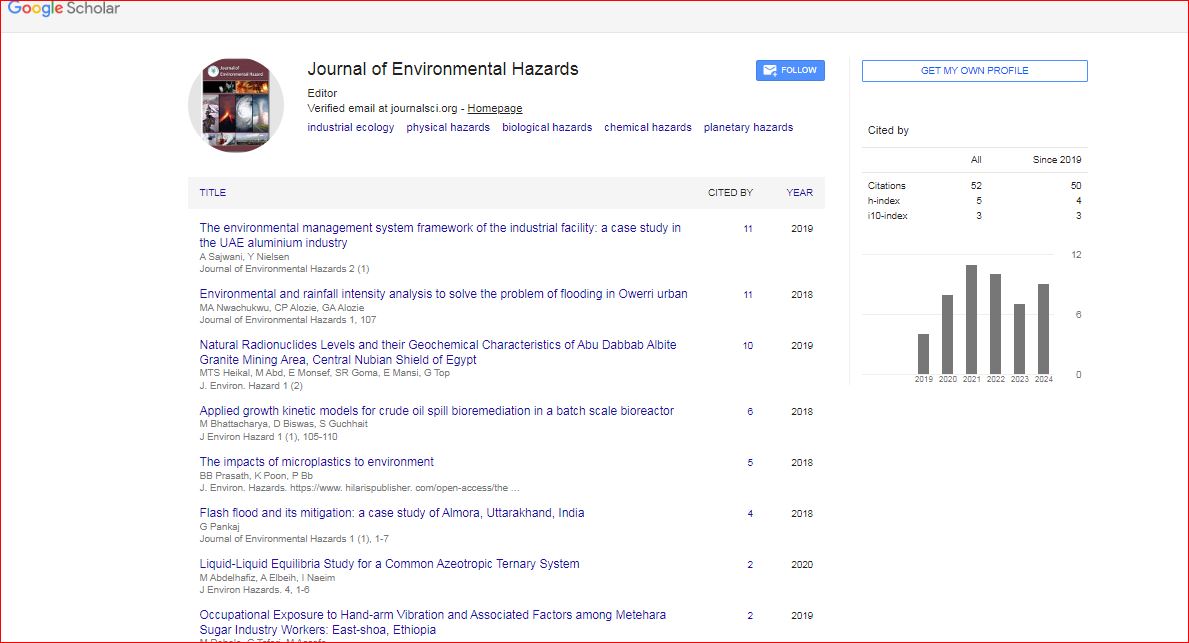
Journal of Environmental Hazards received 51 citations as per Google Scholar report