Perspective - (2025) Volume 9, Issue 2
Received: 01-May-2025, Manuscript No. jeh-26-179974;
Editor assigned: 04-May-2025, Pre QC No. P-179974;
Reviewed: 15-May-2025, QC No. Q-179974;
Revised: 22-May-2025, Manuscript No. R-179974;
Published:
29-May-2025
, DOI: 10.37421/2684-4923.2025.9.262
Citation: Müller, Oliver K..”Workplace Safety: Tech, Culture, Accident Prevention.” J Environ Hazard 09 (2025):262.
Copyright: © 2025 Müller K. Oliver This is an open-access article distributed under the terms of the Creative Commons Attribution License, which permits unrestricted use,
distribution and reproduction in any medium, provided the original author and source are credited.
Research extensively delves into the concept of safety culture and its undeniably crucial role in preventing industrial accidents. It clearly highlights how a strong safety culture, which comprehensively encompasses shared beliefs, deeply ingrained values, and consistent practices related to safety, can significantly reduce accident rates. This reduction occurs by positively influencing both employee behavior at all levels and critical management decisions. This literature synthesizes existing knowledge, effectively identifying key components that contribute to an effective safety culture and proposes actionable strategies for its robust development and long-term sustainment within complex industrial settings. The core idea here is that cultivating a genuinely proactive safety mindset across an entire organization is absolutely foundational to minimizing occupational risks and ensuring a safer working environment [1].
A systematic review explores the transformative application of Internet of Things (IoT) technologies to fundamentally enhance occupational safety and health within the demanding construction industry. This investigation precisely identifies various IoT devices and advanced platforms utilized for real-time monitoring of potential hazards, tracking worker locations, assessing environmental conditions, and evaluating equipment status. The paper strongly underscores how IoT can strategically provide crucial early warning systems, significantly improve site surveillance capabilities, and expertly facilitate proactive risk management. This ultimately reduces the likelihood of severe accidents and injuries in inherently high-risk construction environments. The main takeaway is that IoT offers tangible, measurable benefits for creating consistently safer workplaces [2].
Another systematic review meticulously investigates the innovative application of the Human Factors Analysis and Classification System (HFACS) in the complex domain of industrial accident analysis. It carefully maps out how HFACS, a system originally developed for the aviation industry, has been successfully adapted to categorize the intricate layers of human errors contributing to industrial incidents. This ranges from the immediate unsafe acts of frontline operators to broader organizational failures. The article convincingly demonstrates HFACS's utility in providing a structured and comprehensive framework for understanding the deep-seated root causes of accidents, extending beyond immediate technical malfunctions. It emphasizes the critical interconnectedness of human factors, supervisory deficiencies, and overarching organizational influences. The key insight is that HFACS offers a truly comprehensive lens for effective accident investigation and robust prevention in diverse industrial contexts [3].
The implementation and effectiveness of Occupational Safety and Health Management Systems (OSHMS) are specifically examined within Small and Medium-sized Enterprises (SMEs) through a dedicated systematic review. This research vividly reveals the unique challenges SMEs often face, such as notably limited resources, a frequent lack of specialized expertise, and numerous competing priorities, all of which hinder the successful adoption of formal safety management systems. The paper identifies critical success factors and persistent barriers for OSHMS in SMEs, suggesting carefully tailored approaches and essential policy support to significantly improve safety performance. The central point is that while OSHMS are undoubtedly vital, their successful integration into SMEs requires nuanced strategies that acknowledge and effectively address their distinct operational realities and constraints [4].
A comparative study deeply explores the efficacy of various machine learning (ML) models in accurately predicting industrial accidents. It involves applying and thoroughly evaluating different ML algorithms, including decision trees, support vector machines, and sophisticated neural networks. This is done using extensive historical accident data to identify intricate patterns and reliably predict future occurrences. The research definitively demonstrates that ML techniques can effectively learn from complex datasets to accurately flag high-risk situations or areas, thereby offering a powerful and innovative tool for proactive accident prevention. The core insight is that leveraging machine learning provides a significant data-driven advantage in anticipating and skillfully mitigating industrial safety hazards before they escalate [5].
This paper introduces an advanced dynamic Bayesian network (DBN) model specifically for assessing dynamic risk and meticulously analyzing the propagation of domino accidents within chemical industrial parks. It intently focuses on the evolving nature of risks inherent in complex industrial environments, where an initial, seemingly minor incident can unfortunately trigger a catastrophic cascade of failures. The DBN approach uniquely allows for real-time updating of risk probabilities based on ever-changing operational conditions and provides an exceptionally robust framework for accurately predicting both the likelihood and the potential severe impact of domino effects. The key takeaway is that dynamic risk modeling is absolutely essential for preventing large-scale disasters in hazardous industrial complexes and ensuring facility integrity [6].
A comprehensive systematic review meticulously investigates the primary causes contributing to major industrial accidents. It synthesizes critical findings from numerous accident investigations and a wide range of research studies, systematically categorizing the contributing factors into technical, human, and organizational failures. The review prominently highlights common and persistent themes such as inadequate safety management systems, pervasive human error, equipment malfunction, inherent design flaws, and insufficient training as recurring elements in large-scale industrial incidents. The core insight is that major accidents rarely, if ever, stem from a single isolated cause but rather from a complex and often insidious interplay of systemic weaknesses that demand comprehensive, integrated preventative strategies [7].
Further exploration through a systematic review delves into the diverse and expanding applications of machine learning (ML) in occupational safety and health (OSH). It thoroughly examines how ML algorithms are being increasingly utilized for a variety of critical tasks, such as accurately predicting accident risks, efficiently identifying hazards from visual data, optimizing safety training programs, and even personalizing protective equipment for individual workers. The review consolidates research from various industries, powerfully demonstrating ML's profound potential to transform conventional OSH practices from being merely reactive to becoming truly proactive. The core message is that ML provides powerful analytical capabilities to detect subtle yet significant patterns in OSH data, leading to more intelligent, precise, and ultimately effective safety interventions, consequently resulting in fewer industrial accidents overall [8].
The profound impact of the COVID-19 pandemic on occupational safety and health (OSH) across various sectors is meticulously investigated in another systematic review. It precisely identifies a range of new and significantly exacerbated risks, including increased psychosocial stress, heightened exposure to biological hazards, rapid changes in work processes, and considerable challenges in maintaining existing rigorous safety protocols. The paper critically discusses how the pandemic urgently necessitated rapid adaptations in OSH strategies, unequivocally highlighting the paramount importance of resilient safety management systems. The central finding is that global crises like pandemics can profoundly reshape workplace safety landscapes, demanding highly flexible and comprehensive responses to effectively prevent new forms of industrial accidents and emergent health issues [9].
This specific study focuses intently on identifying critical factors that significantly influence construction safety performance by ingeniously integrating Bayesian network (BN) and rough set theory (RST). It expertly uses these advanced analytical methods to uncover complex and often hidden relationships between various safety factors, such as dedicated management commitment, proactive worker behavior, dynamic site conditions, and ultimately, accident occurrences. The integrated approach proves invaluable in pinpointing the most influential factors that, if adequately addressed, can lead to a substantial improvement in safety outcomes and a measurable reduction in industrial accidents within the construction sector. The core idea is that combining BN and RST provides a robust, evidence-based framework for sophisticated decision-making in complex construction safety management [10].
A robust understanding of safety in industrial settings begins with foundational elements. Cultivating a proactive safety mindset through a strong safety culture, which integrates shared beliefs and practices, is fundamental to reducing accident rates by influencing employee actions and management decisions [1]. Complementing this, the effective implementation of Occupational Safety and Health Management Systems (OSHMS) is crucial for improving safety performance. However, Small and Medium-sized Enterprises (SMEs) face distinct challenges like limited resources and expertise in adopting these formal systems, necessitating tailored approaches and policy support for successful integration [4]. Ultimately, major industrial accidents seldom result from a single failure but rather from a complex interplay of systemic weaknesses, often categorized into technical, human, and organizational failures, highlighting the need for comprehensive preventative strategies [7].
To effectively prevent accidents, it is vital to have advanced analytical tools for understanding and predicting incidents. The Human Factors Analysis and Classification System (HFACS), originally from aviation, provides a structured framework for categorizing human errors and organizational failures in industrial accidents, offering a comprehensive lens for investigation and prevention [3]. Beyond retrospective analysis, predictive capabilities are enhanced by machine learning (ML) models. Various ML algorithms, including decision trees and neural networks, are successfully applied to historical data to identify patterns and predict future accident occurrences, serving as a powerful tool for proactive prevention [5]. This extends to the broader application of ML in Occupational Safety and Health (OSH) for predicting risks, identifying hazards from visual data, and optimizing safety training, transforming OSH practices from reactive to proactive [8].
Modern technology offers significant advancements in real-time safety management. Internet of Things (IoT) technologies are increasingly applied to enhance occupational safety and health, particularly in the construction industry. IoT devices and platforms enable real-time monitoring of hazards, worker locations, environmental conditions, and equipment status, providing early warning systems and facilitating proactive risk management to reduce accidents [2]. For complex and high-risk environments, like chemical industrial parks, dynamic risk assessment is critical. Dynamic Bayesian network (DBN) models are introduced to assess evolving risks and analyze the propagation of domino accidents, allowing for real-time updating of risk probabilities and predicting the impact of cascading failures, which is essential for preventing large-scale disasters [6].
Contextual factors and integrated approaches further refine safety management. Global events, such as the COVID-19 pandemic, demonstrate how external crises can profoundly impact OSH, introducing new risks like psychosocial stress and biological hazards, and demanding adaptable and resilient safety management systems [9]. Within specific industries like construction, identifying critical factors influencing safety performance benefits from integrated analytical methods. Combining Bayesian network (BN) and rough set theory (RST) helps uncover complex relationships between safety factors such as management commitment, worker behavior, and site conditions, providing a robust framework for evidence-based decision-making and improved safety outcomes [10]. These diverse studies collectively underscore the multifaceted nature of industrial safety, where cultural, technological, analytical, and contextual elements must be synergistically addressed for effective accident prevention.
This collection of research explores diverse strategies and analytical tools for enhancing occupational safety and health and preventing industrial accidents. A central theme is the importance of a strong safety culture, which involves shared beliefs and practices to reduce accident rates by influencing employee behavior and management decisions. Advances in technology play a significant role. Internet of Things (IoT) applications are enhancing safety in construction by providing real-time monitoring of hazards, worker locations, and equipment, enabling proactive risk management. Machine learning (ML) models are also being developed to predict industrial accidents, using historical data to identify patterns and flag high-risk situations for preventative action. This includes a broader application of ML in Occupational Safety and Health (OSH) for tasks like risk prediction, hazard identification from visual data, and optimizing safety training. Understanding the root causes of accidents is crucial. The Human Factors Analysis and Classification System (HFACS) offers a structured framework to analyze human errors and organizational failures contributing to incidents. Similarly, identifying critical factors in construction safety performance uses Bayesian networks and rough set theory to pinpoint influential elements for improved safety. The reviews also highlight the need for robust Occupational Safety and Health Management Systems (OSHMS), especially for Small and Medium-sized Enterprises (SMEs), acknowledging their unique challenges. Furthermore, managing dynamic risks, such as domino accidents in chemical parks, employs sophisticated models like dynamic Bayesian networks. Finally, global events like the COVID-19 pandemic demonstrate how external factors profoundly reshape workplace safety, demanding adaptable OSH strategies to address new and exacerbated risks.
None
None
Mengyu L, Jianjun Z, Zhaobo S. "A review of safety culture and its role in industrial accident prevention".Saf Sci 121 (2020):182-192.
Indexed at, Google Scholar, Crossref
Ammar A, Tarek Z, Ziyad MA. "Application of Internet of Things (IoT) for enhancing occupational safety and health in construction industry: A systematic review".Saf Sci 161 (2023):106096.
Indexed at, Google Scholar, Crossref
Xiaohui Z, Lei X, Qian L. "Human factors analysis and classification system (HFACS) in industrial accident analysis: a systematic review".Hum Factors Ergon Manuf Serv Ind 32 (2022):622-638.
Indexed at, Google Scholar, Crossref
Mohammad SJ, Ali S, Ahmad S. "Occupational safety and health management systems (OSHMS) in small and medium-sized enterprises (SMEs): a systematic review".J Occup Health 62 (2020):e2020002.
Indexed at, Google Scholar, Crossref
Mohsen F, Fatemeh S, Seyed HH. "Predicting Industrial Accidents Using Machine Learning: A Comparative Study".Saf Health Work 12 (2021):103-110.
Indexed at, Google Scholar, Crossref
Lei Y, Bo Z, Jinhai W. "Dynamic Bayesian network for dynamic risk assessment and propagation analysis of domino accidents in chemical industrial parks".Process Saf Environ Prot 140 (2020):153-162.
Indexed at, Google Scholar, Crossref
Milad F, Hamidreza M, Mohammad MZ. "Causes of major industrial accidents: A systematic review".J Loss Prev Process Ind 67 (2020):104231.
Indexed at, Google Scholar, Crossref
Xiaojun Z, Lin L, Guoliang F. "Machine learning application in occupational safety and health: A systematic review".Saf Sci 143 (2021):105423.
Indexed at, Google Scholar, Crossref
Fatemeh F, Maryam A, Nader K. "The impact of COVID-19 on occupational safety and health: A systematic review".Saf Sci 152 (2022):105786.
Indexed at, Google Scholar, Crossref
Yuanhong L, Yuze L, Fan Z. "Identifying critical factors affecting construction safety performance using Bayesian network and rough set theory".J Constr Eng Manag 145 (2019):04019046.
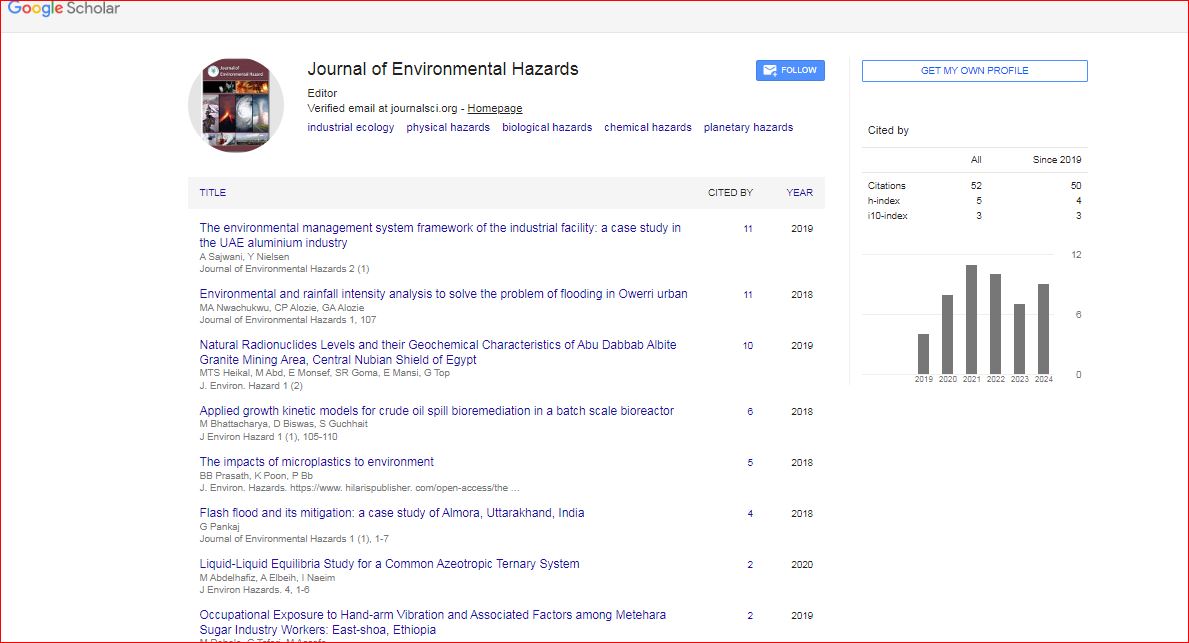
Journal of Environmental Hazards received 51 citations as per Google Scholar report