Short Communication - (2025) Volume 10, Issue 6
Received: 01-Dec-2025, Manuscript No. cgj-26-186556;
Editor assigned: 03-Dec-2025, Pre QC No. P-186556;
Reviewed: 17-Dec-2025, QC No. Q-186556;
Revised: 22-Dec-2025, Manuscript No. R-186556;
Published:
29-Dec-2025
, DOI: 10.37421/2952-8518.2025.10.349
Citation: Kim, Grace. ”Gastroenterology’s Future: Personalized Medicine, AI, Microbiome.” Clin Gastroenterol J 10 (2025):349.
Copyright: © 2025 Kim G. This is an open-access article distributed under the terms of the Creative Commons Attribution License, which permits unrestricted use, distribution and reproduction in any medium, provided the original author and source are credited.
The field of gastroenterology is undergoing a profound transformation, driven by advancements in our understanding of the gut microbiome and its intricate role in health and disease. This burgeoning area of research is opening up new avenues for personalized therapeutic interventions, moving beyond generalized treatment approaches. Specifically, there is a growing focus on targeted microbial modulation, aiming to precisely alter the composition and function of the gut flora to achieve therapeutic benefits for various gastrointestinal conditions [1].
The management of Inflammatory Bowel Disease (IBD) is being revolutionized by the development of novel biologics and small molecule inhibitors. These advanced therapies are designed to target specific inflammatory pathways implicated in the pathogenesis of IBD, offering more precise and effective treatment options than traditional approaches. Future research in this domain will concentrate on optimizing existing treatment strategies, predicting individual patient responses to therapy, and minimizing the long-term side effects associated with these potent medications [2].
Artificial intelligence (AI) and machine learning (ML) are emerging as powerful tools poised to significantly enhance diagnostic and prognostic capabilities within gastroenterology. The development of predictive models for disease onset, progression, and treatment outcomes, coupled with AI-assisted image analysis for endoscopic procedures and pathological specimens, promises to improve both the accuracy and efficiency of clinical decision-making [3].
Innovations in endoscopic techniques are also at the forefront of improving the early and precise diagnosis of gastrointestinal cancers and precancerous lesions. Advanced modalities such as confocal laser endomicroscopy and capsule endoscopy, equipped with enhanced imaging capabilities, are enabling clinicians to visualize the gastrointestinal tract at a cellular level. Furthermore, next-generation sequencing technologies are being explored for the early detection of cancer through non-invasive methods like blood and stool samples [4].
A deeper understanding of the genetic and epigenetic underpinnings of gastrointestinal diseases is becoming increasingly crucial for enabling personalized risk assessment and tailoring treatment strategies. Genome-wide association studies (GWAS) and sophisticated genomic sequencing technologies are instrumental in identifying novel therapeutic targets and biomarkers for a range of conditions, including celiac disease and hereditary gastrointestinal polyposis syndromes [5].
The management of Functional Gastrointestinal Disorders (FGIDs) is undergoing a significant shift towards a more mechanistic understanding, recognizing the complex interplay between the gut-brain axis, the microbiome, and neuroinflammation. Future research efforts are being directed towards developing targeted therapies that specifically address these interconnected pathways, aiming to move beyond purely symptom-based management towards addressing the underlying causes of these debilitating disorders [6].
Therapeutic drug monitoring (TDM) for biologics and immunomodulators used in the treatment of IBD is gaining substantial importance as a strategy for optimizing treatment efficacy and minimizing potential toxicity. As our understanding of drug pharmacokinetics and pharmacodynamics in IBD patients improves, future research will focus on refining TDM strategies and exploring its broader application to other classes of gastrointestinal medications [7].
The gut barrier, a critical interface between the host and the external environment, is increasingly recognized as a central player in both gastrointestinal health and disease. Ongoing research is meticulously investigating the mechanisms underlying barrier dysfunction, its intricate relationship with inflammation and the gut microbiome, and the development of therapeutic strategies aimed at restoring barrier integrity. These efforts are crucial for managing conditions such as leaky gut syndrome and Clostridioides difficile infection [8].
Non-alcoholic fatty liver disease (NAFLD) is now widely acknowledged as a gastrointestinal-related disorder with profound systemic implications, extending beyond the liver itself. Future research endeavors will concentrate on elucidating the complex pathogenesis of NAFLD, identifying reliable biomarkers for accurately staging liver fibrosis, and developing effective pharmacological and lifestyle interventions to manage this growing epidemic [9].
The application of liquid biopsies, encompassing technologies such as circulating tumor DNA (ctDNA) analysis and the detection of circulating tumor cells (CTCs), holds immense potential for the early detection, monitoring of treatment response, and surveillance for recurrence of gastrointestinal cancers. Current research is dedicated to enhancing the sensitivity and specificity of these techniques and standardizing their implementation for widespread clinical application [10].
The burgeoning field of gastroenterology is being profoundly reshaped by a deeper comprehension of the gut microbiome's influence on health and disease. This expanding research frontier is paving the way for novel personalized therapeutic interventions, moving beyond conventional one-size-fits-all approaches. A significant focus is placed on targeted microbial modulation, with the objective of precisely altering the composition and function of the gut microbiota to achieve beneficial therapeutic outcomes for a spectrum of gastrointestinal ailments [1].
In the realm of Inflammatory Bowel Disease (IBD) management, the advent of novel biologics and small molecule inhibitors represents a paradigm shift. These cutting-edge therapies are engineered to selectively target specific inflammatory pathways that contribute to IBD's underlying pathology, thereby offering more precise and efficacious treatment modalities compared to traditional methods. The trajectory of future research in this area is geared towards refining existing treatment strategies, accurately predicting individual patient responses to therapeutic agents, and mitigating the long-term adverse effects associated with these potent interventions [2].
Artificial intelligence (AI) and machine learning (ML) are rapidly emerging as indispensable tools, poised to significantly augment diagnostic and prognostic capabilities within the discipline of gastroenterology. The ongoing development of predictive models designed to forecast disease onset, progression, and treatment outcomes, in conjunction with AI-driven image analysis for endoscopic procedures and histopathological examinations, holds the promise of elevating both the precision and efficiency of clinical decision-making processes [3].
Advancements in endoscopic technologies are critically important for facilitating the earlier and more accurate diagnosis of gastrointestinal malignancies and their precursor lesions. Sophisticated modalities such as confocal laser endomicroscopy and advanced capsule endoscopy, equipped with enhanced imaging functionalities, empower clinicians with the ability to visualize the gastrointestinal tract at a microscopic level. Concurrently, next-generation sequencing technologies are being rigorously investigated for their potential in the early detection of cancer through non-invasive biological samples, including blood and stool [4].
An in-depth understanding of the genetic and epigenetic factors that influence gastrointestinal disorders is becoming increasingly vital for the establishment of individualized risk assessments and the development of personalized treatment plans. Genome-wide association studies (GWAS) and sophisticated genomic sequencing methodologies play a pivotal role in the identification of novel therapeutic targets and crucial biomarkers for a variety of conditions, such as celiac disease and hereditary gastrointestinal polyposis syndromes [5].
The approach to managing Functional Gastrointestinal Disorders (FGIDs) is evolving towards a more mechanistic perspective, incorporating the intricate connections between the gut-brain axis, the gut microbiome, and the phenomenon of neuroinflammation. The focus of future research is centered on the creation of targeted therapies that specifically address these interconnected biological pathways, aiming to transition from a symptom-focused management approach to one that targets the root causes of these disorders [6].
Therapeutic drug monitoring (TDM) for biologic agents and immunomodulators employed in the treatment of IBD is increasingly recognized as a critical strategy for optimizing therapeutic efficacy and minimizing the risk of toxicity. As the knowledge base concerning drug pharmacokinetics and pharmacodynamics in IBD patients continues to expand, future research will be directed towards refining TDM protocols and exploring its applicability to other categories of gastrointestinal medications [7].
The gut barrier, serving as a crucial interface between the host organism and its external environment, is gaining recognition as a fundamental component in maintaining gastrointestinal health and preventing disease. Current research is actively exploring the underlying mechanisms of barrier impairment, its complex relationship with inflammatory processes and the gut microbiome, and the development of therapeutic interventions designed to restore the integrity of this vital barrier. These investigative efforts are paramount for the effective management of conditions like increased intestinal permeability and Clostridioides difficile infection [8].
Non-alcoholic fatty liver disease (NAFLD) is progressively being acknowledged as a gastrointestinal-related pathology with significant systemic repercussions that extend far beyond the liver. Future research initiatives will be directed towards unraveling the complex pathogenesis of NAFLD, identifying dependable biomarkers for accurate staging of liver fibrosis, and formulating effective pharmacological and lifestyle-based interventions to address this escalating global health concern [9].
The utilization of liquid biopsies, which include the analysis of circulating tumor DNA (ctDNA) and circulating tumor cells (CTCs), presents a promising avenue for the early detection, assessment of treatment response, and monitoring for recurrence of gastrointestinal cancers. Ongoing research is committed to enhancing the sensitivity and specificity of these diagnostic techniques and establishing standardized protocols for their integration into routine clinical practice [10].
Gastroenterology is being transformed by advancements in gut microbiome understanding, leading to personalized therapies and diagnostics for conditions like IBD and IBS. Precision medicine, integrating genetic, environmental, and microbial data, is becoming standard. Novel biologics and small molecule inhibitors are revolutionizing IBD management, with research focusing on optimizing treatments and minimizing side effects. AI and machine learning are enhancing diagnostic and prognostic capabilities, improving accuracy and efficiency through predictive models and image analysis. Advanced endoscopic techniques and liquid biopsies, including ctDNA and CTCs, are improving early detection and monitoring of gastrointestinal cancers. Understanding the genetic and epigenetic basis of gastrointestinal diseases is crucial for personalized risk assessment and treatment. Functional gastrointestinal disorders are being approached with a mechanistic understanding of the gut-brain axis and microbiome. Therapeutic drug monitoring for IBD medications is vital for optimizing efficacy and reducing toxicity. The gut barrier's role in health and disease is a key research area, with therapeutic strategies for restoring its integrity being developed. Non-alcoholic fatty liver disease is recognized as a gastrointestinal-related disorder with systemic implications, and research is focused on its pathogenesis and treatment.
None
None
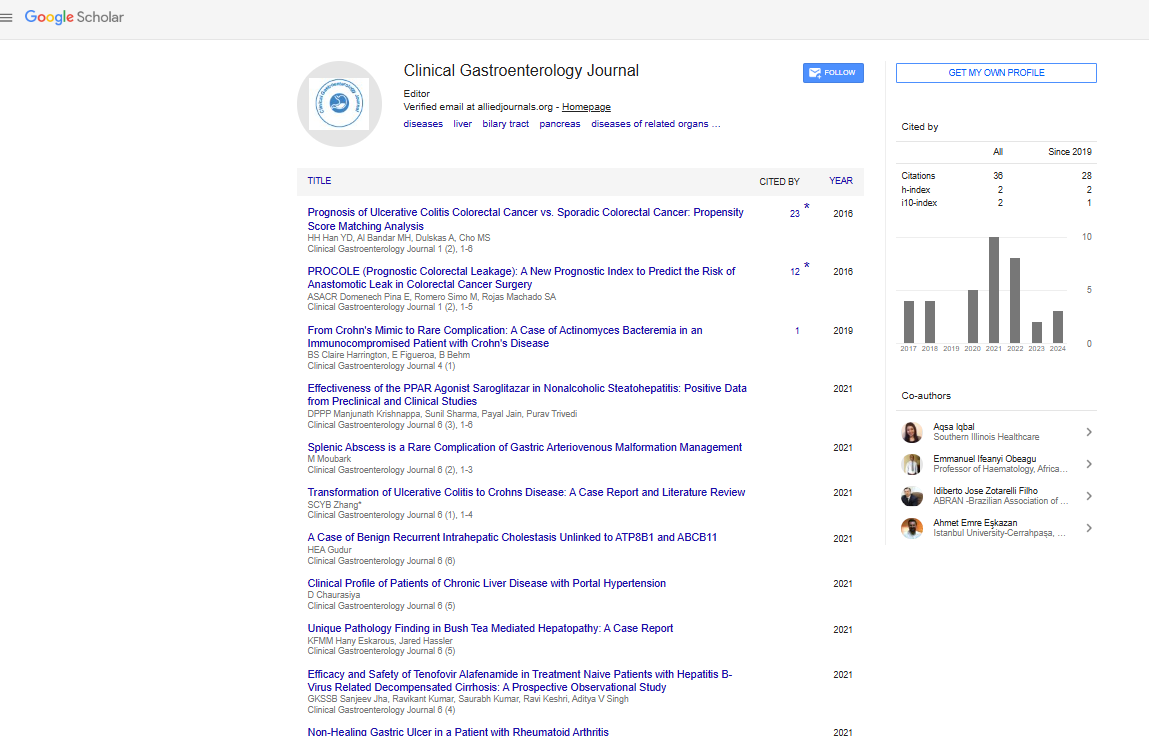
Clinical Gastroenterology Journal received 33 citations as per Google Scholar report