DOI: 10.37421/2471-2671.2025.11.205
DOI: 10.37421/2471-2671.2025.11.204
DOI: 10.37421/2471-2671.2025.11.203
DOI: 10.37421/2471-2671.2025.11.202
DOI: 10.37421/2471-2671.2025.11.201
DOI: 10.37421/2471-2671.2025.11.200
DOI: 10.37421/2471-2671.2025.11.199
DOI: 10.37421/2471-2671.2025.11.198
DOI: 10.37421/2471-2671.2025.11.197
DOI: 10.37421/2471-2671.2025.11.196
Freddy Houehanou Rodrigue GNANGNON*, Marthe Alice AGOSSOU, Yacoubou IMOROU SOUAIBOU, Moufalilou ABOUBAKAR, Patrice DANGBEMEY, Josiane Angéline Adjoua TONATO-BAGNAN, Dansou Gaspard GBESSI, DENAKPO Justin Lewis and Francis Moise DOSSOU
Introduction: Breast cancer is a major public health problem. Its management is particularly difficult in countries with limited resources. Surgery is sometimes the only therapeutic option available. Our objective was to study the place of surgery in this management in the Republic of Benin. Methods: This was a descriptive and analytical multicenter study that included medical records of patients undergoing surgery for breast cancer over the period from January 2013 to October 2019 in two university hospitals in Cotonou, southern Republic of Benin. Results: The 141 included patients had an average age of 47.2 years. Surgery was of curative intent in 84.4% of cases. Mastectomy was the most common treatment (92.9%). The Patey technique modified by Madden (81.56%) was the most used technique. The overall morbidity was 8.5% dominated by postoperative hematoma. The other therapeutic methods used were chemotherapy (95.7%) and radiotherapy (37.8%). Conclusion: Breast cancer surgery is dominated in our context by mastectomy. The development of conservative surgery and oncoplasty, associated with a policy of organized screening program and better access to radiotherapy, will improve the supply of care.
Freddy Houéhanou Rodrigue GNANGNON*, Hénok Mahutin DÉPKÉMADOHA, Ganiou ADJADÉ, Patrice DANGBEMEY, Gilbert FASSINOU, Fidèle AGOSSOU, Moufalilou ABOUBAKAR and Dansou Gaspard GBESSI
Background: Breast cancer is a major global health concern, particularly in low-resource settings like Benin, where late-stage presentation often necessitates mastectomy. Mastectomy, while therapeutic, profoundly impacts body image, sexuality and psychosocial well-being. However, evidence on these post-mastectomy outcomes is scarce in the Beninese context. This study aimed to assess the Quality of Life (QoL), psychosocial experience and symptoms of anxiety and depression among mastectomized women in southern Benin. Methods: We conducted a descriptive and analytical cross-sectional study from August to December 2023 in two tertiary hospitals in Cotonou. Fifty consecutive women who had undergone total or partial mastectomy at least two months prior were recruited. Data were collected using a structured questionnaire that included sociodemographic and clinical variables, the EORTC QLQ-C30 (global QoL), the EORTC QLQ-BR23 (breast cancer–specific domains) and the Hospital Anxiety and Depression Scale (HADS) for psychosocial assessment. Statistical significance was set at p<0.05. Results: The 50 participants had a mean age of 55.4 years. Most had received chemotherapy (98%) and radiotherapy (79%). The mean global quality-of-life score (EORTC QLQ-C30) was 69.4, with generally high physical, emotional, cognitive and social functioning scores. Sexual functioning and sexual satisfaction were the most impaired domains, while body image scores remained moderate. Only 2.3% of women presented clinically significant depressive symptoms on the HADS. Age, education level, income and family support showed significant associations with several quality-of-life dimensions (p<0.05). Conclusion: Despite socioeconomic constraints, mastectomized women in southern Benin reported overall satisfactory quality of life, although sexual functioning remained notably affected. These results underscore the critical need for integrated psychosocial and sexual support in survivorship care and provide initial evidence to inform patient-centred breast cancer care in Benin.
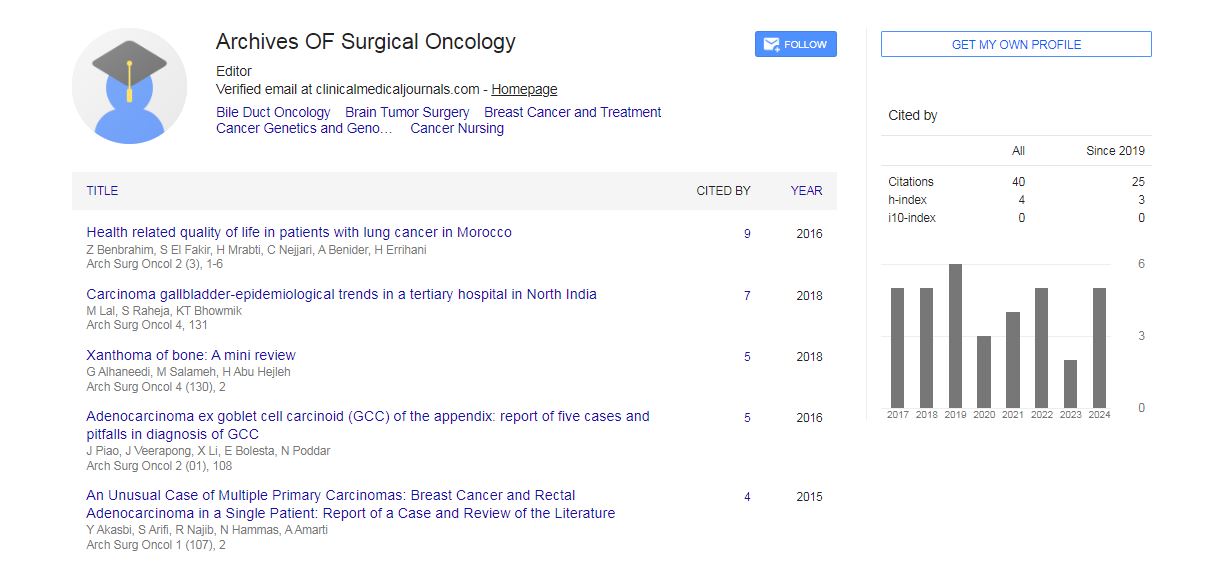
Archives of Surgical Oncology received 37 citations as per Google Scholar report
 Spanish
  Chinese
  Russian
  German
  French
  Japanese
  Portuguese
  Hindi
Hindi 