Opinion - (2025) Volume 11, Issue 6
Received: 02-Nov-2025, Manuscript No. aso-26-184665;
Editor assigned: 04-Nov-2025, Pre QC No. P-184665;
Reviewed: 18-Nov-2025, QC No. Q-184665;
Revised: 24-Nov-2025, Manuscript No. R-184665;
Published:
01-Dec-2025
, DOI: 10.37421/2471-2671.2025.11.200
Citation: Alvarez, Miguel. ”Oncologic Resection: Outcomes,
Complications, And Survivorship.” Arch Surg Oncol 11 (2025):200.
Copyright: © 2025 Alvarez M. This is an open-access article distributed under the terms of the Creative Commons Attribution License, which permits unrestricted use,
distribution and reproduction in any medium, provided the original author and source are credited.
Curative oncologic resection represents a cornerstone of cancer treatment, aiming for complete tumor removal to achieve long-term survival and disease eradication. The success of such procedures, however, is not solely determined by the immediate surgical outcome but also by a complex interplay of short-term postoperative complications and the patient's long-term trajectory after treatment. A comprehensive assessment is crucial, extending beyond the operating room to encompass survival, quality of life, and recurrence rates, highlighting the need for a holistic view of patient care following surgery [1].
In the realm of gastrointestinal stromal tumors (GIST), the meticulous achievement of negative surgical margins is of paramount importance. This principle holds true even when adjuvant therapies like imatinib are administered, as clear margins are critical for minimizing local recurrence and enhancing overall survival rates, underscoring the irreplaceable role of surgical precision in managing this specific malignancy [2].
The management of complications following colorectal cancer surgery demands a strategic and timely approach. Early detection and prompt intervention are vital for mitigating short-term morbidity and significantly improving long-term patient outcomes. Strategies focusing on the prevention of anastomotic leaks and effective management of surgical site infections are key to facilitating patient recovery and preventing oncologic recurrence [3].
For patients undergoing treatment for esophageal cancer, the impact of neoadjuvant chemotherapy on subsequent surgical outcomes is a critical consideration. While neoadjuvant therapy can enhance resectability and potentially improve survival, it may also be associated with an increased risk of perioperative complications. Therefore, careful patient selection and optimized perioperative care are essential to strike a balance between the therapeutic benefits and the associated risks [4].
Minimally invasive surgery (MIS) has emerged as a significant advancement in the surgical management of pancreatic cancer. Studies suggest that MIS approaches can lead to reduced postoperative pain, shorter hospital stays, and oncologic outcomes that are comparable to those achieved with open surgery, provided the procedures are performed by experienced surgeons. This trend indicates a growing preference for less invasive techniques in complex oncologic resections [5].
Salvage surgery for recurrent rectal cancer, while challenging, can offer a valuable opportunity for achieving cure or prolonging survival in carefully selected patients. The long-term oncologic and functional outcomes of these procedures are influenced by a multidisciplinary team approach and meticulous surgical planning, both of which are vital for maximizing the potential for positive long-term results [6].
The assessment of frailty in patients undergoing hepatectomy for hepatocellular carcinoma is crucial for predicting short-term postoperative outcomes. Frail individuals are more prone to developing complications, experiencing prolonged hospital stays, and facing increased mortality rates. This highlights the necessity of pre-operative frailty screening to optimize perioperative management and enhance patient outcomes [7].
Survivorship and quality of life following curative resection for lung cancer are significant considerations that extend beyond the immediate oncologic success. Treatment can have a substantial impact on pulmonary function and overall well-being, necessitating robust survivorship care plans that address both oncologic surveillance and the management of long-term sequelae [8].
In the treatment of early-stage endometrial cancer, robotic-assisted surgery and laparoscopic resection have been compared in terms of their oncologic outcomes. Studies indicate similar short-term recovery profiles and comparable long-term recurrence rates between these two minimally invasive approaches, suggesting that robotic surgery provides equivalent oncologic control with potentially enhanced precision [9].
Sarcopenia, a condition characterized by the loss of muscle mass, has a notable impact on short-term surgical outcomes in patients undergoing oncologic resections. Sarcopenic individuals face a significantly higher risk of postoperative complications, including prolonged hospital stays and increased mortality, underscoring the importance of identifying and managing sarcopenia preoperatively [10].
The outcomes following curative oncologic resection are multifaceted, encompassing not only immediate surgical success but also the longer-term implications for patient survival, quality of life, and disease recurrence. A comprehensive evaluation necessitates considering both short-term postoperative complications and enduring effects, emphasizing the importance of personalized follow-up strategies informed by predictive factors for both adverse events and successful outcomes [1].
In the context of gastrointestinal stromal tumors (GIST), achieving negative surgical margins during resection is fundamentally important for long-term oncologic control. This meticulous surgical practice is crucial for minimizing the likelihood of local recurrence and improving overall survival, even when patients receive adjuvant imatinib therapy, thereby highlighting the critical role of surgical technique in optimizing outcomes for this specific type of cancer [2].
The management of complications arising from colorectal cancer surgery is a critical component of patient care. Strategies aimed at the early identification and effective intervention for complications such as anastomotic leaks and surgical site infections are paramount for reducing short-term morbidity and positively influencing long-term patient recovery and oncologic prognosis [3].
The influence of neoadjuvant chemotherapy on surgical outcomes in esophageal cancer patients is a complex issue. While such preoperative treatment can enhance the resectability of tumors and potentially improve survival rates, it may also increase the risk of perioperative complications. Consequently, careful patient selection and optimization of perioperative care are essential to effectively balance the benefits and risks associated with this approach [4].
Minimally invasive surgical techniques are increasingly being adopted for pancreatic cancer resection, offering promising short- and long-term outcomes. These approaches have been associated with reduced postoperative pain and shorter hospital stays, while maintaining oncologic results comparable to traditional open surgery, particularly when performed by experienced surgeons, reflecting a shift towards less invasive methodologies in complex oncologic procedures [5].
Salvage surgery for recurrent rectal cancer presents a significant therapeutic challenge but can offer a pathway to cure or prolonged survival for appropriately selected individuals. The successful execution of these complex resections hinges on the expertise of a multidisciplinary team and highly precise surgical planning to maximize the potential for favorable long-term oncologic and functional results [6].
The impact of patient frailty on short-term postoperative outcomes after hepatectomy for hepatocellular carcinoma is a critical concern. Frail patients are demonstrably at a higher risk for experiencing complications, requiring extended hospital stays, and facing increased mortality, underscoring the importance of pre-operative frailty assessments to guide perioperative management and improve patient results [7].
Long-term survivorship and the quality of life experienced by patients who have undergone curative resection for lung cancer are areas of significant focus. The treatment process can have lasting effects on pulmonary function and overall well-being, necessitating comprehensive survivorship care plans that address both ongoing oncologic surveillance and the management of any long-term consequences of the therapy [8].
In the surgical treatment of early-stage endometrial cancer, a comparison between robotic-assisted and laparoscopic resection reveals comparable short-term recovery periods and similar long-term recurrence rates. These findings suggest that robotic surgery can provide equivalent oncologic control while potentially offering enhanced surgical precision [9].
The presence of sarcopenia, a decline in muscle mass, significantly affects short-term surgical outcomes in patients undergoing oncologic resections. Sarcopenic patients exhibit a considerably elevated risk of postoperative complications, including prolonged hospitalization and increased mortality, emphasizing the imperative for preoperative identification and management of sarcopenia [10].
This collection of studies explores various aspects of oncologic resection, focusing on short-term and long-term outcomes. Key themes include the importance of surgical margins in GIST, complication management in colorectal cancer, the role of neoadjuvant therapy in esophageal cancer, and the benefits of minimally invasive surgery for pancreatic cancer. The impact of frailty and sarcopenia on postoperative outcomes is highlighted, alongside survivorship and quality of life after lung cancer resection. Comparative studies on surgical techniques for endometrial cancer and salvage surgery for recurrent rectal cancer are also discussed, emphasizing the need for comprehensive patient assessment and personalized follow-up strategies.
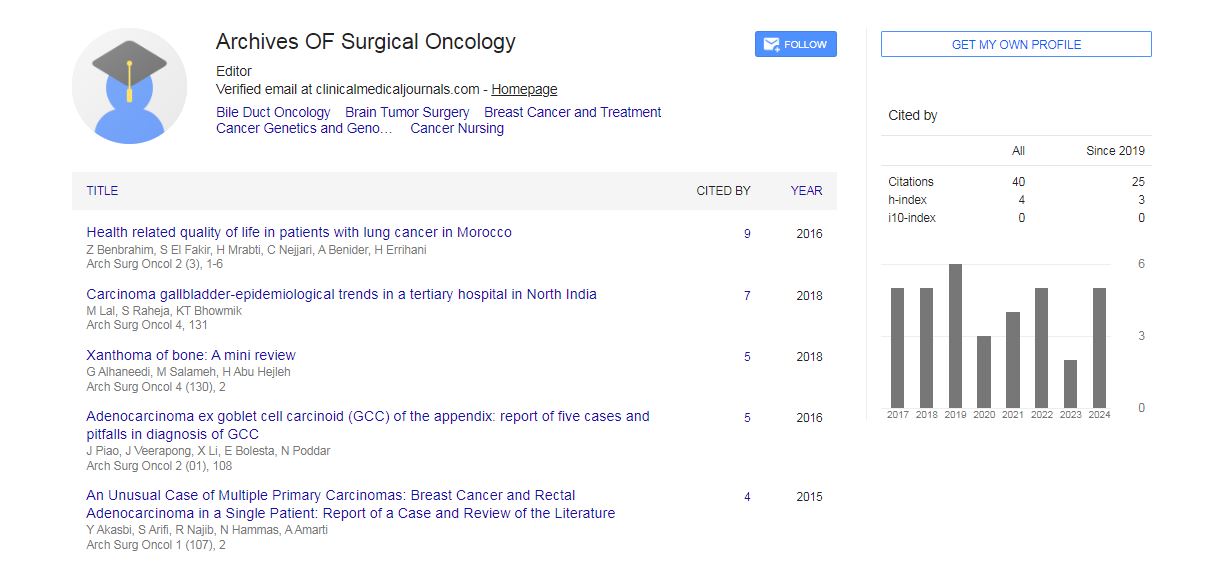
Archives of Surgical Oncology received 37 citations as per Google Scholar report