Perspective - (2025) Volume 11, Issue 6
Received: 02-Nov-2025, Manuscript No. aso-26-184663;
Editor assigned: 04-Nov-2025, Pre QC No. P-184663;
Reviewed: 18-Nov-2025, QC No. Q-184663;
Revised: 24-Nov-2025, Manuscript No. R-184663;
Published:
01-Dec-2025
, DOI: 10.37421/2471-2671.2025.11.202
Citation: Khan, Fatima. ”AI Enhances Cancer Surgery: Precision
and Outcomes.” Arch Surg Oncol 11 (2025):202.
Copyright: © 2025 Khan F. This is an open-access article distributed under the terms of the Creative Commons Attribution License, which permits unrestricted use, distribution
and reproduction in any medium, provided the original author and source are credited.
Artificial intelligence (AI) is significantly transforming image-guided technology within cancer surgery, leading to enhanced precision and improved patient outcomes. AI algorithms adeptly analyze various medical images, including CT, MRI, and intraoperative ultrasound, to furnish real-time guidance for surgical practitioners. This advanced capability aids in the precise identification of tumor margins and critical anatomical structures, as well as guiding instrument placement, thereby minimizing inadvertent damage to healthy tissue and bolstering the completeness of tumor resection. The seamless integration of AI with sophisticated navigation systems and robotic surgery platforms is ushering in an era of unprecedented surgical accuracy, which consequently leads to a reduction in complications and accelerates patient recovery times [1].
The application of intraoperative imaging, when synergistically combined with AI, is fundamentally reshaping the landscape of surgical precision. Advanced imaging modalities, augmented by AI-driven analysis, facilitate a more accurate delineation of cancerous tissue from surrounding healthy parenchyma during surgical procedures. This refined capability is absolutely critical for achieving negative margins, a principal determinant in preventing the recurrence of cancer. AI possesses the capacity to process extensive volumes of imaging data, identifying subtle features that might otherwise elude the human eye, thus serving to amplify the surgeon's decision-making process and enhance overall oncological control [2].
AI-powered image navigation systems are making substantial advancements in both surgical planning and the execution of complex procedures. These systems leverage pre-operative imaging data to construct detailed three-dimensional models of the patient's unique anatomy and the specific tumor. This allows surgeons to meticulously plan optimal surgical trajectories before entering the operating room. During the actual surgery, these meticulously crafted models are overlaid onto the live surgical field, providing surgeons with real-time, intuitive guidance. AI plays a pivotal role in refining the accuracy of this image registration process and in dynamically adapting the navigation system to accommodate real-time surgical changes, thereby ensuring that the originally planned surgical path is rigorously maintained, even in the presence of anatomical variations or tissue deformation [3].
Robotic surgery, particularly when it is integrated with AI and sophisticated advanced imaging techniques, offers dramatically enhanced dexterity and visualization capabilities for surgeons. AI algorithms are instrumental in assisting robotic systems by automatically identifying critical anatomical structures, predicting precise instrument trajectories, and even automating specific surgical tasks under the watchful supervision of the surgeon. This powerful synergy between AI, advanced imaging, and robotic platforms culminates in surgical procedures that are both more precise and minimally invasive. This approach contributes to reduced surgeon fatigue and, most importantly, improved patient safety. The inherent ability of AI to interpret complex imaging data in real-time further refines and amplifies the capabilities of these cutting-edge surgical platforms [4].
The overall impact of AI in the realm of surgery is profoundly significant, particularly concerning its role in reducing surgical errors and enhancing patient safety. By delivering highly precise guidance and real-time feedback derived from meticulous image analysis, AI-driven technologies effectively minimize the inherent risks associated with misidentifying critical structures or causing unintended tissue damage. This translates directly into fewer intraoperative complications, shorter hospital stays for patients, and ultimately, a superior recovery experience for cancer patients undergoing surgery. Furthermore, the inherent continuous learning capability of AI algorithms means that these sophisticated systems possess the ability to adapt and improve their performance over time, thereby further bolstering surgical safety protocols [5].
AI algorithms are currently undergoing extensive development with the specific aim of automatically segmenting tumors and crucial anatomical structures from both pre-operative and intra-operative imaging data. This automated segmentation process is absolutely vital for achieving accurate surgical planning and effective navigation. It enables surgeons to reliably differentiate between cancerous tissue that needs to be removed and the surrounding healthy organs that must be preserved. The remarkable speed and accuracy of AI-driven segmentation techniques demonstrably surpass those of traditional manual methods. This advancement leads to more efficient surgical workflows and a marked improvement in precision, particularly in the context of complex oncological resections where meticulous accuracy is paramount [6].
The future trajectory of cancer surgery is undeniably poised to be profoundly influenced by the increasingly sophisticated integration of AI with advanced image-guided technologies. AI's remarkable ability to learn from vast and diverse datasets of surgical procedures and associated imaging data holds the key to developing powerful predictive analytics for surgical outcomes. This capability also paves the way for highly personalized treatment strategies. Such advancements include the precise identification of patient cohorts who would benefit most from specific AI-assisted surgical techniques and the accurate prediction of potential intraoperative or postoperative complications. This proactive management allows for timely interventions and ultimately contributes to a significant improvement in the overall efficacy of cancer treatment regimens [7].
AI is actively enhancing the capabilities of intraoperative imaging within the context of cancer surgery by enabling sophisticated real-time analysis and interpretation of visual data. Emerging technologies, such as augmented reality (AR), which are increasingly powered by AI, have the remarkable ability to overlay critical information extracted from medical imaging directly onto the surgeon's visual field of view. This provides immediate and intuitive visual cues, guiding the surgeon regarding tumor margins, the precise location of vital structures, and the optimal positioning of surgical instruments. This capability significantly improves both the accuracy and the safety of surgical resections, especially in anatomically complex regions where precision is of utmost importance [8].
The ethical considerations that surround the implementation of AI in surgical oncology are of paramount importance and demand careful and thorough attention. While AI undeniably offers immense potential for substantially improving patient outcomes, critical issues such as data privacy, the potential for algorithmic bias, and the precise delineation of surgeon responsibility must be meticulously addressed. Ensuring equitable access to these advanced AI-driven technologies and fostering transparent development processes for AI algorithms are absolutely crucial steps for the responsible and beneficial implementation of AI in the challenging field of cancer surgery [9].
The successful development of robust and reliable AI models is fundamentally contingent upon access to extensive and high-quality datasets. For the specific application of image-guided cancer surgery, this necessitates the curation of comprehensive collections of both pre-operative and intra-operative images, meticulously paired with corresponding detailed surgical outcomes. Collaborative initiatives focused on data sharing and standardization are therefore essential for effectively training AI algorithms. The goal is to create AI systems that are not only accurate but also generalizable and reliable across diverse patient populations and varied surgical settings, ultimately driving significant advancements in the burgeoning field of AI within surgical oncology [10].
Artificial intelligence (AI) is revolutionizing image-guided technology in cancer surgery by enhancing precision and improving patient outcomes. AI algorithms analyze medical images like CT, MRI, and intraoperative ultrasound to provide real-time guidance. This includes identifying tumor margins, critical anatomical structures, and guiding instrument placement to minimize damage to healthy tissue and improve tumor resection completeness. Integrating AI with navigation and robotic surgery platforms achieves unprecedented accuracy, reducing complications and speeding recovery [1].
The application of intraoperative imaging combined with AI is transforming surgical precision. Advanced imaging modalities coupled with AI-driven analysis allow for more accurate delineation of cancerous tissue from healthy tissue during surgery. This is crucial for achieving negative margins, a key factor in preventing recurrence. AI processes vast imaging data, identifying subtle features missed by the human eye, augmenting surgeon decision-making and improving oncological control [2].
AI-powered image navigation systems are enhancing surgical planning and execution. These systems use pre-operative imaging to create detailed 3D models of anatomy and tumors, allowing surgeons to plan optimal trajectories. During operations, these models overlay onto the live surgical field, providing real-time guidance. AI improves the accuracy of image registration and dynamically adapts navigation to surgical changes, ensuring the planned path is maintained despite anatomical variations or tissue deformation [3].
Robotic surgery, when integrated with AI and advanced imaging, offers enhanced dexterity and visualization. AI algorithms assist robotic systems by automatically identifying critical structures, predicting instrument trajectories, and automating certain surgical tasks under supervision. This synergy leads to more precise, minimally invasive procedures, reducing surgeon fatigue and improving patient safety. AI's ability to interpret complex imaging data in real-time further refines these advanced surgical platforms [4].
The impact of AI on reducing surgical errors and improving patient safety is significant. By providing precise guidance and real-time feedback based on image analysis, AI-driven technologies minimize the risk of misidentifying structures or causing unintended damage. This leads to fewer intraoperative complications, shorter hospital stays, and better recovery for cancer patients. The continuous learning capability of AI algorithms allows these systems to adapt and improve over time, further enhancing surgical safety [5].
AI algorithms are being developed to automatically segment tumors and critical anatomical structures from pre-operative and intra-operative images. This segmentation is vital for accurate surgical planning and navigation, enabling surgeons to differentiate cancerous tissue from surrounding healthy organs. The speed and accuracy of AI-driven segmentation surpass manual methods, leading to more efficient surgical workflows and improved precision in complex oncological resections [6].
The future of cancer surgery will be heavily influenced by the integration of AI with image-guided technologies. AI's ability to learn from vast datasets of surgical procedures and imaging can lead to predictive analytics for surgical outcomes and personalized treatment strategies. This includes identifying patients who would benefit most from AI-assisted techniques and predicting potential complications, allowing for proactive management and improving the overall efficacy of cancer treatment [7].
AI is enhancing the capabilities of intraoperative imaging in cancer surgery by enabling real-time analysis and interpretation. Technologies like augmented reality, powered by AI, can overlay critical information from imaging directly onto the surgeon's field of view. This provides immediate visual cues for tumor margins, vital structures, and instrument positioning, significantly improving the accuracy and safety of resections, particularly in complex anatomical regions [8].
Ethical considerations surrounding AI in surgical oncology are paramount. While AI offers immense potential for improved outcomes, issues of data privacy, algorithmic bias, and surgeon responsibility need careful attention. Ensuring equitable access to these advanced technologies and transparent development of AI algorithms are crucial for responsible implementation in cancer surgery [9].
The development of robust AI models requires extensive and high-quality datasets. For image-guided cancer surgery, this means curated collections of pre-operative and intra-operative images, along with corresponding surgical outcomes. Collaborative efforts in data sharing and standardization are essential for training AI algorithms that are generalizable and reliable across different patient populations and surgical settings, ultimately advancing the field of AI in surgical oncology [10].
Artificial intelligence (AI) is revolutionizing cancer surgery through enhanced image guidance, offering greater precision and improved patient outcomes. AI algorithms analyze medical images for real-time surgical guidance, aiding in tumor margin identification and critical structure navigation. This integration with navigation and robotic systems leads to higher accuracy, fewer complications, and faster recovery. AI-driven analysis of intraoperative imaging precisely delineates cancerous tissue, crucial for achieving negative margins and preventing recurrence. AI-powered navigation systems create 3D anatomical models for surgical planning and provide real-time guidance during procedures. Robotic surgery, enhanced by AI, offers improved dexterity and visualization, leading to more precise and minimally invasive interventions. AI significantly reduces surgical errors and improves patient safety by providing precise guidance and minimizing the risk of damage to healthy tissue. Automated segmentation of tumors and critical structures by AI algorithms streamlines surgical workflows and enhances precision. The future of cancer surgery involves further AI integration for predictive analytics and personalized treatment. Emerging technologies like AI-powered augmented reality overlay critical imaging information onto the surgeon's view, boosting accuracy and safety. Ethical considerations, including data privacy and bias, are vital for responsible AI implementation. The development of robust AI models relies on high-quality, shared datasets for effective training and generalization.
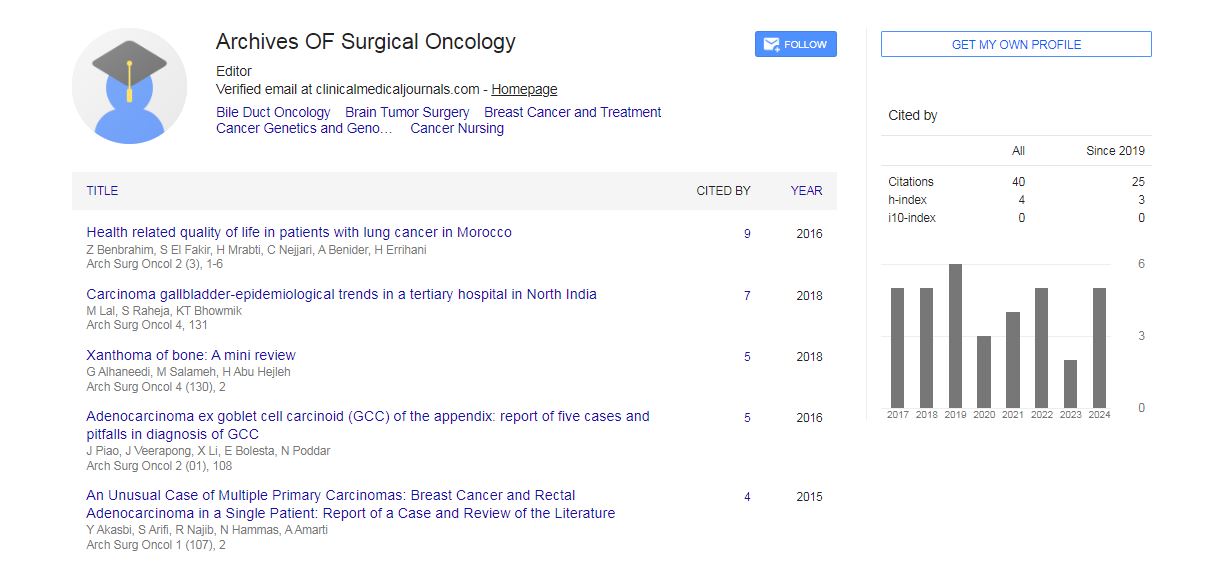
Archives of Surgical Oncology received 37 citations as per Google Scholar report