Opinion - (2025) Volume 11, Issue 6
Received: 02-Nov-2025, Manuscript No. aso-26-184664;
Editor assigned: 04-Nov-2025, Pre QC No. P-184664;
Reviewed: 18-Nov-2025, QC No. Q-184664;
Revised: 24-Nov-2025, Manuscript No. R-184664;
Published:
01-Dec-2025
, DOI: 10.37421/2471-2671.2025.11.201
Citation: Muller, Ingrid. ”Precision Surgery: Tailored Oncology
For Better Outcomes.” Arch Surg Oncol 11 (2025):201.
Copyright: © 2025 Muller I. This is an open-access article distributed under the terms of the Creative Commons Attribution License, which permits unrestricted use, distribution
and reproduction in any medium, provided the original author and source are credited.
The integration of precision and personalized approaches in surgical oncology is profoundly reshaping patient care by tailoring treatments to individual tumor characteristics and patient profiles. This paradigm shift moves beyond traditional, one-size-fits-all methodologies, emphasizing molecular profiling, advanced imaging, and minimally invasive techniques to optimize surgical outcomes and mitigate treatment toxicity [1].
Robotic surgery has emerged as a central component in precision oncology, offering enhanced dexterity, magnified three-dimensional visualization, and improved ergonomics for intricate oncologic procedures. This technological advancement leads to smaller incisions, reduced blood loss, shorter hospital stays, and potentially superior functional outcomes compared to traditional open or laparoscopic approaches [2].
The influence of artificial intelligence (AI) and machine learning (ML) in advancing surgical oncology is substantial. These algorithms can process vast datasets, including imaging, pathology, and genomic information, to assist in preoperative planning, intraoperative guidance, and postoperative prognostication, thereby improving diagnostic accuracy and surgical planning for personalized treatment decisions [3].
Molecular profiling of tumors serves as a cornerstone of personalized surgical oncology. By analyzing the specific genetic and molecular alterations within a patient's tumor, oncologists gain critical insights into tumor behavior, metastatic potential, and responsiveness to targeted therapies, which is vital for guiding surgical decisions and overall treatment strategy [4].
Minimally invasive surgical techniques, such as laparoscopy and endoscopy, are fundamental to personalized surgical oncology, offering significant advantages over open surgery. These benefits include reduced postoperative pain, faster recovery times, and improved cosmetic results, allowing for precise tumor removal while preserving surrounding healthy tissues [5].
The role of advanced imaging modalities, including MRI, CT, and PET scans, is critical in precision surgical oncology. These technologies facilitate the precise localization of tumors, assessment of their extent, and evaluation of treatment response, directly informing surgical planning and execution for more accurate margin assessment [6].
The strategic integration of neoadjuvant therapy, often informed by molecular profiling, is increasingly central to personalized surgical oncology. Preoperative systemic treatments can shrink tumors, rendering them more amenable to complete surgical resection, and can also provide valuable insights into tumor responsiveness to therapy, allowing for tailored operative strategies [7].
Intraoperative technologies are indispensable for enhancing surgical precision in oncology. Advanced navigation systems, fluorescence-guided surgery, and real-time imaging provide surgeons with superior visualization and anatomical guidance, enabling more accurate identification of tumor margins and critical structures during procedures for highly personalized surgical intervention [8].
Patient-reported outcomes (PROs) and quality of life (QoL) are gaining prominence in personalized surgical oncology. Beyond achieving oncologic control, the focus extends to maintaining or improving a patient's overall well-being and functional status, guiding treatment decisions and follow-up care to align with individual needs and priorities [9].
The continuous evolution of surgical oncology is characterized by the ongoing integration of precision and personalized approaches. This journey leverages technological advancements, molecular insights, and a deep understanding of individual patient needs to deliver effective and less burdensome care, aiming to improve survival rates, reduce toxicity, and enhance the overall quality of life for cancer patients [10].
The integration of precision and personalized approaches in surgical oncology is fundamentally transforming patient care by precisely tailoring treatments to the unique characteristics of individual tumors and patient profiles. This evolution represents a significant departure from historical one-size-fits-all methodologies, placing a strong emphasis on molecular profiling, the utilization of advanced imaging technologies, and the application of minimally invasive surgical techniques to optimize surgical outcomes and minimize treatment-related toxicity [1].
Robotic surgery has become an increasingly central modality within precision oncology, providing surgeons with enhanced dexterity, magnified three-dimensional visualization capabilities, and improved ergonomic conditions that are particularly advantageous for complex oncologic procedures. The clinical benefits of this technology include the facilitation of smaller incisions, a reduction in blood loss during surgery, shorter hospital stays for patients, and the potential for improved functional outcomes when contrasted with traditional open or laparoscopic surgical methods [2].
The significant role of artificial intelligence (AI) and machine learning (ML) in advancing the field of surgical oncology cannot be overstated. These sophisticated algorithms possess the capacity to analyze extensive datasets, encompassing imaging findings, pathological reports, and genomic information, thereby providing crucial assistance in preoperative planning, intraoperative guidance, and the prognostication of postoperative outcomes, ultimately leading to enhanced diagnostic accuracy and more effective surgical planning for personalized treatment strategies [3].
Molecular profiling of tumors stands as a foundational element in the practice of personalized surgical oncology. Through the detailed analysis of specific genetic and molecular alterations present within a patient's tumor, oncologists can acquire critical insights into the tumor's biological behavior, its propensity for metastasis, and its likely responsiveness to particular therapeutic interventions, all of which are vital for informing surgical decisions and shaping the comprehensive treatment plan [4].
Minimally invasive surgical techniques, encompassing approaches such as laparoscopy and endoscopy, are indispensable components of personalized surgical oncology. These techniques offer distinct advantages over conventional open surgery, including diminished postoperative pain, accelerated recovery periods for patients, and improved cosmetic results, all while enabling precise tumor removal and the preservation of surrounding healthy tissues and critical anatomical structures [5].
The integration of advanced imaging modalities, including magnetic resonance imaging (MRI), computed tomography (CT), and positron emission tomography (PET) scans, plays a crucial role in the precise execution of surgical oncology. These technologies are instrumental in enabling the accurate localization of tumors, the thorough assessment of their extent, and the effective evaluation of treatment response, thereby directly influencing surgical planning and operative procedures to achieve more accurate margin assessments [6].
The concept of neoadjuvant therapy, frequently guided by detailed molecular profiling data, is becoming increasingly integrated into the framework of personalized surgical oncology. The administration of systemic treatments, such as chemotherapy, targeted therapies, or immunotherapies, prior to surgical intervention can lead to tumor shrinkage, making them more amenable to complete surgical resection, and can also provide crucial information regarding the tumor's response to treatment, allowing for operative strategy adjustments [7].
Intraoperative technologies are paramount for enhancing the precision of surgical interventions in oncology. This category includes advanced navigation systems, fluorescence-guided surgery, and real-time imaging platforms that provide surgeons with augmented visualization and critical anatomical guidance throughout operative procedures. This real-time feedback is essential for achieving surgical goals while minimizing patient morbidity, thus contributing to a highly personalized surgical approach [8].
Patient-reported outcomes (PROs) and the assessment of quality of life (QoL) are increasingly recognized as vital considerations within personalized surgical oncology. Beyond the primary objective of achieving oncologic control, a significant aim is to maintain or enhance the patient's overall well-being and functional capacity. The utilization of PROs allows for the monitoring of recovery, the identification of potential complications, and the evaluation of the long-term effects of surgical interventions, ensuring that the surgical approach aligns with the patient's broader health objectives [9].
The continued evolution of surgical oncology is marked by the persistent integration of precision and personalized strategies. This ongoing journey involves the strategic harnessing of technological advancements, the application of molecular insights, and a more profound understanding of individual patient needs to deliver care that is both maximally effective and minimally burdensome. The future trajectory points towards a landscape enhanced by AI-driven decision support, sophisticated robotic platforms, and the use of liquid biopsies to further refine surgical planning and execution, ultimately aiming to improve survival rates, reduce treatment-related toxicity, and elevate the overall quality of life for cancer patients through truly personalized surgical practice [10].
Precision and personalized approaches are revolutionizing surgical oncology by tailoring treatments to individual tumor and patient profiles, moving beyond generalized methods. This involves utilizing molecular profiling, advanced imaging, and minimally invasive techniques to enhance surgical outcomes and reduce toxicity. Key advancements include AI-driven image analysis for improved tumor detection and margin assessment, robotic surgery for greater dexterity and precision, and minimally invasive techniques leading to faster recovery. Molecular profiling guides the selection of targeted therapies and influences surgical decisions regarding resection extent and adjuvant treatments. Advanced imaging aids in precise tumor localization and assessment of treatment response. Neoadjuvant therapy, guided by molecular data, can shrink tumors pre-surgery and assess treatment responsiveness. Intraoperative technologies provide real-time guidance for accurate tumor removal and preservation of healthy tissue. Finally, patient-reported outcomes and quality of life are increasingly integrated to ensure surgical goals align with the patient's overall well-being and functional status. Continuous innovation in these areas aims to improve survival, minimize side effects, and enhance patient quality of life.
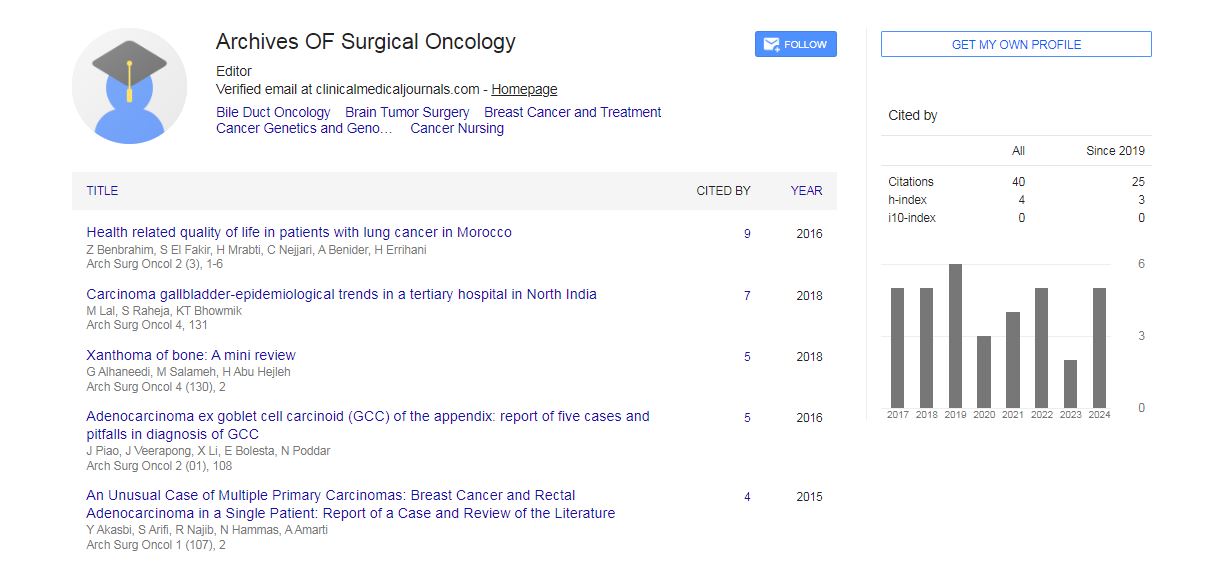
Archives of Surgical Oncology received 37 citations as per Google Scholar report