Perspective - (2025) Volume 11, Issue 6
Received: 02-Nov-2025, Manuscript No. aso-25-184662;
Editor assigned: 04-Nov-2025, Pre QC No. P-184662;
Reviewed: 18-Nov-2025, QC No. Q-184662;
Revised: 24-Nov-2025, Manuscript No. R-184662;
Published:
01-Dec-2025
, DOI: 10.37421/2471-2671.2025.11.203
Citation: Ivanov, Sergei. ”Surgical Oncology: Advanced Tech For
Personalized Cancer Care.” Arch Surg Oncol 11 (2025):203.
Copyright: © 2025 Ivanov S. This is an open-access article distributed under the terms of the Creative Commons Attribution License, which permits unrestricted use, distribution
and reproduction in any medium, provided the original author and source are credited.
The field of surgical oncology is undergoing a profound transformation, driven by the relentless pursuit of enhanced patient outcomes and the integration of cutting-edge technologies. This evolution is characterized by a paradigm shift towards more precise, personalized, and less invasive treatment strategies. The future landscape promises a harmonious blend of technological innovation and a deeper biological understanding of cancer, aiming to redefine the standards of care for oncological patients. This forward momentum is crucial for addressing the complexities of cancer and improving the quality of life for those affected.
The advent of robotic surgery has revolutionized the way complex oncological procedures are performed. This technology offers surgeons unparalleled dexterity, enhanced visualization capabilities, and superior precision, leading to less invasive operations and quicker recovery times. Its adoption is a testament to the ongoing drive to minimize patient morbidity while maximizing the effectiveness of surgical interventions in cancer treatment. Furthermore, the integration of artificial intelligence (AI) and machine learning (ML) is heralding a new era in surgical oncology. These powerful computational tools possess the capability to analyze vast and intricate datasets, including imaging and genomic information, thereby assisting in early and accurate diagnosis, predicting individual treatment responses, and optimizing surgical planning. This promises a more tailored and effective approach to cancer management. Precision medicine represents a cornerstone of this evolving field, focusing on tailoring therapeutic interventions to the unique molecular and genetic makeup of an individual's tumor. This approach leverages advancements in molecular diagnostics and the development of targeted therapies, which are increasingly integrated with surgical procedures to achieve superior outcomes and reduce unintended side effects. The integration of augmented reality (AR) and virtual reality (VR) technologies is also significantly enhancing surgical oncology. These immersive tools are proving invaluable in surgical planning, providing real-time intraoperative guidance, and revolutionizing surgical education. By offering surgeons enhanced visualization of patient anatomy and pathology, they contribute to improved precision and safety during intricate surgical procedures. In parallel, liquid biopsies are emerging as a remarkably potent tool in the realm of surgical oncology. These non-invasive techniques enable the early detection and continuous monitoring of cancer, offering a dynamic approach to patient care. Their seamless integration with surgical management facilitates earlier diagnosis, more accurate assessment of treatment response, and timely detection of recurrence. The role of advanced imaging modalities in surgical oncology continues to expand with remarkable speed. Techniques such as fluorescence-guided surgery and intraoperative magnetic resonance imaging (MRI) and computed tomography (CT) are providing surgeons with real-time anatomical and functional information. This enhanced visualization directly contributes to improving the accuracy of tumor resection margins and reducing the incidence of reoperations. Understanding the intricate dynamics of the tumor microenvironment (TME) is providing critical insights into cancer progression and its response to therapy. Research into the complex interplay of cellular components, signaling molecules, and the extracellular matrix within the TME is foundational for developing novel therapeutic strategies. These insights are increasingly being incorporated into comprehensive treatment plans that include surgical interventions. Nanotechnology presents a frontier of exciting possibilities for targeted drug delivery and advanced diagnostics within surgical oncology. Nanoparticles can be meticulously engineered to deliver therapeutic agents directly to tumor sites, thereby significantly minimizing systemic toxicity and enhancing treatment efficacy. This innovative approach complements the surgical removal of the primary tumor, offering a synergistic therapeutic effect. Finally, the development of sophisticated surgical simulation and advanced training platforms is paramount for equipping the next generation of surgeons with the requisite skills for performing complex oncological procedures. These platforms, often incorporating VR/AR and AI, provide a safe and realistic environment for practicing and refining surgical techniques, ultimately contributing to improved patient safety and surgical outcomes.The landscape of surgical oncology is being reshaped by a confluence of technological advancements and a deeper understanding of cancer biology, aiming for more effective and patient-centric care. Key developments include the widespread adoption of minimally invasive techniques, such as robotic surgery, which offers enhanced precision and reduced patient trauma. Alongside this, sophisticated imaging technologies are providing surgeons with unprecedented real-time visualization, aiding in more accurate tumor localization and resection.
Robotic surgery has firmly established itself as a critical component in numerous oncological procedures, providing surgeons with superior dexterity, magnified 3D visualization, and the ability to perform complex dissections with enhanced precision. This technological leap not only improves surgical outcomes by enabling less invasive approaches but also plays a vital role in surgeon training and the exploration of novel surgical methodologies. The integration of artificial intelligence (AI) and machine learning (ML) is profoundly transforming surgical oncology by enabling the analysis of massive datasets, including medical imaging and genomic information. These algorithms are instrumental in facilitating earlier diagnoses, predicting treatment effectiveness, and optimizing the planning of surgical interventions, thereby paving the way for more personalized cancer management. Precision medicine in surgical oncology is characterized by its focus on tailoring treatments to the specific molecular and genetic profiles of a patient's tumor. This involves significant progress in molecular diagnostics and the development of targeted therapies that can be synergistically combined with surgical procedures to achieve optimal outcomes and minimize collateral damage to healthy tissues. The application of augmented reality (AR) and virtual reality (VR) in surgical oncology is significantly enhancing the planning, execution, and educational aspects of cancer surgery. These technologies provide surgeons with a more comprehensive and immersive understanding of patient anatomy and pathology, leading to improved precision and a higher degree of safety during complex operative procedures. Liquid biopsies are emerging as a highly promising tool in surgical oncology, offering a non-invasive method for cancer detection and ongoing monitoring. Their incorporation into surgical management strategies can lead to earlier diagnosis, more accurate assessment of treatment response, and the prompt identification of any recurrence, contributing to a more adaptive and personalized care plan. Advanced imaging techniques are playing an increasingly vital role in surgical oncology, providing critical intraoperative information. Modalities such as fluorescence-guided surgery and real-time intraoperative MRI/CT scans offer unparalleled anatomical and functional insights, which are crucial for achieving complete tumor resection and reducing the need for subsequent surgeries. Research into the tumor microenvironment (TME) is yielding crucial insights into the mechanisms driving cancer progression and influencing treatment efficacy. A thorough understanding of the complex interactions between various cellular components, signaling molecules, and the extracellular matrix within the TME is indispensable for the development of innovative therapeutic strategies that can be effectively integrated with surgical interventions. Nanotechnology holds significant promise for advancing surgical oncology through targeted drug delivery systems and sophisticated diagnostic tools. Nanoparticles can be designed to precisely deliver therapeutic agents directly to tumor sites, thereby minimizing systemic toxicity and enhancing the overall effectiveness of treatment, complementing the surgical removal of cancerous tissue. Finally, the development and utilization of advanced surgical simulation and comprehensive training platforms are essential for preparing surgeons to handle the complexities of modern oncological procedures. These cutting-edge tools, frequently enhanced by VR/AR and AI, enable realistic practice and skill refinement in a controlled environment, ultimately fostering improved patient safety and superior surgical outcomes.The field of surgical oncology is rapidly evolving, integrating advanced technologies like robotic surgery, AI, and precision medicine to personalize cancer care. Minimally invasive techniques and enhanced imaging are improving surgical outcomes, while AI aids in diagnosis and treatment planning. Precision medicine tailors treatments to individual tumor profiles. Emerging tools such as liquid biopsies and nanotechnology offer new avenues for early detection, targeted therapy, and monitoring. Augmented and virtual reality are enhancing surgical training and intraoperative guidance. Understanding the tumor microenvironment is also crucial for developing novel therapeutic strategies. The overall aim is to improve patient outcomes, reduce morbidity, and enhance the quality of cancer care.
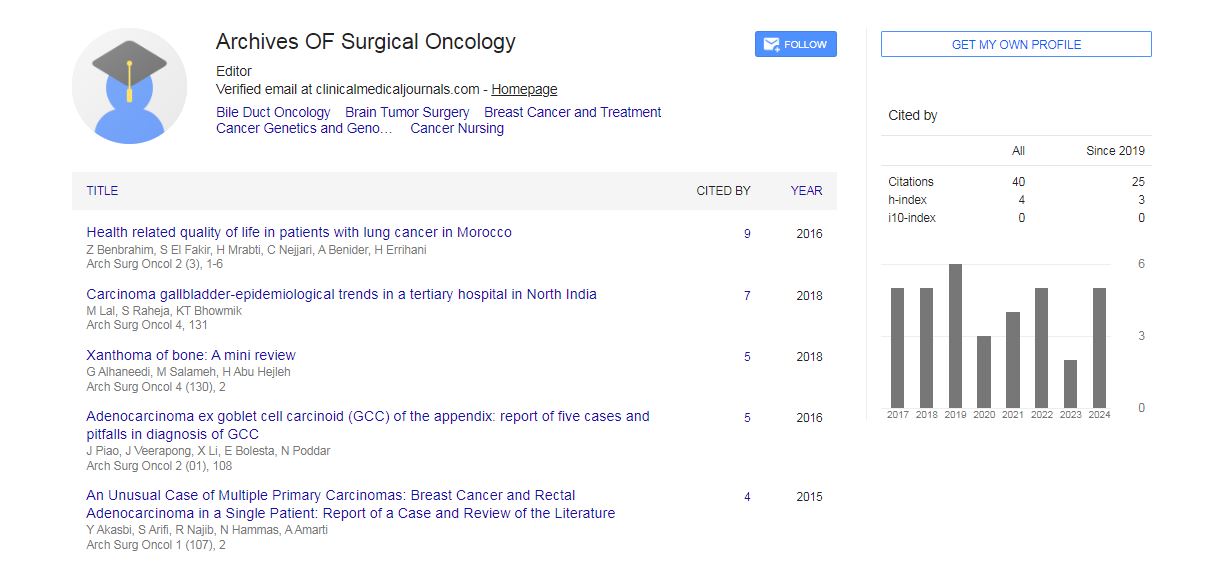
Archives of Surgical Oncology received 37 citations as per Google Scholar report