Short Communication - (2025) Volume 11, Issue 6
Received: 02-Nov-2025, Manuscript No. aso-25-184661;
Editor assigned: 04-Nov-2025, Pre QC No. P-184661;
Reviewed: 18-Nov-2025, QC No. Q-184661;
Revised: 24-Nov-2025, Manuscript No. R-184661;
Published:
01-Dec-2025
, DOI: 10.37421/2471-2671.2025.11.204
Citation: Watson, Emily. ”Innovations And Future Of Surgical
Oncology.” Arch Surg Oncol 11 (2025):204.
Copyright: © 2025 Watson E. This is an open-access article distributed under the terms of the Creative Commons Attribution License, which permits unrestricted use,
distribution and reproduction in any medium, provided the original author and source are credited.
The field of surgical oncology is undergoing a transformative period, marked by significant advancements in both therapeutic strategies and technological integration. Recent breakthroughs are focusing on optimizing patient outcomes through minimally invasive approaches, enhancing surgical precision, and personalizing treatment plans. Robotic surgery, for instance, continues to expand its role in complex oncologic resections, offering surgeons unparalleled dexterity and visualization, which translates to reduced invasiveness and improved patient recovery [1].
Complementing these surgical innovations, the paradigm of precision medicine is increasingly influencing surgical oncology. This involves tailoring treatments to the individual patient's genetic makeup and tumor characteristics, with targeted therapies and immunotherapies playing a pivotal role. The integration of these molecularly guided treatments into surgical protocols aims to enhance response rates and improve long-term survival, representing a fundamental shift in cancer care [2].
Minimally invasive techniques, beyond the realm of robotics, such as laparoscopic and endoscopic surgery, are also experiencing continuous evolution. These approaches are being refined and their applications expanded across a broader spectrum of cancers, with a consistent emphasis on maintaining oncologic control while prioritizing patient recovery and minimizing morbidity [3].
Furthermore, the implementation of Enhanced Recovery After Surgery (ERAS) protocols is becoming a cornerstone in optimizing patient management in oncologic surgery. These multidisciplinary pathways are designed to streamline postoperative care, reduce complications, shorten hospital stays, and improve patient satisfaction, thereby contributing significantly to a more efficient and patient-centered recovery process [4].
The burgeoning field of artificial intelligence (AI) is poised to revolutionize surgical oncology by enhancing diagnostic accuracy, refining surgical planning, and predicting patient responses to treatment. Current AI applications are being explored, with significant future opportunities for AI-driven decision-making to further optimize surgical interventions and patient outcomes [5].
In parallel with technological advancements, liquid biopsies are emerging as powerful, non-invasive tools in surgical oncology. These advancements offer new avenues for early cancer detection, real-time monitoring of treatment response, and the timely identification of recurrence, fundamentally changing how cancer management is approached [6].
The fundamental understanding of cancer biology, particularly the tumor microenvironment (TME), is providing critical insights that are directly influencing the development of novel therapeutic strategies. By targeting stromal components and immune cells within the TME, researchers aim to enhance the efficacy of surgical interventions and overcome treatment resistance [7].
Beyond the immediate surgical procedure, the strategic use of neoadjuvant and adjuvant therapies is being continually refined. The integration of systemic therapies before or after surgery aims to improve resectability, minimize the risk of recurrence, and ultimately enhance the overall survival rates for cancer patients, reflecting a comprehensive approach to cancer management [8].
Looking towards the future, the trajectory of surgical oncology is clearly defined by the continued integration of advanced technologies and increasingly personalized treatment approaches. Emerging trends such as intraoperative imaging, sophisticated robotics, and tailored neoadjuvant strategies hold the potential to profoundly transform cancer care delivery [9].
In summary, the landscape of surgical oncology is characterized by a dynamic interplay of technological innovation, biological understanding, and personalized medicine. The collective advancements in minimally invasive surgery, precision oncology, AI, and supportive care pathways are collectively driving towards improved patient outcomes and a more effective, patient-centric approach to cancer treatment [10].
Surgical oncology is witnessing a paradigm shift driven by innovation in surgical techniques and adjunctive therapies. The integration of minimally invasive procedures, notably robotic surgery, is enhancing surgical precision and reducing patient morbidity. These advanced techniques offer improved visualization and dexterity for surgeons, leading to benefits such as decreased blood loss, shorter hospital stays, and faster recovery periods for patients undergoing complex cancer surgeries [1].
Precision medicine represents another significant frontier, with targeted therapies and immunotherapies becoming increasingly integral to surgical treatment plans. This approach tailors interventions based on individual patient and tumor molecular profiles, aiming to improve treatment efficacy and long-term survival outcomes. The synergistic application of these modalities with surgical interventions is a key area of development [2].
Minimally invasive surgery encompasses a range of techniques, including laparoscopic and endoscopic approaches, which continue to be refined. These methods are expanding their application in the surgical management of various cancers, with a focus on achieving optimal oncologic control while minimizing the impact on patient recovery and quality of life [3].
Enhanced Recovery After Surgery (ERAS) pathways are fundamental to optimizing the perioperative care of oncologic patients. These protocols are designed to reduce postoperative complications, manage pain effectively, shorten the duration of hospital stays, and improve overall patient satisfaction, thereby contributing to a more streamlined and effective recovery process [4].
The advent of artificial intelligence (AI) is introducing novel capabilities in surgical oncology. AI tools are being developed to improve diagnostic accuracy, assist in intricate surgical planning, and predict patient responses to various treatments, promising to enhance decision-making and optimize surgical outcomes [5].
Liquid biopsies are emerging as a transformative technology, providing non-invasive means for early cancer detection, monitoring treatment efficacy, and identifying potential recurrence. These advancements are crucial for timely intervention and personalized cancer management strategies in surgical oncology [6].
Understanding the tumor microenvironment (TME) is providing critical insights into cancer progression and therapeutic response. Research into the TME is paving the way for innovative strategies that target stromal and immune components, aiming to augment the effectiveness of surgical interventions and overcome therapeutic resistance [7].
The judicious application of neoadjuvant and adjuvant therapies is crucial for maximizing the success of surgical oncology. These systemic treatments, administered before or after surgery, are designed to enhance tumor resectability, reduce the likelihood of recurrence, and improve overall survival rates in patients with cancer [8].
Future directions in surgical oncology are increasingly focused on the synergy between advanced technologies and personalized treatment paradigms. Innovations such as intraoperative imaging, next-generation robotics, and individualized neoadjuvant strategies are expected to revolutionize cancer care and surgical practice [9].
In conclusion, the evolution of surgical oncology is characterized by a multifaceted approach that integrates surgical expertise with advances in precision medicine, technological innovation, and comprehensive patient care pathways. These developments collectively aim to improve patient outcomes and redefine the standard of care in cancer treatment [10].
Surgical oncology is rapidly advancing with innovations in minimally invasive techniques like robotic surgery and enhanced recovery protocols. Precision medicine, including targeted therapies and immunotherapies, is being integrated into treatment paradigms. Future directions involve further personalization of treatment through artificial intelligence for surgical planning and outcome prediction, alongside novel approaches to manage treatment resistance. Liquid biopsies offer non-invasive cancer detection and monitoring. Understanding the tumor microenvironment is leading to new therapeutic strategies. The strategic use of neoadjuvant and adjuvant therapies is crucial for optimizing surgical outcomes. Emerging trends in intraoperative imaging and advanced robotics are set to revolutionize cancer care.
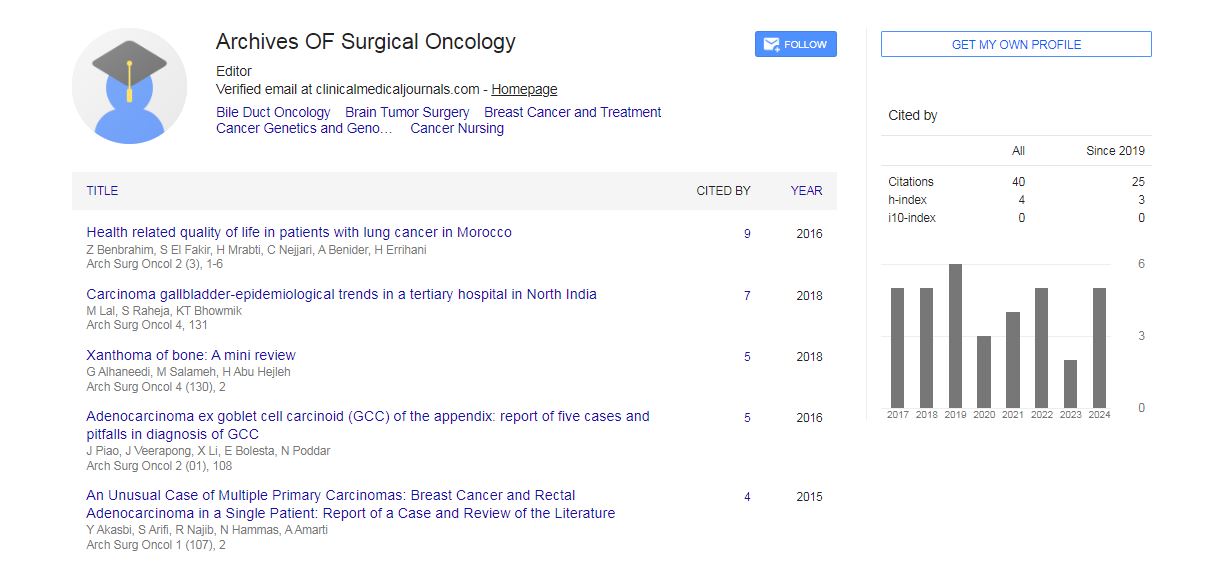
Archives of Surgical Oncology received 37 citations as per Google Scholar report