Commentary - (2025) Volume 11, Issue 6
Received: 02-Nov-2025, Manuscript No. aso-25-184666;
Editor assigned: 04-Nov-2025, Pre QC No. P-184666;
Reviewed: 18-Nov-2025, QC No. Q-184666;
Revised: 24-Nov-2025, Manuscript No. R-184666;
Published:
01-Dec-2025
, DOI: 10.37421/2471-2671.2025.11.199
Citation: Al-Farsi, Amina. ”Optimizing Cancer Surgery: A Multidisciplinary
Approach.” Arch Surg Oncol 11 (2025):199.
Copyright: © 2025 Al-Farsi A. This is an open-access article distributed under the terms of the Creative Commons Attribution License, which permits unrestricted use,
distribution and reproduction in any medium, provided the original author and source are credited.
The landscape of oncologic surgery is continually being reshaped by advancements in surgical techniques, perioperative management, and an increasing understanding of patient-specific factors, all of which exert a profound influence on long-term outcomes after cancer resections [1].
Minimally invasive surgical approaches, including laparoscopic and robotic techniques, are becoming more prevalent and are associated with improved short-term recovery and a reduction in postoperative complications across a spectrum of cancer surgeries [2].
The neoadjuvant treatment paradigm, which involves administering therapies such as chemotherapy, radiation, or immunotherapy prior to surgical intervention, is significantly transforming the management and outcomes for numerous solid tumors by facilitating tumor downstaging and addressing micrometastatic disease [3].
Intraoperative imaging technologies, exemplified by fluorescence imaging using indocyanine green (ICG), are progressively being integrated into surgical practice to enhance precision by aiding in the identification of tumor margins, assessment of lymph node status, and evaluation of vascular perfusion, thereby improving oncologic control [4].
Beyond surgical and therapeutic interventions, patient-specific factors such as age, comorbidities, nutritional status, and overall performance status play a substantial role in determining the success and tolerability of cancer surgery and subsequent adjuvant therapies, thereby impacting oncologic outcomes [5].
The tumor microenvironment (TME), a complex interplay of cellular and molecular components, is increasingly recognized for its profound influence on cancer progression and response to treatment, with surgical resection aiming to remove the primary tumor while acknowledging the TME's predictive role in recurrence and metastasis [6].
Adjuvant therapies, encompassing chemotherapy, radiation, and targeted treatments, remain an integral component of optimizing oncologic outcomes post-resection for many cancers, with their selection guided by prognostic indicators and molecular markers to eradicate residual disease and mitigate recurrence risk [7].
Evidence consistently links the expertise of the surgical team and the high-volume nature of cancer centers to superior oncologic outcomes, with institutions and surgeons performing a greater number of specific cancer surgeries often exhibiting lower complication rates and improved survival [8].
Molecular profiling of tumors is emerging as a critical tool in predicting treatment response and informing surgical and adjuvant strategies, enabling personalized medicine approaches by identifying specific genetic mutations and biomarkers to tailor therapy for maximal efficacy and minimal toxicity [9].
Furthermore, the integration of immunotherapy into the perioperative setting, whether neoadjuvant or adjuvant, represents a rapidly evolving strategy aimed at stimulating the immune system to enhance cancer cell recognition and elimination, potentially leading to improved complete response rates and reduced recurrence [10].
Surgical technique, perioperative management, and patient-specific factors collectively play a critical role in shaping oncologic outcomes following cancer surgery. Enhancements in surgical precision, driven by innovations like minimally invasive techniques and advanced intraoperative imaging, are pivotal in improving local tumor control and minimizing recurrence rates [1].
Minimally invasive surgical modalities, such as laparoscopic and robotic approaches, are increasingly associated with benefits such as accelerated short-term recovery and reduced complications in diverse cancer surgeries. Nevertheless, a rigorous evaluation of their long-term oncologic efficacy, including recurrence rates and overall survival, is essential to confirm equivalence or superiority compared to traditional open surgical methods, with surgeon experience and judicious patient selection being paramount [2].
The neoadjuvant treatment paradigm, which incorporates chemotherapy, radiation therapy, or immunotherapy prior to surgical intervention, is revolutionizing outcomes for a variety of solid tumors. This strategy can facilitate tumor downstaging, enabling more complete surgical resection, and may also provide an early means to address micrometastatic disease. However, it necessitates meticulous patient selection and comprehensive multidisciplinary planning to optimize treatment response and effectively manage potential treatment-related toxicities that could compromise surgical feasibility or recovery [3].
Intraoperative imaging technologies, including fluorescence imaging with indocyanine green (ICG), are progressively being incorporated to augment surgical precision. These tools assist in delineating tumor margins, evaluating lymph node involvement, and assessing vascular perfusion, all of which are crucial for achieving complete tumor extirpation and preventing local recurrence. Their seamless integration into surgical workflows holds the promise of improving oncologic control and potentially reducing the incidence of reoperation [4].
Patient-specific factors, encompassing age, the presence of comorbidities, nutritional status, and overall performance status, significantly influence oncologic outcomes post-cancer surgery. Elderly patients or those with substantial comorbidities may exhibit poorer tolerance to extensive surgical procedures and adjuvant therapies, which can affect their capacity to achieve optimal oncologic results. Consequently, a thorough pre-operative assessment and optimization are indispensable for maximizing the therapeutic benefits of surgical intervention [5].
The tumor microenvironment (TME) constitutes a complex ecosystem of cells, molecules, and extracellular matrix that profoundly impacts cancer progression and the response to therapeutic interventions. While surgical resection aims to eradicate the primary tumor, the inherent characteristics of the TME can serve as predictors of recurrence and metastasis. Current research is increasingly focused on understanding how surgical manipulation influences the TME and exploring strategies to target specific TME components to enhance oncologic outcomes [6].
Adjuvant therapies, including chemotherapy, radiation therapy, and targeted therapies, are fundamental to optimizing oncologic outcomes after surgical resection for a wide range of cancers. The decision-making process for employing adjuvant treatment is informed by prognostic factors, tumor stage, and molecular markers, with the overarching goal of eliminating residual disease and diminishing the risk of recurrence. The strategic sequencing and combination of surgical interventions with adjuvant treatments are critical determinants for maximizing patient benefit [7].
The expertise resident within surgical teams and the high-volume nature of specialized cancer centers are consistently correlated with improved oncologic outcomes. Surgeons and institutions that perform a higher volume of specific cancer surgeries typically demonstrate lower rates of complications, enhanced local control, and superior survival rates. This concentration of specialized knowledge and resources facilitates the refinement of surgical techniques and the optimization of perioperative care [8].
Molecular profiling of tumors is becoming increasingly indispensable for predicting treatment response and guiding both surgical and adjuvant therapeutic strategies. The identification of specific genetic mutations, protein expression patterns, and biomarkers enables the implementation of personalized medicine approaches, tailoring treatments to the unique biology of an individual patient's tumor. This precision in therapeutic selection aims to maximize treatment efficacy while minimizing toxicity, ultimately leading to improved oncologic outcomes [9].
The incorporation of immunotherapy into the perioperative setting is a rapidly evolving frontier in cancer surgery. Neoadjuvant or adjuvant immunotherapy strategies aim to potentiate the host immune system's ability to recognize and eliminate cancer cells, potentially resulting in enhanced rates of complete tumor response and a reduced risk of recurrence. Careful patient selection and diligent monitoring for immune-related adverse events are paramount for the successful application of these therapies [10].
Achieving optimal oncologic outcomes after cancer surgery hinges on a multifaceted approach integrating sophisticated surgical techniques, meticulous perioperative management, and a deep understanding of patient-specific factors. Advances in minimally invasive surgery and intraoperative imaging enhance surgical precision and improve local control. Neoadjuvant therapies can downstage tumors, enabling more complete resection. Patient characteristics, tumor biology, and the tumor microenvironment are crucial considerations for personalized treatment. Adjuvant therapies remain vital for eradicating residual disease. High-volume centers and experienced surgical teams are linked to better outcomes. Molecular profiling guides tailored treatment strategies. The role of perioperative immunotherapy is an emerging area with significant potential. Comprehensive multidisciplinary care is essential throughout the patient's journey to maximize survival and quality of life.
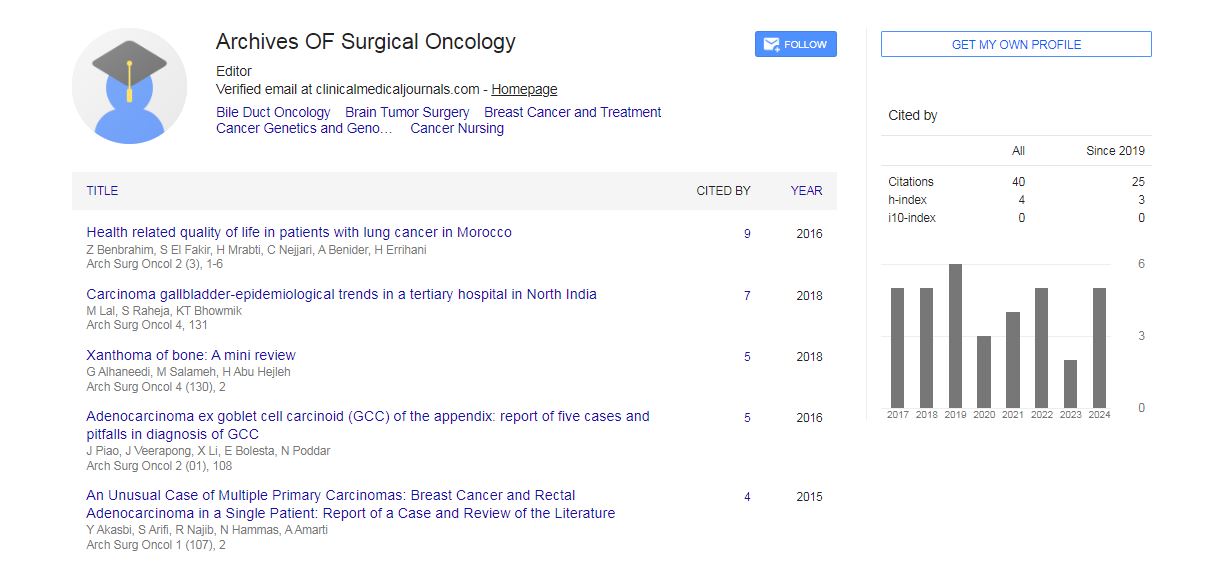
Archives of Surgical Oncology received 37 citations as per Google Scholar report