DOI: 10.37421/2472-0992.2025.11.353
Vikas C. Roy* and Rajni Bala
DOI: 10.37421/2472-0992.2025.11.351
Respiratory tract infections encompass a range of infections impacting different parts of the respiratory system. These are broadly categorized into Upper Respiratory Tract Infections (URTI), which involve the nose, sinuses, and throat, or lower respiratory tract infections, affecting the airways and lungs. Influenza, often referred to as the "flu," is a highly contagious viral infection predominantly caused by influenza viruses is one of an URTI. This review focuses on anti-influenza effects of honey highlighting key findings from various studies. In-vitro research demonstrates that honey, particularly Castanea crenata and Tilia amurensis, significantly reduces influenza virus replication in cell models and enhances immune response mechanisms. The studies highlighted the activation of the IFN signaling pathway as a crucial mechanism. This involves the stimulation of JAK-STAT signaling pathway, leading to the formation of the ISGF3 transcription factor complex. Honey was found to boost the immune response by increasing the production of inflammatory cytokines (IL-6, TNF-α, and IFN-β) and enhancing the expression of Interferon-Inducible Transmembrane Protein (IFITM3), a key player in obstructing viral entry. Clinical studies showed that honey, in various forms, could alleviate symptoms of URTIs like cough and sleeping difficulties, likely due to its anti-viral properties. All these findings suggest the potential of honey as a natural, effective treatment for influenza. However, human studies are limited, with existing Randomized Controlled Trials (RCTs) focusing on Upper Respiratory Tract Infection (URTI) symptoms like cough, not specifically influenza. Future research should not only include double-blind RCTs involving adults and children but also further in-vitro studies to explore different honey types and mechanisms related to treatment of influenza.
Sakshi B Rongate* and Pratiksha R Pawar
DOI: 10.37421/2472-0992.2025.11.352
The goal of these project it assesses besides create a natural face pack designed to promote a healthy and vibrant complexion using natural ingredients. The demand for herbal cosmetics has been on the rise globally and among the diverse range of herbal products, the herbal face pack stands out. The popularity and utilization of herbal products are consistently growing, driven by an increasing preference for natural alternatives. The natural herbal face pack serves the purpose of enhancing skin health by delivering essential nutrients. Presently, a majority of women opt for natural products over chemical ones for their skincare routines, aiming to enhance their beauty. Herbal products gain approval for being free from synthetic chemicals. The use of a natural herbal face pack has been found effective in addressing various skin ailments. In this study, herbal components such as wheatgrass powder, sariva, shastishali rice, nutmeg, turmeric, neem orange peel, Kapoor Kachri, karchoor, manjishta, amargandhi haridra were employed in dried powder form. Careful sieving of these components using sieve no: 180 ensured uniformity. Accurate weighing and thorough mixing of these natural powders resulted in a combined dried powder with favorable flow properties suitable for an herbal face pack. This formulation not only addresses specific skin issues but also nourishes facial skin, promotes blood circulation, maintains skin elasticity and aids in removing dirt. The work concludes that the herbal face pack exhibits positive properties, emphasizing the need for further optimization studies. Ongoing research is crucial to uncover the practical and significant benefits of the herbal face pack in human cosmetic products, including its impact on facial skin, promotion of blood circulation, preservation of skin elasticity and non-toxic nature. While the current findings highlight the good qualities of the herbal face pack, additional optimization research is necessary to fully understand and leverage its practical advantages in human cosmetic products.
Bushra Elfatih Bushra Suliman*
DOI: 10.37421/2472-0992.2025.11.351
Plant compounds are of interest as a source of safe and effective substitutes of the classic synthetically produced antimicrobial agents. Hence, this study aims to investigate the phytochemical constituents and antimicrobial activity present in Acacia nubica root bark extracts. The plant was extracted by maceration using ethanol (70%). The crude extract was used for the detection of the phytochemical constituents. The antibacterial activity was measured by the agar well diffusion method. The qualitative chemical analysis of the crude organic extracts confirmed the presence of diterpenes, cardiac glycosides, tannins, flavonoids, saponins and phenols. The chemical ingredients were identified by Gas Chromatography-Mass Spectrometry (GC-MS). The major constituents in crude ethanol extract were 5-hydroxymethylfurfural (3.96%), di-n-octyl phthalate (4.33%), n-hexadecanoic acid (1.6%), and 4-O-methylmannose (81.11%). While the major constituents of aqueous methanol fraction were 4-O-methylmannose (74.98%), 5 hydroxymethylfurfural (12.45%), and 3-buten-2-one, 4-(4-hydroxy-3-methoxyphenyl) (3.74%), and of the hexane fraction were Di-n-octyl phthalate (54.92%), hexanedioic acid, bis (2-ethylhexyl) ester (9.9%), and hexadecanoic acid, ethyl ester (8.18%). A. nubica crude ethanolic extract produced clear zone of inhibition (9.00-12.5 mm) in the antimicrobial assay. The aqueous methanol fraction produced clear zone of inhibition of 11.00-13 mm against Staphylococcus aureus (ATCC 25923), while the hexane fraction was found to be devoid of activity. Escherichia coli (ATCC 25927) proved to be resistant to the crude extract and its fractions. On the other hand, ethanol (70%) extract showed antifungal activity with minimal inhibitory effect of 12.2-13.2 mm against C. albicans clinical isolates, while the aqueous methanol fraction produced 13.3–14.43 mm clear zone of inhibition. The hexane fraction produced no inhibition of the fungal growth. Further, studies on phytochemical, antimicrobial and mechanism of action are needed.
Krishna Kakkad*, Chitaliya Sahil, Bhakhar Jay, Thummar Shyam and Bukhari Mohammad Saqlen
DOI: 10.37421/2472-0992.2025.11.350
Aim of study to formulation and evaluation of multipurpose herbal skin cream. The outermost covering of the body is termed as skin. It is known as the largest organ of the body. It constitutes the first line of defense. A waterproof layer is formed by skin, which is mainly provided by its keratinized epithelium, which protects the deeper and more delicate structures. These creams, which serve as the primary treatment for numerous skin conditions or dermatomes, may either be medicated or unmediated. People use different types of creams including ayurveda, herbal or allopathic based on their individual needs and skin condition. They consist of thick liquids or semi-solid emulsions that come in either oil-in-water or water-in-oil forms and include herbal ingredients. Anti-aging creams are often moisturizer-based cosmeceuticals skin care items that claim to make users look younger by minimizing, concealing, or avoiding the indications of ageing skin. Here we were use the Aprajita plant for the preparation of cream it consists the major photo-constituents found in the plant are the pent acyclic triterpenoids such as taraxerol and taraxerone. Alkaloids, flavonoids, saponins, tannins, carbohydrates, proteins, resins, starch, taraxerol and taraxerone. Appearance of the cream was derived by its color, odor and texture prepared herbal cream was smooth, bluer after application of the prepared herbal cream on a particular area it gave good emolliency and soothes the skin.
DOI: 10.37421/2472-0992.2025.11.351
DOI: 10.37421/2472-0992.2025.11.352
DOI: 10.37421/2472-0992.2025.11.354
DOI: 10.37421/2472-0992.2025.11.355
DOI: 10.37421/2472-0992.2025.11.356
DOI: 10.37421/2472-0992.2025.11.357
DOI: 10.37421/2472-0992.2025.11.358
DOI: 10.37421/2472-0992.2025.11.359
DOI: 10.37421/2472-0992.2025.11.360
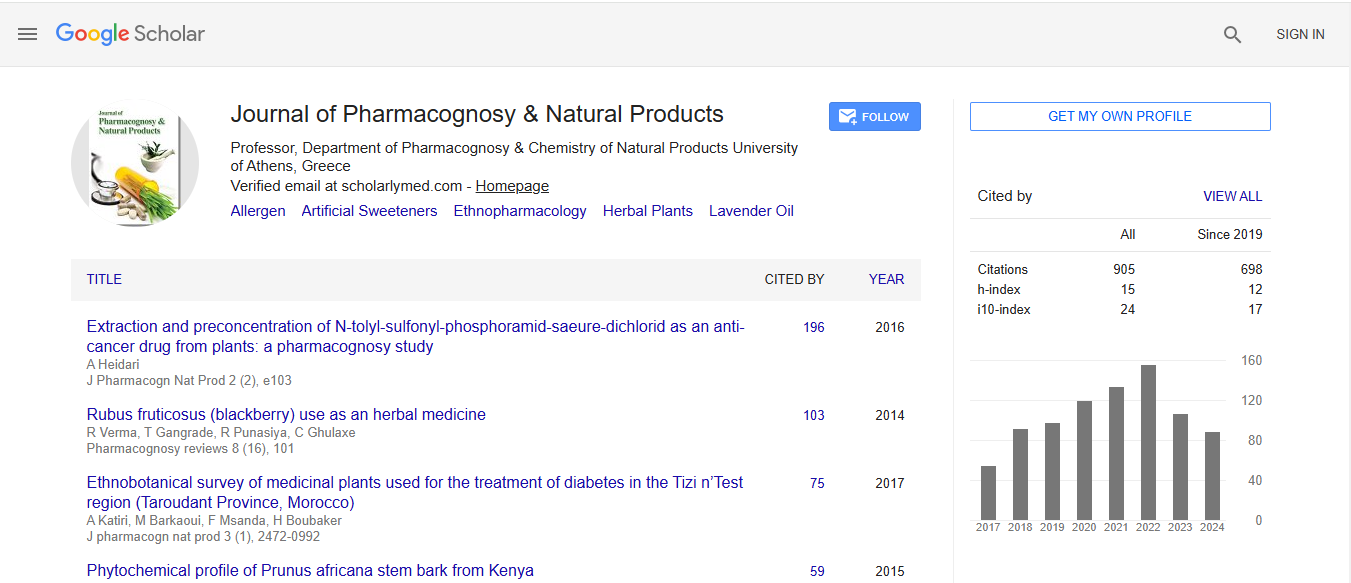
Journal of Pharmacognosy & Natural Products received 606 citations as per Google Scholar report
 Spanish
  Chinese
  Russian
  German
  French
  Japanese
  Portuguese
  Hindi
Hindi 