Opinion - (2025) Volume 11, Issue 2
Received: 01-Apr-2025, Manuscript No. jpnp-25-166014;
Editor assigned: 03-Apr-2025, Pre QC No. P-166014;
Reviewed: 15-Apr-2025, QC No. Q-166014;
Revised: 22-Apr-2025, Manuscript No. R-166014;
Published:
29-Apr-2025
, DOI: 10.37421/2472-0992.2025.11.352
Citation: Tekgul, Veronica. “Targeting Cancer: The Role of Natural Products in the Development of New Anti-cancer Drugs.” J Pharmacogn Nat Prod 11 (2025): 352.
Copyright: © 2025 Tekgul V. This is an open-access article distributed under the terms of the Creative Commons Attribution License, which permits unrestricted use, distribution and reproduction in any medium, provided the original author and source are credited.
Cancer remains one of the leading causes of death worldwide, with millions of new cases diagnosed each year. Despite advancements in treatment, including surgery, chemotherapy, and radiation therapy, these approaches often come with significant side effects and limited long-term effectiveness. The search for novel and more effective therapies continues, and natural products have emerged as a promising source of potential anti-cancer agents. These compounds, derived from plants, marine organisms, and microorganisms, have been recognized for their diverse biological activities, including their ability to selectively target cancer cells while minimizing damage to healthy tissues. Over the past few decades, natural products have played a pivotal role in drug discovery, contributing to the development of several clinically approved anti-cancer drugs. The growing interest in natural products as a source of anti-cancer agents is driven by their unique structural diversity and the complex mechanisms by which they interact with cancer cells. Many natural compounds possess the ability to modulate key signaling pathways involved in cancer development, such as apoptosis, cell cycle regulation, and angiogenesis. Furthermore, the ability of these compounds to target multiple aspects of cancer biology makes them an attractive option for combination therapies, enhancing their efficacy and reducing the likelihood of drug resistance. This exploration of natureâ??s chemical wealth has led to the identification of several promising lead compounds, many of which are currently undergoing clinical trials. As our understanding of the molecular underpinnings of cancer deepens, the role of natural products in the development of new, more effective anti-cancer drugs is poised to expand even further [1].
Cancer remains one of the most formidable health challenges facing humanity, with millions of people diagnosed every year across the globe. Despite remarkable advancements in oncology, such as surgery, chemotherapy, and radiation therapies, the disease continues to claim lives and significantly impact individuals' quality of life. Current treatment modalities, though life-saving in many instances, often come with significant side effects, resistance issues, and limitations regarding long-term efficacy. In light of these challenges, researchers have turned to natural products as a potential source for the development of new and more effective anti-cancer drugs. Natural products, which include compounds derived from plants, marine organisms, fungi, and microorganisms, have been the cornerstone of many significant pharmaceutical discoveries. The inherent diversity of these natural molecules presents an exceptional opportunity for the development of novel therapeutic agents that can combat cancer more effectively, with fewer side effects. The value of natural products in drug discovery is not a new concept. Historically, natural compounds have been pivotal in the development of life-saving medicines, particularly in oncology. One of the earliest and most well-known examples of a natural product used in cancer treatment is the chemotherapy drug paclitaxel, derived from the Pacific yew tree. This drug, first isolated in the 1960s, remains a cornerstone of cancer treatment, particularly in the treatment of ovarian, breast, and lung cancers. Similarly, other natural products, such as vincristine and vinblastine derived from the periwinkle plant, have been instrumental in the treatment of various cancers, including leukemia and lymphomas [2].
These examples highlight the potential of natural products in cancer therapy, offering a blueprint for future drug development. The structure and mechanisms of action of many natural products allow them to specifically target cancerous cells while minimizing harm to healthy cells, making them highly attractive candidates for the treatment of cancer. In recent years, research has increasingly focused on understanding how natural compounds can modulate cancer-associated pathways at the molecular level. Cancer is a disease characterized by uncontrolled cell growth, invasion into surrounding tissues, and metastasis to distant organs. It involves the alteration of several key signaling pathways that regulate cell cycle progression, apoptosis (programmed cell death), angiogenesis (formation of new blood vessels), and immune surveillance. Many natural products have been found to interfere with these critical biological processes, making them highly effective against various cancer types. For example, some natural compounds induce cell cycle arrest, preventing cancer cells from proliferating and spreading. Others initiate apoptosis, selectively triggering the death of cancer cells while leaving healthy cells intact. Additionally, certain natural products can inhibit angiogenesis, thereby preventing tumors from developing the blood supply they need to grow and metastasize.The use of natural products in cancer therapy is not limited to a single mechanism of action. Many of these compounds exhibit pleiotropic effects, meaning they can target multiple cancer-related processes simultaneously. This multipronged approach is especially valuable in cancer therapy, where the complexity of the disease often leads to the development of resistance against a single therapeutic agent [3].Similarly, compounds like resveratrol, found in grapes and red wine, have demonstrated anticancer properties through their ability to modulate key pathways involved in inflammation, apoptosis, and cell cycle regulation. Resveratrol has been shown to activate the sirtuin family of proteins, which regulate cell survival and stress responses. By promoting the activation of these proteins, resveratrol helps cancer cells become more susceptible to death, while simultaneously preventing the growth and spread of tumors. Additionally, resveratrol has been linked to the inhibition of angiogenesis, preventing tumors from developing a sufficient blood supply for growth and metastasis. Such natural compounds exemplify how the study of plant and other natural substances can open the door to novel cancer therapies that work on multiple levels, potentially reducing the likelihood of drug resistance. Marine organisms have also proven to be an invaluable source of anti-cancer agents. The oceans, home to an incredibly diverse array of life forms, have yielded a wealth of bioactive compounds with potent anti-cancer properties. Similarly, marine-derived compounds, such as the alkaloid manoalide from the marine sponge Luffariella spp., have shown promise in preclinical studies due to their ability to inhibit cancer cell migration and invasion. The potential for marine natural products in drug development is vast, and their unique chemical structures make them stand out from terrestrial-based compounds, further highlighting the need to explore the oceans for new cancer treatments [4].
The transition from natural products in the laboratory to clinically approved cancer therapies involves a long and rigorous process of screening, isolation, and evaluation. The journey from bench to bedside often requires overcoming significant challenges, such as optimizing the bioavailability of these compounds, ensuring they can be synthesized in large quantities, and determining their safety and efficacy in human trials. However, advancements in technology, such as high-throughput screening and computational drug design, have accelerated the discovery and development of natural product-derived drugs. One of the critical factors in the success of these drugs is the growing understanding of the molecular mechanisms of cancer. By identifying specific molecular targets within cancer cells, researchers are better equipped to develop natural product-based therapies that can more precisely target these abnormalities, improving therapeutic outcomes and minimizing side effects. Despite the promising potential of natural products in cancer treatment, there are still several obstacles to overcome before they can be fully integrated into clinical practice. To address these issues, researchers are increasingly turning to biotechnological approaches, such as genetic engineering and synthetic biology, to produce these compounds more efficiently and cost-effectively. Advances in these fields could potentially revolutionize the production of natural product-based drugs, making them more accessible to patients worldwide [5].
Google Scholar Cross Ref Indexed at
Google Scholar Cross Ref Indexed at
Google Scholar Cross Ref Indexed at
Google Scholar Cross Ref Indexed at
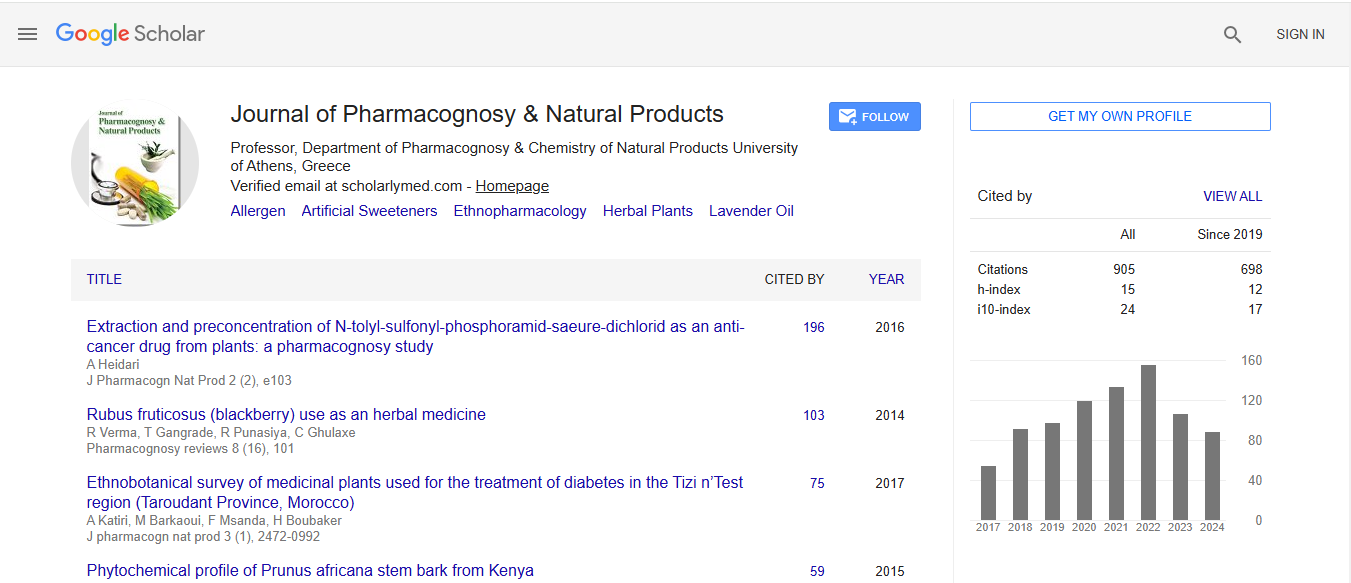
Journal of Pharmacognosy & Natural Products received 606 citations as per Google Scholar report