Short Communication - (2025) Volume 11, Issue 2
Received: 01-Apr-2025, Manuscript No. jpnp-25-166019;
Editor assigned: 03-Apr-2025, Pre QC No. P-166019;
Reviewed: 15-Apr-2025, QC No. Q-166019;
Revised: 22-Apr-2025, Manuscript No. R-166019;
Published:
29-Apr-2025
, DOI: 10.37421/2472-0992.2025.11.357
Citation: Garcia, Reiffel. “Natural Products in Modern Medicine: A Regulatory Overview of Herbal and Plant-based Therapies.” J Pharmacogn Nat Prod 11 (2025): 357.
Copyright: © 2025 Garcia R. This is an open-access article distributed under the terms of the Creative Commons Attribution License, which permits unrestricted use, distribution and reproduction in any medium, provided the original author and source are credited.
Natural products, particularly herbal and plant-based therapies, have been used for thousands of years in traditional medicine systems worldwide. From the ancient remedies of Ayurveda and Traditional Chinese Medicine to indigenous healing practices, plants have long been valued for their therapeutic potential. In modern times, there has been a resurgence of interest in these natural products, driven by the desire for more holistic and accessible healthcare solutions. As consumers increasingly seek alternative and complementary therapies, herbal and plant-based remedies are finding their place alongside conventional pharmaceuticals in treating a variety of conditions, from chronic pain and inflammation to mental health disorders and digestive issues. However, with the rise in popularity of these natural products comes the need for robust regulatory frameworks to ensure their safety, efficacy, and quality. Despite their widespread use, the regulation of herbal and plant-based therapies remains complex and varies significantly across regions. In many countries, natural products are classified as dietary supplements or an over-the-counter medicine, which often means they face less stringent regulation compared to pharmaceutical drugs. This lack of uniformity in regulation can present challenges for both consumers and healthcare professionals, particularly when it comes to ensuring product consistency and avoiding harmful interactions with conventional medications [1].
Natural products, particularly herbal and plant-based therapies, have played a pivotal role in traditional and modern medicine, providing solutions to a wide array of health concerns. From the use of ginseng and echinacea for immune support to turmeric for its anti-inflammatory properties, plant-derived remedies have long been a cornerstone of holistic health practices. In recent years, there has been a marked resurgence in the use of herbal and plant-based therapies, driven by the growing consumer preference for natural, alternative, and complementary treatments. This movement is fueled by the increasing awareness of the potential side effects and long-term risks associated with synthetic pharmaceuticals, prompting many to seek natural alternatives that are perceived as safer and more in harmony with the bodyâ??s innate healing processes. As the natural products industry grows, so too does the need for clearer standards, better scientific evidence, and more comprehensive regulation to ensure that these therapies are both safe and effective. Balancing the benefits of plant-based medicine with consumer protection remains a key issue in the integration of these therapies into modern healthcare. Additionally, the growing body of scientific research supporting the medicinal benefits of plant-based products has led to a greater recognition of their role in modern healthcare. While the use of herbal and plant-based products continues to rise, their regulation presents significant challenges [2].
Unlike pharmaceutical drugs, which undergo rigorous clinical trials and regulatory scrutiny before they reach the market, herbal products are often classified as dietary supplements or traditional medicines, which are subject to far less stringent regulatory oversight. In many countries, this classification means that these products are not required to prove efficacy through clinical trials before they are sold to consumers. As a result, there is a growing concern about the safety and quality of these products, particularly regarding issues such as contamination, adulteration, and inconsistency in active ingredients. Furthermore, the lack of standardization in the formulation and manufacturing processes of herbal remedies can lead to significant variations in the potency and effectiveness of different products. One of the most significant challenges in the regulation of herbal and plant-based therapies is the lack of uniformity across different regions and countries. While some countries have established comprehensive regulatory frameworks for herbal medicine, others operate under looser guidelines, creating confusion for consumers and healthcare providers alike. For example, in the United States, the Food and Drug Administration (FDA) regulates herbal products as dietary supplements, meaning that manufacturers are not required to prove their productsâ?? safety or effectiveness before marketing them [3].
This contrasts with European countries, where the European Medicines Agency (EMA) has more stringent regulations in place for herbal medicines, requiring pre-market approval and evidence of efficacy for certain products. In addition, many countries have different standards for labeling, dosage, and quality control, making it difficult for consumers to navigate the vast array of herbal products on the market. Despite these regulatory challenges, there has been progress in developing standards to ensure the safety and efficacy of herbal and plant-based products. The World Health Organization (WHO) has established guidelines for the quality control, safety, and efficacy of herbal medicines, and many national health agencies are increasingly adopting similar standards. Additionally, efforts are being made to improve the scientific evidence base for plant-based therapies through clinical trials and research. Some countries, like Canada and Germany, have established regulatory bodies specifically for herbal medicines, ensuring that these products meet certain safety and quality standards before they are sold. Meanwhile, in other regions, there is a push to develop more robust regulatory frameworks that balance consumer safety with the growing demand for natural therapies. The rise of Good Manufacturing Practices (GMP) and third-party certification programs also serves to provide greater transparency and accountability within the industry [4].
Another key aspect of regulation involves the integration of herbal and plant-based therapies into mainstream healthcare. In many countries, there is growing interest in incorporating these therapies into conventional medical practices, often referred to as integrative or complementary medicine. However, for healthcare professionals to confidently recommend these treatments, they need assurances regarding their safety, dosage, and potential interactions with other medications. This underscores the need for ongoing research into the pharmacology of herbal products, as well as clear guidelines for healthcare providers to navigate the complexities of natural medicine. Regulatory bodies and professional organizations have an important role to play in bridging the gap between traditional and modern medicine, ensuring that natural products are both safe and effective when used in conjunction with conventional treatments. Moreover, consumer education is a crucial element in the responsible use of herbal and plant-based products. As demand for natural remedies increases, consumers need clear, accessible information about the potential benefits and risks of these products. The rise of e-commerce has made it easier for consumers to access herbal products, but it has also made it more challenging to verify the quality and authenticity of these products. As such, consumers must be empowered to make informed choices about the products they use, ensuring that they are purchasing from reliable and certified manufacturers [5].
Google Scholar Cross Ref Indexed at
Google Scholar Cross Ref Indexed at
Google Scholar Cross Ref Indexed at
Google Scholar Cross Ref Indexed at
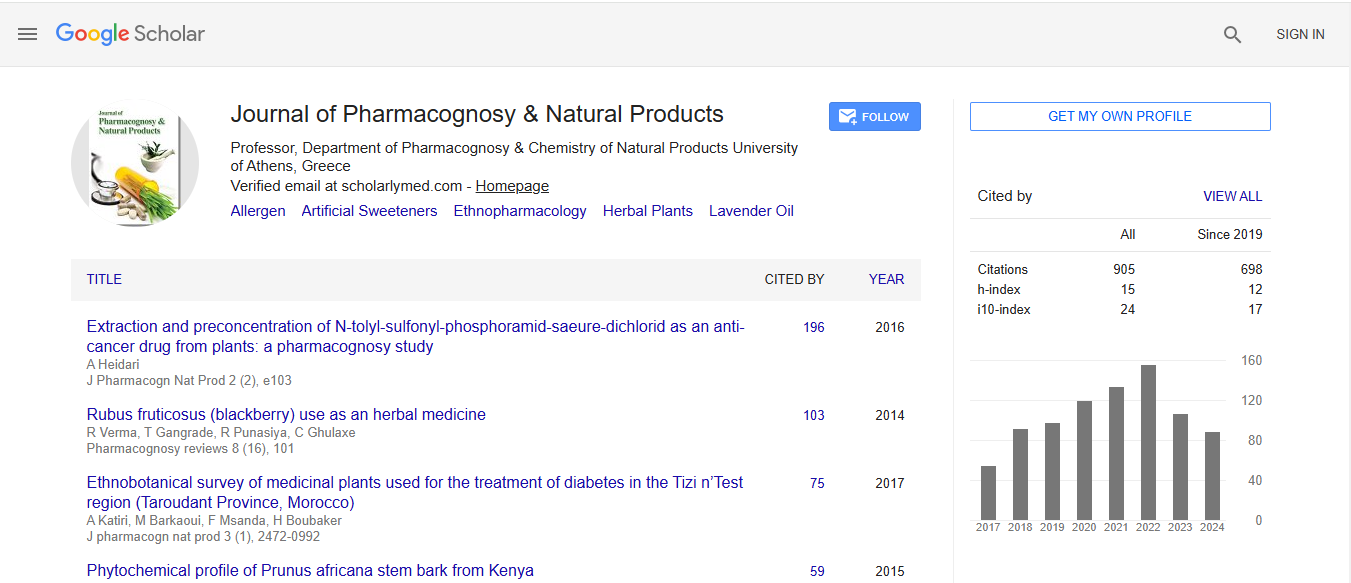
Journal of Pharmacognosy & Natural Products received 606 citations as per Google Scholar report