Opinion - (2025) Volume 11, Issue 2
Received: 01-Apr-2025, Manuscript No. jpnp-25-166015;
Editor assigned: 03-Apr-2025, Pre QC No. P-166015;
Reviewed: 15-Apr-2025, QC No. Q-166015;
Revised: 22-Apr-2025, Manuscript No. R-166015;
Published:
29-Apr-2025
, DOI: 10.37421/2472-0992.2025.11.353
Citation: Dryson, Zilaee. “Fungal Allies: The Role of Endophytic Fungi in Producing Bioactive Compounds for Medicine.” J Pharmacogn Nat Prod 11 (2025): 353.
Copyright: © 2025 Dryson Z. This is an open-access article distributed under the terms of the Creative Commons Attribution License, which permits unrestricted use, distribution and reproduction in any medium, provided the original author and source are credited.
Endophytic fungi, which reside within the tissues of plants without causing apparent harm, represent an invaluable and largely untapped source of bioactive compounds with potential applications in medicine. These fungi have evolved a unique symbiotic relationship with their host plants, providing benefits such as enhanced resistance to stress, disease, and herbivores, while simultaneously producing a variety of secondary metabolites. These metabolites often serve as chemical defense mechanisms for the plant, deterring pests or inhibiting the growth of competing microorganisms. The remarkable diversity and specificity of these compounds make endophytic fungi an exceptional resource for drug discovery, with an array of bioactive molecules that could be harnessed for therapeutic purposes. As our understanding of the complex interactions between endophytic fungi and their host plants grows, so too does our appreciation for the vast library of bioactive compounds they may offer. These compounds include alkaloids, terpenoids, phenolics, and peptides, many of which have shown promising antimicrobial, anticancer, antioxidant, and anti-inflammatory activities. The ability of these compounds to target specific biological pathways within human cells provides a strong foundation for their potential use in treating diseases ranging from infections to cancer and neurodegenerative disorders [2].
One of the most exciting aspects of endophytic fungi is their ability to produce novel compounds with unique mechanisms of action that are not found in conventional medicinal sources. Additionally, the ability of some endophytic fungi to produce compounds that inhibit cancer cell growth, induce apoptosis (programmed cell death), and prevent metastasis has made them a focus of cancer research. The diversity of these bioactive metabolites also suggests that endophytic fungi could be used in the development of combination therapies, where multiple compounds work synergistically to target different aspects of disease progression, enhancing treatment efficacy while reducing the likelihood of resistance. The process of discovering and developing bioactive compounds from endophytic fungi involves several critical steps. First, fungal strains must be isolated from the host plant tissue, often through careful cultivation under laboratory conditions. Once isolated, researchers must identify the compounds produced by the fungi and determine their biological activity. This is typically done through bioassays, which test the compoundsâ?? effects on various biological systems, such as bacterial cultures, cancer cells, or animal models. The Once a compound is identified, its chemical structure must be determined, and its mechanism of action understood. In some cases, researchers may even genetically modify the fungi to increase the production of a specific compound, using biotechnology to optimize yields for commercial or clinical use [3].
Advances in genomic and molecular biology technologies have greatly facilitated the study of endophytic fungi and the bioactive compounds they produce. Sequencing the genomes of these fungi allows researchers to uncover the genetic pathways involved in the biosynthesis of specific compounds, enabling the possibility of enhancing or even artificially replicating these pathways for large-scale production. Furthermore, metagenomics the study of genetic material recovered directly from environmental samples has opened new doors for the discovery of fungal species that may not have been previously identified, expanding the pool of potential bioactive compounds. By understanding the genetic basis of compound production, scientists can also explore ways to manipulate fungal biosynthesis pathways to produce new, modified, or enhanced compounds that may be more effective or less toxic than their natural counterparts. The therapeutic potential of endophytic fungi extends beyond the realm of infectious diseases and cancer treatment. Additionally, some endophytic fungi produce compounds that have been shown to enhance cognitive function and memory, presenting opportunities for developing novel treatments for cognitive decline. As the population ages and the prevalence of neurological disorders continues to rise, the need for innovative, effective therapies becomes more pressing, and endophytic fungi could play a significant role in meeting that demand [4].
The use of endophytic fungi in medicine is not without challenges, however. The most immediate concern is the sustainability of fungal sources. While fungi can often be cultivated in controlled environments, ensuring a consistent and sustainable supply of bioactive compounds remains a logistical challenge. Many endophytic fungi produce only small quantities of their bioactive metabolites, making large-scale production difficult and expensive. This has led to increasing interest in biotechnological solutions, such as the use of fermentation or genetic engineering to enhance production. Additionally, safety and toxicity concerns must be thoroughly evaluated before any bioactive compounds derived from endophytic fungi can be used in clinical settings. Comprehensive preclinical and clinical studies are necessary to assess the efficacy and safety profiles of these compounds, as some may present unforeseen side effects or interact with other drugs in unpredictable ways. Despite these challenges, the potential of endophytic fungi as a source of bioactive compounds for medicine is undeniable. As technology advances and our understanding of fungal biosynthesis deepen the ability to harness the medicinal potential of endophytic fungi will likely continue to expand. In the coming years, we may see an increasing number of bioactive compounds derived from endophytic fungi enter clinical trials, providing new and innovative treatment options for patients worldwide [5].
Google Scholar Cross Ref Indexed at
Google Scholar Cross Ref Indexed at
Google Scholar Cross Ref Indexed at
Google Scholar Cross Ref Indexed at
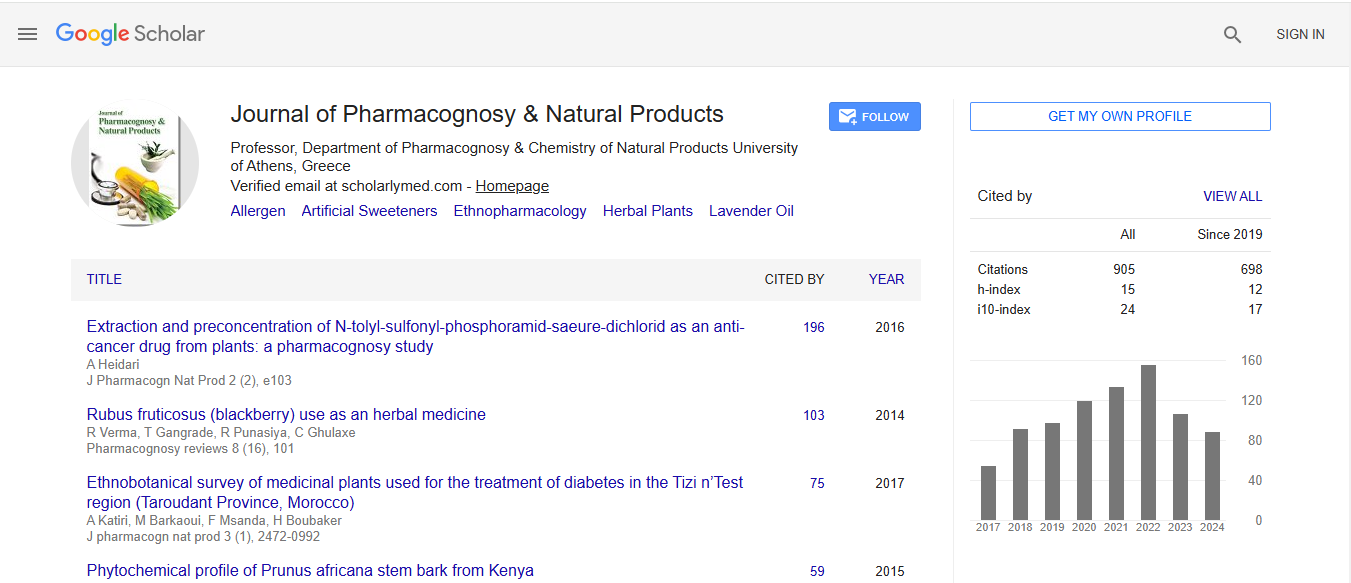
Journal of Pharmacognosy & Natural Products received 606 citations as per Google Scholar report