Commentary - (2025) Volume 11, Issue 2
Received: 01-Apr-2025, Manuscript No. jpnp-25-166013;
Editor assigned: 03-Apr-2025, Pre QC No. P-166013;
Reviewed: 15-Apr-2025, QC No. Q-166013;
Revised: 22-Apr-2025, Manuscript No. R-166013;
Published:
29-Apr-2025
, DOI: 10.37421/2472-0992.2025.11.351
Citation: Sillo, Ellen. “Pharmacological Potential of Alkaloids: Plant-Derived Compounds in Therapeutic Applications.” J Pharmacogn Nat Prod 11 (2025): 351.
Copyright: © 2025 Sillo E. This is an open-access article distributed under the terms of the Creative Commons Attribution License, which permits unrestricted use, distribution and reproduction in any medium, provided the original author and source are credited.
Alkaloids, a diverse group of naturally occurring plant-derived compounds, have long captivated the scientific community due to their wide-ranging pharmacological properties. These nitrogen-containing molecules, which are found in a variety of plants across different species, play a pivotal role in the therapeutic landscape, offering valuable potential in the treatment of various ailments. From the ancient use of opium for pain management to the modern application of anticancer drugs like vincristine, alkaloids have proven to be essential in medicine. Their mechanisms of action often involve interactions with neurotransmitter systems, enzymes, and cellular pathways, making them versatile tools in drug development. This introduction explores the pharmacological potential of alkaloids, highlighting their therapeutic applications, their role in modern medicine, and the promising avenues for further exploration in the field of drug discovery. The therapeutic applications of alkaloids are not only limited to well-established uses, but ongoing research continues to reveal novel and promising possibilities. Advances in plant biotechnology, synthetic chemistry, and pharmacology are enabling the development of new alkaloid-based drugs, optimizing their potency, bioavailability, and safety profiles. Furthermore, the study of alkaloid biosynthesis in plants and the identification of new alkaloid structures offer exciting prospects for the discovery of innovative treatments for diseases that currently have limited therapeutic options [1-2].
Alkaloids are a class of naturally occurring organic compounds that are primarily derived from plants, although they can also be found in fungi, bacteria, and some animal species. These compounds are typically characterized by their nitrogen content and their ability to produce a wide range of pharmacological effects in humans and other animals. Alkaloids have been used for centuries in traditional medicine across cultures, with their potent biological activities making them integral to both ancient healing practices and modern pharmaceuticals. The diverse therapeutic potential of alkaloids has been well-documented, with numerous alkaloid-based drugs playing a vital role in the treatment of various diseases and conditions. One of the key reasons alkaloids are of great interest in pharmacology is their wide spectrum of biological effects, including analgesic, anti-inflammatory, anticancer, antimicrobial, antimalarial, and psychoactive properties. Some of the most famous alkaloids, such as morphine, quinine, and atropine, have been cornerstones of medical treatment for centuries. For example, morphine, derived from the opium poppy, has long been used as a powerful pain reliever, while quinine, extracted from the bark of the cinchona tree, remains an essential drug in the treatment of malaria. Atropine, obtained from plants like belladonna, is used in treating bradycardia (slow heart rate) and has applications in ophthalmology. These are just a few examples of how alkaloids have revolutionized medicine and continue to be indispensable in contemporary clinical practices [3].
The therapeutic effects of alkaloids often arise from their ability to interact with specific molecular targets in the body. They can act on receptors, enzymes, ion channels, and various cellular signaling pathways, making them valuable in treating a wide range of conditions. For instance, nicotine and caffeine, two common alkaloids, exert their effects by stimulating the central nervous system, enhancing alertness, and improving cognitive function. Meanwhile, alkaloids like vincristine and vinblastine, derived from the periwinkle plant, have shown significant promise in oncology by inhibiting the division of cancer cells, thus offering a potential therapeutic approach in the fight against cancer. Additionally, alkaloids like strychnine and scopolamine have demonstrated effects on neuromuscular and autonomic functions, which can be leveraged for both therapeutic and research purposes. Despite their immense potential, the clinical use of alkaloids is not without challenges. Many alkaloids can be toxic at high doses, and their use requires careful dosing and monitoring. For example, while morphine is highly effective as an analgesic, it also carries a significant risk of addiction and overdose. Alkaloids like atropine, while life-saving in emergency situations, must be used with caution due to their potential side effects, such as tachycardia and dry mouth. Moreover, resistance can develop to some alkaloid-based drugs, particularly in the case of antimicrobial and anticancer agents. Malaria resistance to quinine and other antimalarial alkaloids, as well as cancer cell resistance to alkaloid chemotherapy drugs, represent ongoing challenges in the clinical setting [4].
Researchers are actively working to overcome these obstacles by exploring novel alkaloids with improved therapeutic profiles. The advent of plant biotechnology and advancements in synthetic chemistry have made it possible to discover new alkaloid compounds, optimize their bioavailability, and enhance their safety. In addition, pharmacogenomicsâ??the study of how genes affect a personâ??s response to drugs is paving the way for more personalized alkaloid-based therapies, potentially improving treatment outcomes and minimizing adverse effects. Moreover, the identification of new alkaloid structures and the exploration of plant biosynthesis mechanisms hold great promise for the discovery of additional therapeutic agents. Plants remain an abundant and underexplored source of bioactive compounds, and ongoing research in this area could uncover alkaloids with novel actions and applications in medicine. In particular, the use of plant-based alkaloids in combination with other therapeutic strategies, such as immunotherapy and gene therapy, offers exciting possibilities for improving treatment efficacy in diseases like cancer and autoimmune disorders [5].
None.
None.
Google Scholar Cross Ref Indexed at
Google Scholar Cross Ref Indexed at
Google Scholar Cross Ref Indexed at
Google Scholar Cross Ref Indexed at
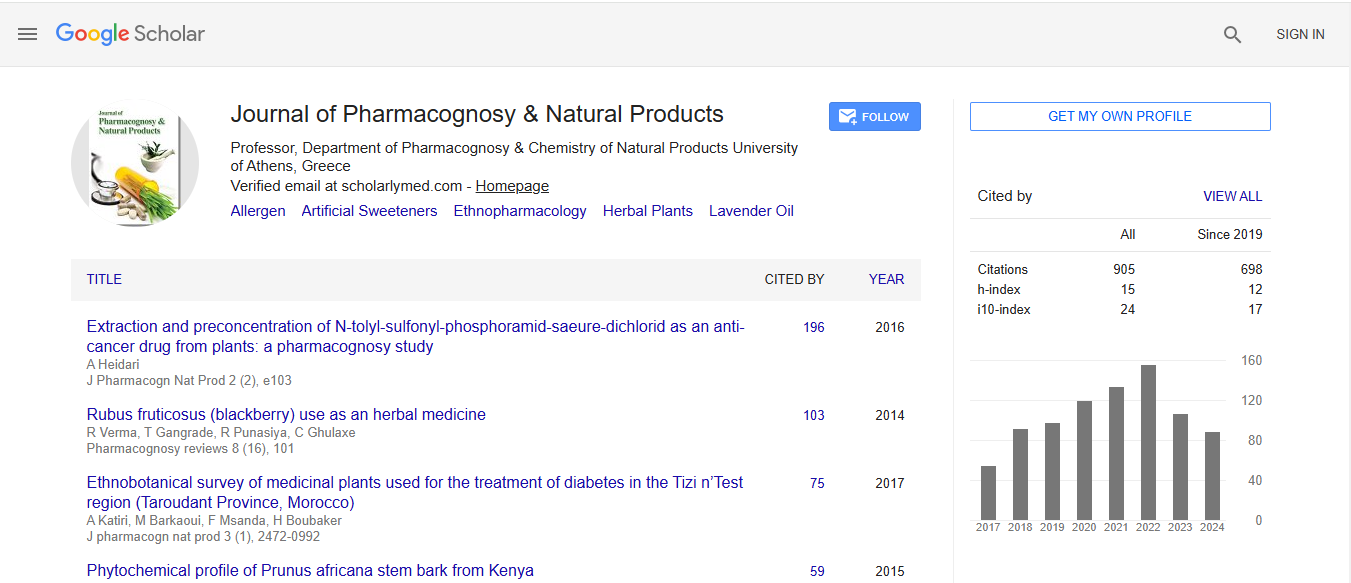
Journal of Pharmacognosy & Natural Products received 606 citations as per Google Scholar report