Perspective - (2025) Volume 11, Issue 2
Received: 01-Apr-2025, Manuscript No. jpnp-25-166020;
Editor assigned: 03-Apr-2025, Pre QC No. P-166020;
Reviewed: 15-Apr-2025, QC No. Q166020;
Revised: 22-Apr-2025, Manuscript No. R-166020;
Published:
29-Apr-2025
, DOI: 10.37421/2472-0992.2025.11.358
Citation: Shafei, Salah. “Bioprospecting and the Search for New Medicines: Unlocking the Potential of Natural Products.” J Pharmacogn Nat Prod 11 (2025): 358.
Copyright: © 2025 Shafei S. This is an open-access article distributed under the terms of the Creative Commons Attribution License, which permits unrestricted use, distribution and reproduction in any medium, provided the original author and source are credited.
Bioprospecting, the process of exploring and harnessing the potential of natural resources particularly plants, fungi, and microorganisms has emerged as a critical strategy in the search for new medicines. For centuries, humans have turned to nature for healing, with plant-based remedies forming the foundation of traditional medicine systems worldwide. In recent decades, however, the growing field of bioprospecting has integrated modern scientific techniques to unlock the hidden therapeutic potential of these natural products. The rich biodiversity found in ecosystems such as tropical rainforests, coral reefs, and marine environments offers a vast reservoir of untapped compounds that could hold the key to addressing some of the most pressing health challenges of our time, from antibiotic resistance to cancer and neurological diseases. The search for new medicines through bioprospecting is an exciting and rapidly evolving field. It combines the ancient knowledge of indigenous cultures with cutting-edge scientific research to identify and isolate bioactive compounds that can be developed into pharmaceuticals. However, this process is not without challenges, including issues related to sustainability, ethical concerns, and the equitable sharing of benefits with local communities. Despite these obstacles, bioprospecting remains a promising avenue for the discovery of new, life-changing medicines [1].
Bioprospecting is an exciting and rapidly growing field that focuses on exploring the natural world to identify and isolate bioactive compounds with the potential to become new medicines. It involves the systematic search for plant, fungal, and microbial species in diverse ecosystems, particularly in regions with high biodiversity, such as tropical rainforests, coral reefs, and marine environments. These environments are home to a rich array of organisms that have evolved unique chemical compounds to survive and thrive in their specific habitats. Natural products have long been the source of life-saving drugs, such as penicillin, aspirin, and paclitaxel, and continue to serve as a rich source of novel therapeutic agents. As researchers delve deeper into the molecular and biochemical properties of these natural compounds, they uncover previously unknown mechanisms of action that may provide new treatment options. These compounds often exhibit therapeutic properties that can be harnessed for drug development, offering solutions for a wide range of diseases, from infectious diseases and cancer to neurodegenerative conditions and cardiovascular diseases. Historically, many life-saving medicines were derived from natural sources [2].
For example, penicillin, the worldâ??s first antibiotic, was discovered from the fungus Penicillium in the early 20th century, revolutionizing medicine and saving millions of lives. Similarly, plant-based compounds like aspirin, derived from willow bark, and paclitaxel, an anti-cancer drug extracted from the Pacific yew tree, have become foundational treatments in modern medicine. These breakthroughs demonstrate the vast untapped potential of natural products in the search for new drugs. As researchers have gained a better understanding of molecular biology, biotechnology, and pharmacology, the process of bioprospecting has evolved from traditional ethnobotanical knowledge to cutting-edge scientific techniques that enable the isolation, identification, and synthesis of bioactive compounds. In bioprospecting, researchers not only rely on traditional knowledge from indigenous cultures, who have long used plants and other natural materials for medicinal purposes, but also employ advanced technologies like high-throughput screening, genomics, and metabolomics to discover new compounds. Through these methods, scientists are able to identify bioactive molecules that may offer novel modes of action, providing new treatment options for diseases that are resistant to current therapies. For example, many species of plants and fungi contain antimicrobial compounds capable of fighting bacteria and viruses, making them valuable candidates for addressing the growing threat of antibiotic resistance [3].
Similarly, the potential of marine organisms, such as sponges and coral, as sources of anti-inflammatory and anti-cancer agents is being explored in the search for new therapies that can target complex diseases. However, despite its promising potential, bioprospecting is not without challenges. One of the primary concerns is the sustainability of natural resource extraction. Overharvesting of plants and other organisms from fragile ecosystems can lead to environmental degradation, endangering species and disrupting ecosystems. As a result, sustainable bioprospecting practices are essential to ensure that the discovery of new medicines does not come at the cost of biodiversity. Additionally, ethical issues surrounding bioprospecting must be carefully considered, particularly in relation to the rights of indigenous communities who may possess traditional knowledge about medicinal plants and organisms. There are growing calls for fair and equitable benefit-sharing arrangements, where local communities are compensated for their contributions to the discovery of new medicines, and the intellectual property rights of indigenous peoples are respected. Another significant issue is the equitable distribution of the benefits derived from bioprospecting. While large pharmaceutical companies may profit from the commercialization of drugs derived from natural products, there is an ongoing debate about how to ensure that local communities, where these plants or organisms are found, share in the economic benefits. This has led to the development of frameworks like the Nagoya Protocol, an international agreement that aims to ensure the fair and equitable sharing of benefits arising from the use of genetic resources [4].
The protocol emphasizes the need for prior informed consent from local communities and nations before accessing and using their biological resources, ensuring that they benefit from any potential discoveries. Despite these challenges, the future of bioprospecting looks promising. As scientific research and technology continue to advance, the ability to explore the natural world for new medicinal compounds is expanding. The development of novel drug discovery techniques, such as artificial intelligence and machine learning, is making it possible to analyze vast amounts of data more efficiently, accelerating the identification of promising natural compounds. Bioprospecting is a rapidly advancing field that explores biodiversity-rich ecosystems to discover bioactive compounds with potential for drug development. Drawing on both traditional knowledge and modern technologies like genomics and AI, it has led to the discovery of life-saving medicines while highlighting the need for sustainable practices and equitable benefit-sharing with indigenous communities. Despite ethical and environmental challenges, bioprospecting holds great promise for developing new treatments for complex and resistant diseases. Additionally, the increasing focus on personalized medicine tailoring treatments to the specific genetic makeup of individuals has led to a greater interest in plant-based and natural products, which may offer unique compounds that can be used to address the genetic diversity of diseases [5].
Google Scholar Cross Ref Indexed at
Google Scholar Cross Ref Indexed at
Google Scholar Cross Ref Indexed at
Google Scholar Cross Ref Indexed at
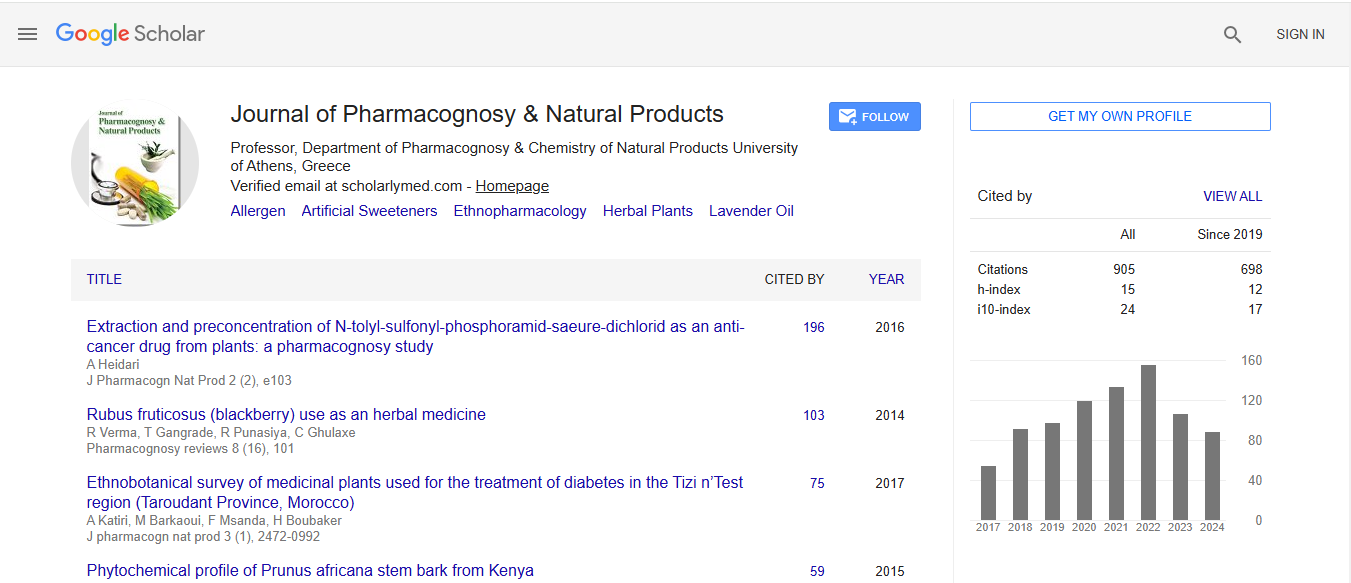
Journal of Pharmacognosy & Natural Products received 606 citations as per Google Scholar report