Short Communication - (2025) Volume 11, Issue 4
Received: 01-Jul-2025, Manuscript No. jfim-26-178576;
Editor assigned: 03-Jul-2025, Pre QC No. P-178576;
Reviewed: 17-Jul-2025, QC No. Q-178576;
Revised: 22-Jul-2025, Manuscript No. R-178576;
Published:
29-Jul-2025
, DOI: 10.37421/2572-4134.2025.11.362
Citation: Zielinski, Tomasz. ”Sustainable Organic Acid Production: Microbial Innovation Driving Progress.” J Food Ind Microbiol 11 (2025):362.
Copyright: © 2025 Zielinski T. This is an open-access article distributed under the terms of the Creative Commons Attribution License, which permits unrestricted use, distribution and reproduction in any medium, provided the original author and source are credited.
Microbial fermentation stands as a fundamental method for the sustainable industrial production of organic acids, leveraging the metabolic capabilities of microorganisms to transform renewable feedstocks into valuable compounds such as lactic, citric, and acetic acids. Significant advancements are being made in strain optimization via genetic engineering, the development of cost-effective fermentation media, and enhanced downstream processing to improve yield, purity, and economic viability. The crucial roles of bioreactor design and process control are also highlighted in efficiently scaling up production [1].
Optimizing lactic acid production hinges on the careful selection of microbial strains, especially lactic acid bacteria, and their metabolic pathways. Research emphasizes the importance of substrate choice, like glucose from lignocellulosic biomass, and the creation of robust strains tolerant to inhibitory compounds in hydrolysates. Fine-tuning process parameters such as pH, temperature, and aeration is essential to maximize acid yield and minimize byproduct formation [2].
Citric acid production through fermentation, primarily utilizing Aspergillus niger, is a well-established industrial process. Current research aims to boost yields through strain improvement, optimizing submerged fermentation conditions, and exploring alternative, less expensive carbon sources. Strategies include enhancing the activity of enzymes involved in citric acid biosynthesis and managing the accumulation of inhibitory byproducts, with downstream purification developments being vital for achieving high purity for food and pharmaceutical applications [3].
The microbial production of succinic acid via fermentation is gaining traction due to its versatility as a platform chemical. Engineered strains of Escherichia coli and Actinobacillus succinogenes are being developed for efficient sugar conversion into succinic acid. Research efforts are focused on improving metabolic flux towards succinate, increasing tolerance to product inhibition, and utilizing diverse renewable feedstocks, with continuous fermentation and advanced separation techniques being investigated for industrial scalability [4].
Acetic acid, a widely utilized industrial chemical, can be produced through microbial fermentation by acetogenic bacteria or yeast. Advances in this field focus on the use of waste streams, such as agricultural residues or industrial byproducts, as substrates to enhance economic feasibility and environmental sustainability. Process intensification through continuous fermentation and optimizing operating conditions are key strategies for improving production efficiency and product recovery [5].
The development of robust microbial strains through synthetic biology and metabolic engineering is central to enhancing the industrial production of organic acids. This involves precise manipulation of genetic pathways to boost precursor availability, enzyme activity, and tolerance to harsh fermentation conditions. Advances in gene editing technologies and systems biology are enabling the design of highly efficient microbial cell factories for targeted organic acid synthesis [6].
Downstream processing of fermentation-produced organic acids presents a significant bottleneck for economic feasibility. Innovative separation and purification techniques, including membrane filtration, chromatography, and crystallization, are being developed to achieve high product purity and reduce energy consumption. Research also targets integrated bioprocessing strategies that combine fermentation and separation steps to improve overall efficiency and minimize waste [7].
The utilization of lignocellulosic biomass as a feedstock for organic acid fermentation offers a sustainable alternative to conventional sugar sources. Pretreatment methods to liberate fermentable sugars and the development of microbial strains tolerant to inhibitors present in biomass hydrolysates are critical research areas. The successful implementation of these strategies can significantly reduce production costs and the environmental impact of organic acid manufacturing [8].
The application of omics technologies, encompassing genomics, transcriptomics, and metabolomics, provides a deeper understanding of microbial metabolism for organic acid production. These tools are essential for identifying key genes and pathways involved in biosynthesis, regulation, and stress response, with this knowledge being leveraged for rational strain design and fermentation process optimization to achieve higher yields and productivity [9].
Bioreactor design and operational strategies are vital for the efficient industrial-scale microbial fermentation of organic acids. Continuous and fed-batch fermentation modes, coupled with advanced process control systems, are employed to maintain optimal conditions and maximize productivity. Ongoing research aims to develop novel bioreactor configurations and aeration strategies that enhance mass transfer, reduce energy consumption, and improve the overall economic viability of organic acid production [10].
Microbial fermentation is a cornerstone for the sustainable production of organic acids in industrial settings. This process harnesses the metabolic capabilities of microorganisms like bacteria and fungi to convert renewable feedstocks into valuable organic acids such as lactic acid, citric acid, and acetic acid. Key advancements focus on strain optimization through genetic engineering, development of cost-effective fermentation media, and improved downstream processing techniques to enhance yield, purity, and economic viability. Bioreactor design and process control also play critical roles in scaling up production efficiently [1].
Optimizing the fermentation process for lactic acid production involves careful selection of microbial strains, particularly lactic acid bacteria (LAB), and their metabolic pathways. Research highlights the importance of substrate choice, such as glucose derived from lignocellulosic biomass, and the development of robust strains tolerant to inhibitory compounds present in hydrolysates. Process parameters like pH, temperature, and aeration are fine-tuned to maximize acid yield and reduce byproduct formation [2].
Citric acid production via fermentation, primarily using Aspergillus niger, is a well-established industrial process. Current research focuses on improving yields through strain improvement, optimizing submerged fermentation conditions, and exploring alternative, lower-cost carbon sources. Strategies include enhancing enzyme activity involved in citric acid biosynthesis and managing the accumulation of inhibitory byproducts. Developments in downstream purification methods are also crucial for achieving high-purity citric acid for food and pharmaceutical applications [3].
The production of succinic acid using microbial fermentation is gaining momentum due to its versatility as a platform chemical. Engineered strains of Escherichia coli and Actinobacillus succinogenes are being developed to efficiently convert sugars into succinic acid. Research efforts are directed towards improving metabolic flux towards succinate, increasing tolerance to product inhibition, and utilizing diverse renewable feedstocks. Continuous fermentation processes and advanced separation techniques are being investigated for industrial scalability [4].
Acetic acid, a widely used industrial chemical, can be produced through microbial fermentation by acetogenic bacteria or yeast. Advances in this area focus on utilizing waste streams as substrates, such as agricultural residues or industrial byproducts, to improve economic feasibility and environmental sustainability. Process intensification through continuous fermentation and optimizing operating conditions are key strategies for enhancing production efficiency and product recovery [5].
The development of robust microbial strains through synthetic biology and metabolic engineering is central to improving the industrial production of organic acids. This involves precise manipulation of genetic pathways to enhance precursor availability, enzyme activity, and tolerance to harsh fermentation conditions. Advances in gene editing technologies and systems biology approaches are enabling the design of highly efficient microbial cell factories for targeted organic acid synthesis [6].
Downstream processing of organic acids produced by fermentation is a critical bottleneck for economic feasibility. Innovative separation and purification techniques, including membrane filtration, chromatography, and crystallization, are being developed to achieve high product purity and reduce energy consumption. Research also focuses on integrated bioprocessing strategies that combine fermentation and separation steps to improve overall efficiency and minimize waste [7].
The use of lignocellulosic biomass as a feedstock for organic acid fermentation offers a sustainable alternative to conventional sugar sources. Pretreatment methods to release fermentable sugars and the development of microbial strains tolerant to inhibitors present in biomass hydrolysates are key research areas. Successful implementation of these strategies can significantly reduce production costs and the environmental footprint of organic acid manufacturing [8].
The application of omics technologies, including genomics, transcriptomics, and metabolomics, provides a deeper understanding of microbial metabolism for organic acid production. These tools are instrumental in identifying key genes and pathways involved in biosynthesis, regulation, and stress response. This knowledge is then leveraged for rational strain design and optimization of fermentation processes to achieve higher yields and productivity [9].
Bioreactor design and operational strategies are crucial for efficient industrial-scale microbial fermentation of organic acids. Continuous and fed-batch fermentation modes, along with advanced process control systems, are employed to maintain optimal conditions and maximize productivity. Research is ongoing to develop novel bioreactor configurations and aeration strategies that improve mass transfer, reduce energy consumption, and enhance the overall economic viability of organic acid production [10].
Microbial fermentation is a key technology for sustainable organic acid production. Advancements focus on optimizing microbial strains, media, and downstream processing to improve yield and purity. Lactic acid production relies on careful strain selection and substrate choice, while citric acid production utilizes Aspergillus niger with ongoing research into strain improvement and alternative carbon sources. Succinic acid is recognized as a versatile platform chemical, with research on engineered strains and feedstock diversification. Acetic acid production leverages waste streams, enhancing economic and environmental sustainability. Synthetic biology and metabolic engineering are crucial for developing robust strains for efficient organic acid synthesis. Downstream processing remains a bottleneck, driving innovation in separation techniques. Lignocellulosic biomass presents a sustainable feedstock option, requiring effective pretreatment and inhibitor-tolerant strains. Omics technologies are vital for understanding microbial metabolism and guiding strain design. Efficient bioreactor design and process control are essential for industrial-scale production, with ongoing research into novel configurations and operational strategies.
None
None
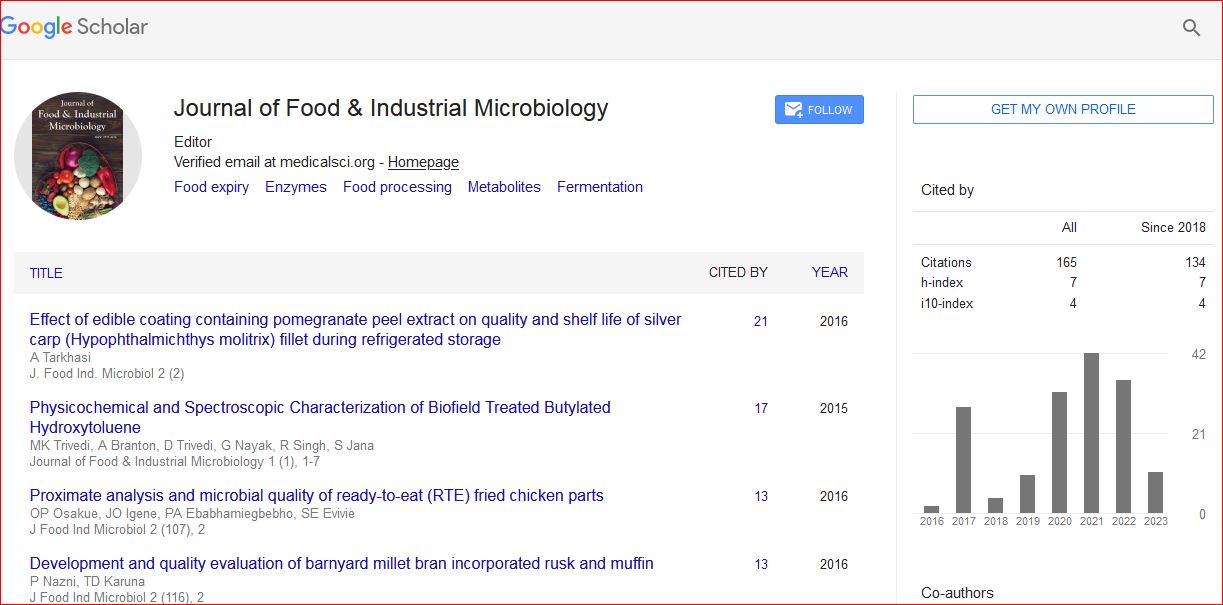
Journal of Food & Industrial Microbiology received 160 citations as per Google Scholar report