Perspective - (2025) Volume 11, Issue 4
Received: 01-Jul-2025, Manuscript No. jfim-26-178574;
Editor assigned: 03-Jul-2025, Pre QC No. P-178574;
Reviewed: 17-Jul-2025, QC No. Q-178574;
Revised: 22-Jul-2025, Manuscript No. R-178574;
Published:
29-Jul-2025
, DOI: 10.37421/2572-4134.2025.11.360
Citation: Anderson, Jacob L.. ”Omics Revolutionizing Food and Industrial Microbiology.” J Food Ind Microbiol 11 (2025):360.
Copyright: © 2025 Anderson L. Jacob This is an open-access article distributed under the terms of the Creative Commons Attribution License, which permits unrestricted use, distribution and reproduction in any medium, provided the original author and source are credited.
Omics technologies, encompassing genomics, transcriptomics, proteomics, and metabolomics, are fundamentally transforming the landscape of food and industrial microbiology by offering an unprecedentedly detailed view of microbial systems. These advanced tools enable a comprehensive understanding of microbial communities, their diverse functions, and their intricate interactions within complex environmental niches. In the critical domain of food microbiology, omics provide invaluable insights into the mechanisms of food spoilage, the assessment of food safety, and the optimization of fermentation processes, thereby facilitating enhanced control and fostering innovation in food production and preservation. For a wide array of industrial applications, these technologies are instrumental in optimizing bioprocesses, significantly enhancing the production of essential products such as biofuels, pharmaceuticals, and industrial enzymes, and crucially aiding in the strategic development of tailored microbial consortia for a multitude of specialized applications. [1] Metagenomics, a pivotal omics discipline, is exceptionally instrumental in meticulously dissecting the highly complex microbial communities that inherently reside within various food matrices. This powerful approach permits researchers to accurately identify dominant microbial species, characterize essential functional genes, and pinpoint potential pathogens or beneficial microbes without the stringent necessity for traditional cultivation methods. A profound understanding of these dynamic microbial population shifts is absolutely crucial for reliably predicting food spoilage, rigorously ensuring food safety standards, and strategically developing superior starter cultures for fermented foods that possess desired sensory profiles and extended shelf-life characteristics. [2] Transcriptomics offers a dynamic and invaluable snapshot of gene expression patterns within microbial populations under specific, controlled conditions, such as those encountered during fermentation processes or in response to various environmental stresses. This capability provides a crucial, real-time view of cellular physiological processes, vividly revealing which genes are actively activated or significantly repressed at any given moment. Within the sphere of industrial microbiology, this acquired knowledge is exceptionally helpful in fine-tuning fermentation parameters, accurately identifying critical bottlenecks in bioproduction pathways, and effectively engineering microbial strains to achieve enhanced product yields and improved process efficiency. [3] Proteomics, another cornerstone of omics research, allows for the precise identification and accurate quantification of proteins within a microbial cell, thereby providing profound insights into its functional state and metabolic activities. Observable changes in protein abundance and the presence of post-translational modifications can effectively reveal key metabolic pathways that are actively engaged and elucidate complex regulatory mechanisms governing cellular behavior. This analytical capability is particularly valuable for gaining a deep understanding of microbial stress responses encountered during food processing operations and for thoroughly characterizing the intricate enzymatic machinery employed by industrial microorganisms for various biotechnological purposes. [4] Metabolomics furnishes a comprehensive and holistic profile of low-molecular-weight metabolites present within a microbial cell or organism, which directly reflects its current physiological state and its interactions with the surrounding environment. In the context of food microbiology, this technology proves invaluable for understanding the complex biochemical pathways underlying flavor development, for the early detection of specific spoilage markers, and for the identification of potentially bioactive compounds with health-promoting properties. Similarly, in industrial settings, metabolomics significantly aids in the precise monitoring of fermentation efficiency and the identification of novel metabolic pathways that can be exploited for enhanced bioproduction. [5] The synergistic integration of multiple omics datasets, commonly referred to as multi-omics or systems biology, offers a profoundly holistic and interconnected understanding of microbial systems. By meticulously combining diverse information derived from genomics, transcriptomics, proteomics, and metabolomics, researchers are empowered to construct more accurate predictive models of microbial behavior and to anticipate their responses to dynamic environmental changes with greater precision. This integrated, systems-level approach is absolutely critical for deciphering the complexities of microbial interactions in diverse food webs and for optimizing sophisticated industrial bioprocesses. [6] In the critical area of food safety, omics technologies are actively transforming the methodologies for the detection, characterization, and surveillance of foodborne pathogens. Whole-genome sequencing, a powerful genomic tool, allows for the rapid and precise identification and characterization of microbial strains, thereby enabling highly accurate tracing of infection outbreaks and a deeper understanding of the mechanisms underlying antimicrobial resistance. This forward-thinking, proactive approach is fundamentally essential for effectively safeguarding public health and mitigating the risks associated with contaminated food products. [7] For the large-scale production of industrial enzymes, omics technologies are being extensively employed to discover novel enzymes possessing desirable catalytic properties and to engineer microbial hosts for achieving high-level expression of these enzymes. Transcriptomics and proteomics play crucial roles in elucidating enzyme production pathways and in optimizing fermentation conditions to maximize the yields of valuable biocatalysts that are widely utilized across various industrial sectors, contributing to more sustainable and efficient manufacturing processes. [8] The application of omics in the development of next-generation probiotics and functional foods holds significant promise for improving human health. By leveraging transcriptomics and metabolomics to gain a deeper understanding of the metabolic capabilities and complex interactions of beneficial microbes, researchers can effectively design targeted probiotic strains and functional food ingredients that offer enhanced health benefits and exhibit improved stability and efficacy. [9] Within the broad realm of industrial fermentation, omics technologies provide indispensable tools for both strain improvement and process optimization. Genomics and transcriptomics are instrumental in identifying key genes involved in the biosynthesis of valuable chemicals or biofuels, thereby facilitating targeted metabolic engineering efforts. Subsequently, proteomics and metabolomics enable the detailed monitoring of fermentation performance and the identification of specific factors that may be limiting overall productivity, leading to more efficient and cost-effective production of bio-based products. [10]
Omics technologies, including genomics, transcriptomics, proteomics, and metabolomics, are revolutionizing food and industrial microbiology. These tools allow for a comprehensive understanding of microbial communities, their functions, and their interactions within complex environments. In food microbiology, omics provide insights into food spoilage, safety, and fermentation processes, enabling better control and innovation. For industrial applications, they optimize bioprocesses, enhance the production of biofuels, pharmaceuticals, and enzymes, and aid in the development of microbial consortia for diverse applications. [1] Metagenomics is instrumental in dissecting the complex microbial communities residing in food matrices. This approach allows researchers to identify dominant species, functional genes, and potential pathogens or beneficial microbes without the need for cultivation. Understanding these dynamics is crucial for predicting food spoilage, ensuring food safety, and developing starter cultures for fermented foods with desired sensory profiles and shelf-life. [2] Transcriptomics offers a snapshot of gene expression in microbial populations under specific conditions, such as during fermentation or in response to stress. This provides a dynamic view of cellular processes, revealing which genes are activated or repressed. In industrial microbiology, this knowledge helps optimize fermentation parameters, identify bottlenecks in bioproduction, and engineer strains for enhanced product yield. [3] Proteomics allows for the identification and quantification of proteins, providing insights into the functional state of a microbial cell. Changes in protein abundance and post-translational modifications can reveal key metabolic pathways and regulatory mechanisms. This is particularly valuable in understanding microbial stress responses in food processing and in characterizing the enzymatic machinery of industrial microorganisms. [4] Metabolomics provides a comprehensive profile of low-molecular-weight metabolites within a cell or organism, reflecting its physiological state and environmental interactions. In food microbiology, it helps understand flavor development, detect spoilage markers, and identify bioactive compounds. In industrial settings, metabolomics aids in monitoring fermentation efficiency and identifying novel metabolic pathways for bioproduction. [5] The integration of multiple omics datasets, known as multi-omics or systems biology, offers a holistic understanding of microbial systems. By combining information from genomics, transcriptomics, proteomics, and metabolomics, researchers can build more accurate models of microbial behavior and predict responses to environmental changes. This integrated approach is critical for complex food webs and sophisticated industrial bioprocesses. [6] In food safety, omics technologies are transforming the detection and surveillance of foodborne pathogens. Whole-genome sequencing allows for rapid identification and characterization of microbial strains, enabling precise tracing of outbreaks and understanding of antimicrobial resistance mechanisms. This proactive approach is essential for safeguarding public health. [7] For the production of industrial enzymes, omics technologies are employed to identify novel enzymes with desired catalytic properties and to engineer microbial hosts for high-level expression. Transcriptomics and proteomics help understand enzyme production pathways and optimize fermentation conditions for maximizing yields of valuable biocatalysts used in various industries. [8] The application of omics in the development of next-generation probiotics and functional foods is significant. By understanding the metabolic capabilities and interactions of beneficial microbes using transcriptomics and metabolomics, researchers can design targeted probiotic strains and functional food ingredients with enhanced health benefits and improved stability. [9] In the realm of industrial fermentation, omics provide essential tools for strain improvement and process optimization. Genomics and transcriptomics help identify genes involved in the production of valuable chemicals or biofuels, facilitating metabolic engineering efforts. Proteomics and metabolomics then allow for the monitoring of fermentation performance and the identification of factors limiting productivity. [10]
Omics technologies like genomics, transcriptomics, proteomics, and metabolomics are revolutionizing food and industrial microbiology by providing comprehensive insights into microbial communities. In food microbiology, these tools enhance understanding of spoilage, safety, and fermentation, leading to better control and innovation. For industrial applications, omics optimize bioprocesses, improve the production of biofuels, pharmaceuticals, and enzymes, and assist in developing microbial consortia. Metagenomics dissects microbial communities in food without cultivation, crucial for predicting spoilage and ensuring safety. Transcriptomics reveals gene expression dynamics for optimizing fermentation and bioproduction. Proteomics offers insights into cellular functional states and stress responses. Metabolomics profiles metabolites, aiding in flavor development and spoilage detection. Multi-omics integration provides a holistic view for predictive modeling. Omics are transforming food safety through pathogen surveillance and antimicrobial resistance studies. They are also vital for discovering and producing industrial enzymes and for engineering next-generation probiotics and functional foods. In industrial fermentation, omics drive strain improvement and process optimization for valuable bio-based products.
None
None
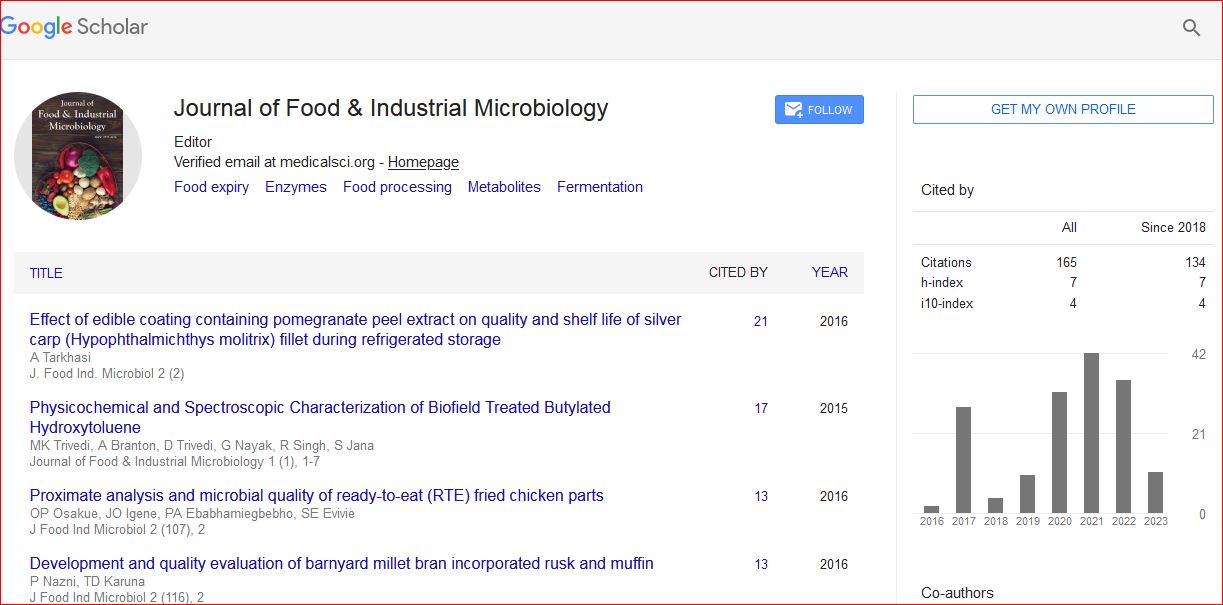
Journal of Food & Industrial Microbiology received 160 citations as per Google Scholar report