Short Communication - (2025) Volume 11, Issue 3
Received: 02-May-2025, Manuscript No. jfim-26-178566;
Editor assigned: 05-May-2025, Pre QC No. P-178566;
Reviewed: 19-May-2025, QC No. Q-178566;
Revised: 23-May-2025, Manuscript No. R-178566;
Published:
30-May-2025
, DOI: 10.37421/2572-4134.2025.11.352
Citation: Miller, David R.. ”Minimally Processed Foods: Microbial Safety Challenges and Solutions.” J Food Ind Microbiol 11 (2025):352.
Copyright: © 2025 Miller R. David This is an open-access article distributed under the terms of the Creative Commons Attribution License, which permits unrestricted use, distribution and reproduction in any medium, provided the original author and source are credited.
Minimally processed foods, while increasingly favored by consumers for their fresh-like qualities, present distinct microbial safety challenges that demand careful consideration within the food industry. These products often undergo less severe processing techniques, a characteristic that, while preserving desirable sensory attributes, may not be sufficient to eliminate all pathogenic microorganisms, thereby elevating the risk of foodborne illnesses. Significant concerns revolve around the potential survival and proliferation of common bacterial pathogens such as Listeria monocytogenes, Salmonella, and E. coli, in addition to viruses and parasites. Critical control points, including inadequate sanitation, cross-contamination, and temperature abuse across production, storage, and distribution stages, necessitate vigilant management and robust oversight. Emerging processing technologies are continuously being developed with the aim of enhancing food safety without compromising the sensory appeal of these foods, yet these innovations require thorough validation before widespread implementation. [1] The growing popularity of minimally processed foods, often promoted for their nutritional benefits and superior sensory profiles, underscores the imperative for a comprehensive understanding of the associated microbial risks. Research in this area highlights the persistence of vegetative bacterial cells and heat-resistant spores within foods subjected to mild processing, emphasizing the critical need for stringent hygiene practices throughout the entire supply chain. Particular attention is directed towards ready-to-eat products, where the risk of post-processing contamination represents a major vulnerability and a significant concern for public health. [2] This article investigates the critical control points inherent in the production of minimally processed foods, with a specific focus on identifying potential sources of microbial contamination that could compromise product safety. It strongly emphasizes the importance of implementing established food safety management systems, such as Good Manufacturing Practices (GMPs) and Hazard Analysis and Critical Control Points (HACCP), as essential strategies to effectively mitigate these risks. Furthermore, the study undertakes a review of innovative hurdle technologies, which are designed to enhance microbial inactivation without causing substantial alterations to the overall quality of the food product. [3] The inherent fragility associated with minimally processed foods renders them particularly susceptible to microbial spoilage and the subsequent growth of pathogenic microorganisms. This paper delves into the documented prevalence of specific foodborne pathogens, most notably Listeria monocytogenes, within these types of products and critically discusses the efficacy of various decontamination methods that can be employed. It strongly emphasizes the fundamental necessity for continuous monitoring protocols and rigorous risk assessment procedures to be integrated throughout the entire food production lifecycle. [4] This study meticulously focuses on the multifaceted impact of different processing and storage conditions on the microbial viability and overall safety of minimally processed vegetables. It effectively highlights how various factors, including the type of packaging atmosphere employed, the precise storage temperature maintained, and the presence or absence of specific sanitizing agents, can significantly influence the growth dynamics of both spoilage microorganisms and potential foodborne pathogens. The research advocates for the adoption of integrated approaches that combine targeted processing interventions with the implementation of highly effective supply chain management strategies. [5] Consumer demand for food products that retain fresh-like characteristics and undergo minimal processing has experienced a substantial surge in recent years. However, this growing trend introduces novel and significant food safety considerations that must be addressed. This review synthesizes the current body of scientific knowledge pertaining to the microbial hazards intrinsically associated with such food products, including a detailed examination of the potential for pathogen survival and subsequent growth. It strongly emphasizes the critical need for the development and implementation of rigorous risk assessments and the continuous refinement of effective control measures across the entire food processing continuum. [6] The inherent challenges associated with ensuring the microbial safety of minimally processed foods are considerably amplified by the absence of severe, inactivating thermal or chemical treatments. This research systematically explores the intricate role that both intrinsic food properties and extrinsic environmental factors play in influencing the microbial stability of these delicate products. It underscores the paramount importance of maintaining exceptionally strict hygienic conditions throughout the processing environment and the imperative of implementing thoroughly validated control measures to effectively prevent microbial contamination and subsequent proliferation. [7] This paper critically addresses the often-underestimated issue of viral contamination within minimally processed foods, a concern with significant public health implications. Given the remarkable resilience of many common viruses, it is acknowledged that traditional, mild processing methods may prove insufficient for their effective inactivation. The study therefore strongly emphasizes the urgent need for the development and implementation of enhanced sanitation protocols, the optimization of effective washing steps, and the establishment of robust surveillance programs for viral presence to safeguard public health. [8] The effective control of bacterial biofilms within the processing environments specifically associated with minimally processed foods represents a significant and persistent hurdle for the food industry. Biofilms provide a protected niche for bacterial colonization, rendering these microorganisms considerably more resistant to conventional disinfection agents and procedures. This research meticulously examines the complex challenges posed by biofilm formation and critically evaluates innovative strategies aimed at their effective removal and long-term prevention, which are absolutely crucial for maintaining the highest standards of product safety. [9] Parasitic contamination of minimally processed foods represents a considerable public health risk that is regrettably often overlooked or underestimated by both consumers and industry stakeholders. This article provides a comprehensive discussion of the various types of parasites that are commonly found contaminating fresh produce and critically examines the limitations inherent in conventional washing techniques for their effective removal. It strongly highlights the importance of implementing stringent source control measures, employing effective disinfection strategies, and promoting consumer education to minimize the risk of transmission and subsequent illness. [10]
Minimally processed foods, valued for their natural qualities, present substantial microbial safety concerns due to less severe treatments, which can allow pathogens like Listeria, Salmonella, and E. coli to survive and grow. Inadequate sanitation, cross-contamination, and temperature mismanagement are critical failure points. While new processing methods aim to improve safety without altering sensory traits, they require thorough validation. [1] The increasing preference for minimally processed foods, often lauded for their nutritional and sensory merits, necessitates a deeper understanding of their associated microbial risks. This research highlights how vegetative bacterial cells and spores can persist in mildly processed foods, underscoring the need for robust hygiene across the supply chain, especially for ready-to-eat products where post-processing contamination is a key concern. [2] This article scrutinizes the critical control points in the production of minimally processed foods, identifying potential microbial contamination sources. It stresses the importance of implementing Good Manufacturing Practices (GMPs) and Hazard Analysis and Critical Control Points (HACCP) systems for risk mitigation. Innovative hurdle technologies that enhance microbial inactivation without significantly impacting food quality are also reviewed. [3] Minimally processed foods, due to their inherent fragility, are highly susceptible to microbial spoilage and pathogen proliferation. This paper examines the prevalence of pathogens like Listeria monocytogenes in these products and evaluates various decontamination methods, emphasizing the continuous need for monitoring and risk assessment throughout the food production lifecycle. [4] This study investigates how processing and storage conditions affect the microbial viability and safety of minimally processed vegetables. Factors such as packaging atmosphere, temperature, and sanitizing agents influence the growth of spoilage organisms and pathogens. The research promotes integrated approaches combining processing interventions with effective supply chain management. [5] The surge in consumer demand for fresh-like, minimally processed foods introduces new food safety considerations. This review synthesizes current knowledge on microbial hazards in such products, including pathogen survival and growth potential, stressing the necessity for rigorous risk assessments and effective control measures throughout the food processing continuum. [6] Ensuring the microbial safety of minimally processed foods is complicated by the lack of severe inactivating treatments. This research explores how intrinsic and extrinsic factors impact microbial stability in these products, highlighting the importance of strict hygiene and validated control measures to prevent contamination and proliferation. [7] Viral contamination in minimally processed foods poses a significant public health risk, as mild processing methods may not inactivate resilient viruses. This paper emphasizes the need for improved sanitation, effective washing, and surveillance for viral presence to ensure public safety. [8] Controlling bacterial biofilms in minimally processed food production environments is a major challenge, as biofilms protect bacteria from disinfection. This research examines these challenges and evaluates innovative strategies for biofilm removal and prevention, which are crucial for maintaining product safety. [9] Parasitic contamination in minimally processed fruits and vegetables is an often-overlooked public health concern. This article discusses common parasites and the limitations of standard washing, emphasizing source control, disinfection, and consumer education to minimize transmission risks. [10]
Minimally processed foods, while appealing for their fresh-like qualities, present significant microbial safety challenges due to less severe processing. This can lead to the survival and growth of pathogens like Listeria, Salmonella, and E. coli, as well as viruses and parasites. Critical control points such as sanitation, temperature control, and cross-contamination require vigilant management throughout the supply chain. Established food safety systems like GMPs and HACCP are essential for risk mitigation. Innovative hurdle technologies and effective decontamination methods are being explored to enhance safety without compromising quality. Continuous monitoring, robust hygiene practices, and integrated approaches combining processing interventions with supply chain management are crucial for ensuring the safety of these products. Addressing biofilm formation and parasitic contamination also remains a key concern.
None
None
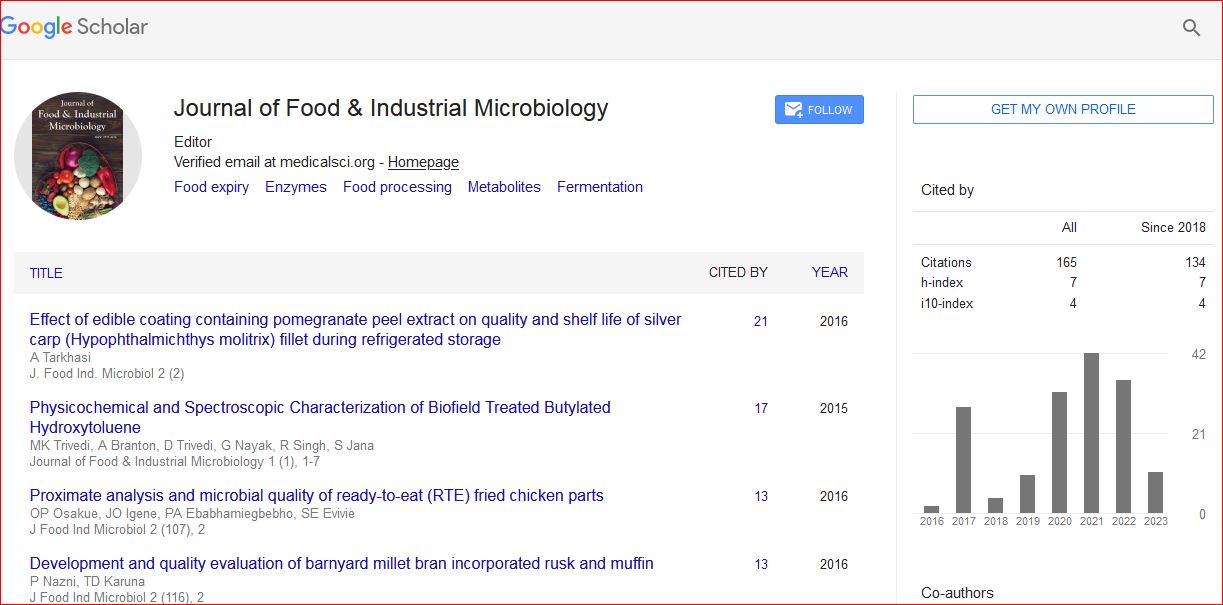
Journal of Food & Industrial Microbiology received 160 citations as per Google Scholar report