Perspective - (2025) Volume 11, Issue 6
Received: 01-Nov-2025, Manuscript No. jfim-26-178593;
Editor assigned: 03-Nov-2025, Pre QC No. P-178593;
Reviewed: 17-Nov-2025, QC No. Q-178593;
Revised: 24-Nov-2025, Manuscript No. R-178593;
Published:
29-Nov-2025
, DOI: 10.37421/2572-4134.2025.11.379
Citation: Horvath, Veronika K.. ”Microbial Lipids: Sustainable Fat Alternatives For Food.” J Food Ind Microbiol 11 (2025):379.
Copyright: © 2025 Horvath K. Veronika This is an open-access article distributed under the terms of the Creative Commons Attribution License, which permits unrestricted use, distribution and reproduction in any medium, provided the original author and source are credited.
Microbial lipids, also known as single-cell oils, are emerging as a sustainable and adaptable alternative to conventional lipid sources within the food industry. Their potential lies in their capacity to yield functional food ingredients, including essential omega-3 and omega-6 fatty acids, and to serve as functional components like fat replacers and emulsifiers. The controlled nutrient profiles and inherent scalability of production processes, particularly through the fermentation of oleaginous microorganisms such as yeasts and microalgae, make them highly attractive for food applications [1].
The exploration of oleaginous yeast strains, such as *Rhodosporidium toruloides*, is proving fruitful for identifying sources of food-grade lipids. Research in this area focuses on optimizing lipid accumulation and characterizing the resulting polyunsaturated fatty acids (PUFAs) for their potential to enhance food formulations with both nutritional and functional benefits [2].
Microalgae, specifically strains like *Schizochytrium sp.*, are also being investigated for their lipid content, with a particular emphasis on the efficient extraction and purification of docosahexaenoic acid (DHA), a critical omega-3 fatty acid. The goal is to ensure its suitability for seamless incorporation into a variety of food products, thereby leveraging its health benefits [3].
Beyond their nutritional value, microbial lipids are being recognized for their functional properties as fat replacers in food systems. Studies are examining how these lipids can be manipulated to improve the texture and mouthfeel of reduced-fat products, demonstrating their utility in altering the sensory and physicochemical characteristics of food matrices [4].
Furthermore, the emulsifying capabilities of microbial lipids are a significant area of research. Lipids derived from yeasts such as *Yarrowia lipolytica* are being assessed for their interfacial properties and their efficacy in stabilizing oil-in-water emulsions, contributing to improved product homogeneity and extended shelf life [5].
The nutritional enrichment of microbial lipids with essential fatty acids, including eicosapentaenoic acid (EPA) and DHA, is another key focus. Advances in metabolic engineering are enabling the enhanced production of specific fatty acid profiles, making these lipids valuable for health-promoting food ingredients and dietary supplements [6].
From a broader perspective, the sustainability and economic viability of microbial lipid production for food applications are under thorough evaluation. Comparative analyses of different microbial sources and fermentation strategies, considering feedstock costs, energy inputs, and waste generation, provide a comprehensive life cycle assessment of these bio-based ingredients [7].
The application of microbial lipids extends to their use in forming oleogels. Research is demonstrating how these lipids can be structured to create oleogels with desirable textural properties, offering a solid fat alternative that can mimic the functionality of traditional fats in various food products [8].
Alongside technological advancements, the regulatory landscape and safety considerations for incorporating microbial lipids into food are crucial. Understanding aspects such as GRAS status, allergenicity, and contaminant profiles is essential for the successful commercialization of these novel ingredients [9].
Finally, the valorization of waste streams for microbial lipid production presents a compelling eco-friendly approach. Research is actively exploring the use of agricultural by-products as substrates for oleaginous microorganisms, aiming to produce valuable lipids while simultaneously addressing waste management challenges [10].
Microbial lipids, or single-cell oils, are gaining prominence as a sustainable and adaptable resource for the food industry, offering a viable alternative to conventional lipid sources. Their versatility allows for the development of functional food ingredients, such as omega-3 and omega-6 fatty acids, and they also function effectively as fat replacers and emulsifiers. The production of these lipids through the fermentation of oleaginous microorganisms, including yeasts and microalgae, provides a controlled method for achieving specific nutrient profiles and ensures scalability for industrial applications [1].
Oleaginous yeasts, exemplified by *Rhodosporidium toruloides*, are being extensively studied as sources of food-grade lipids. The research in this domain is dedicated to optimizing the conditions for lipid accumulation within these yeasts and meticulously characterizing the extracted lipids, particularly polyunsaturated fatty acids (PUFAs), to assess their potential as valuable ingredients in diverse food formulations and to understand their associated nutritional and functional advantages [2].
Microalgae, such as *Schizochytrium sp.*, are also being targeted for their lipid-rich biomass. Significant effort is being directed towards developing efficient extraction and purification techniques to maximize the yield and purity of docosahexaenoic acid (DHA), a vital omega-3 fatty acid. This work aims to confirm the suitability of microalgal DHA for incorporation into food products, thereby enhancing their nutritional value [3].
Beyond their direct nutritional contributions, microbial lipids are being recognized for their functional roles, particularly as fat replacers in various food systems. Investigations are exploring how these lipids can be utilized to modify the textural attributes and mouthfeel of food products with reduced fat content, highlighting their significance in influencing the sensory and physicochemical properties of food matrices [4].
The emulsifying properties of microbial lipids are another area of intense research and development. Lipids obtained from specific yeasts, such as *Yarrowia lipolytica*, are being evaluated for their interfacial behavior and their capacity to form stable emulsions. Their effectiveness in stabilizing oil-in-water systems is crucial for enhancing product homogeneity and extending shelf life in emulsified food products [5].
The potential for enriching microbial lipids with nutritionally significant fatty acids, including EPA and DHA, is a key driver in this field. Advances in metabolic engineering are crucial for enhancing the production of specific fatty acid profiles in microorganisms, making these lipids highly desirable for incorporation into health-promoting food ingredients and dietary supplements [6].
An important consideration for the widespread adoption of microbial lipids is their sustainability and economic feasibility. Studies are undertaking comprehensive techno-economic analyses and sustainability assessments, comparing various microbial sources and fermentation methodologies. These evaluations consider factors such as feedstock costs, energy consumption, and waste generation to provide a holistic life cycle perspective [7].
Microbial lipids are also being explored for their role in creating oleogels, a novel class of food ingredients. Research demonstrates that by structuring microbial lipids, oleogels with desirable textural characteristics can be formed. These oleogels serve as effective alternatives to solid fats, capable of mimicking the functional properties of traditional fats in a wide range of food applications [8].
Navigating the regulatory framework and ensuring the safety of microbial lipids for food applications are paramount. Studies are examining aspects such as Generally Recognized As Safe (GRAS) status, potential allergenicity, and contaminant profiles. This work provides essential guidance for the successful and safe integration of these innovative ingredients into commercial food products [9].
Furthermore, the utilization of waste streams as substrates for microbial lipid production offers a sustainable and environmentally conscious approach. Research is focused on the valorization of agro-industrial by-products through fermentation processes using oleaginous microorganisms, presenting an eco-friendly pathway for generating valuable lipids while simultaneously addressing waste management issues [10].
Microbial lipids, or single-cell oils, are recognized as a sustainable and versatile alternative to traditional fat sources in food applications. They offer potential as functional ingredients, including omega-3 and omega-6 fatty acids, and serve as fat replacers and emulsifiers. Production via fermentation of oleaginous microorganisms like yeasts and microalgae ensures controlled nutrient profiles and scalability. Research focuses on optimizing lipid accumulation in specific yeast strains and efficient extraction from microalgae for DHA. Microbial lipids also impact food texture and stability, and advancements in metabolic engineering enhance their nutritional value. Sustainability and economic feasibility are being assessed, alongside their use in oleogels. Regulatory and safety aspects are crucial for their commercial integration, and valorizing waste streams for production presents an eco-friendly approach.
None
None
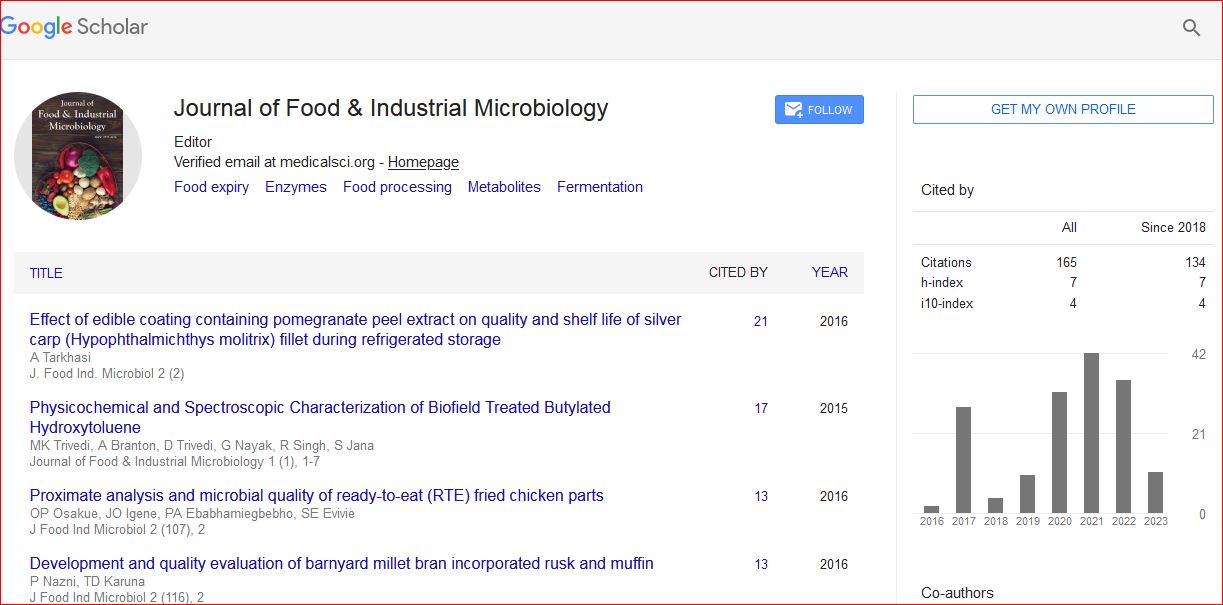
Journal of Food & Industrial Microbiology received 160 citations as per Google Scholar report