Short Communication - (2025) Volume 11, Issue 5
Received: 01-Sep-2025, Manuscript No. jfim-26-178585;
Editor assigned: 03-Sep-2025, Pre QC No. P-178585;
Reviewed: 17-Sep-2025, QC No. Q-178585;
Revised: 22-Sep-2025, Manuscript No. R-178585;
Published:
29-Sep-2025
, DOI: 10.37421/2572-4134.2025.11.371
Citation: Collins, Matthew O.. "Microbes Powering Sustainable Food Packaging Innovations." J Food Ind Microbiol 11 (2025):371.
Copyright: © 2025 Collins O. Matthew This is an open-access article distributed under the terms of the Creative Commons Attribution License, which permits unrestricted use, distribution and reproduction in any medium, provided the original author and source are credited.
Microorganisms are emerging as indispensable agents in the advancement of innovative food packaging solutions, offering a paradigm shift towards sustainability and enhanced food preservation. Their multifaceted roles encompass the production of critical active packaging components, such as potent antimicrobial agents and protective antioxidants. Furthermore, microorganisms are instrumental in the creation of entirely biodegradable films, presenting bio-based materials that serve as environmentally conscious alternatives to conventional petroleum-derived plastics. This bio-integrated approach not only bolsters food safety but also significantly extends product shelf life by actively counteracting microbial spoilage and oxidative degradation pathways. Lactic acid bacteria (LAB), a well-studied group of microorganisms, are recognized for their capacity to yield bacteriocins, a class of antimicrobial peptides with significant potential in food preservation. When these bacteriocins are skillfully incorporated into packaging matrices, they exert a direct inhibitory effect on the proliferation of pathogenic and spoilage bacteria that may contaminate food surfaces. This mechanism consequently leads to enhanced food safety and a prolonged period of product freshness, thereby offering a natural and additive-free method for extending the viability of food items. While often perceived as detrimental agents contributing to food spoilage, yeasts and molds possess a remarkable ability to be harnessed for the synthesis of valuable biopolymers essential for packaging applications. Certain species of yeasts, for instance, are capable of producing polyhydroxyalkanoates (PHAs), a group of naturally occurring biodegradable polyesters. These PHAs can be meticulously processed into versatile films and coatings, providing an ecologically sound substitute for traditional plastics and actively contributing to the establishment of a circular economy within the food packaging industry. The deployment of microbial enzymes within the realm of food packaging is experiencing a notable upsurge in interest and application. Enzymes such as glucose oxidase, for example, demonstrate a crucial capability in scavenging free oxygen from the packaging headspace. This oxygen depletion effectively inhibits oxidative processes affecting food components and curtails the growth of aerobic microorganisms responsible for spoilage, ultimately leading to extended shelf life and preserved food quality. Mycelium, the intricate vegetative network of fungi, presents a novel and sustainable material for packaging. By cultivating mycelium on agricultural waste substrates, a natural and entirely compostable packaging material can be generated. This innovative 'mycelium packaging' boasts desirable attributes, including remarkable lightness and effective insulating properties, while also being amenable to molding into diverse shapes for practical application. Its production process is characterized by low energy consumption and environmental friendliness, positioning it as a compelling alternative to polystyrene and other synthetic packaging foams. Probiotics, defined as live beneficial microorganisms, are currently undergoing extensive investigation for their potential integration into active food packaging systems. The concept involves the controlled release of these probiotics from the packaging material onto the food surface, where they can actively modulate and enhance the existing microbial ecosystem of the food. This innovative strategy holds the promise of simultaneously improving food safety and augmenting its nutritional value, marking a significant step forward in functional food packaging design. Bacterial cellulose, a sophisticated biopolymer meticulously produced by specific Acetobacter species, stands out as a highly promising biomaterial for advanced food packaging. Its superior mechanical strength, exceptional purity, and inherent biodegradability are key advantages. The unique nanofibrous architecture of bacterial cellulose imparts an excellent barrier against the ingress of gases and moisture, rendering it ideally suited for the development of active and intelligent packaging systems focused on optimizing food preservation and enabling real-time monitoring. Microbial fermentation processes are being strategically leveraged for the synthesis of a diverse array of functional compounds integral to the development of smart food packaging solutions. These include, but are not limited to, pH-sensitive dyes that visually indicate food spoilage and ethylene scavengers designed to absorb gases detrimental to food quality. Such components empower packaging systems to dynamically communicate the condition of the food, thereby providing crucial real-time information to both consumers and manufacturers regarding food quality and safety. Chitosan, a versatile biopolymer primarily derived from chitinâ??a substance abundantly found in crustacean exoskeletons and fungal cell wallsâ??can be effectively produced and subsequently modified through sophisticated microbial processes. Chitosan-based films are recognized for their potent antimicrobial and antioxidant attributes, making them highly effective components in active food packaging formulations. Their inherent biodegradability and excellent biocompatibility further enhance their appeal as sustainable and safe packaging alternatives. The integration of genetically engineered microorganisms into the fabric of packaging materials represents a cutting-edge frontier in food packaging technology. This advanced approach facilitates the in-situ production of specific functional molecules, such as vibrant pigments or informative signaling compounds, directly within the packaging itself. Such capabilities pave the way for the creation of highly responsive packaging systems, exemplified by those that can visually change color in response to specific spoilage indicators, offering a clear and immediate visual cue to the consumer regarding food quality and safety.
Microorganisms are increasingly vital in developing innovative food packaging, encompassing their use in producing active packaging components like antimicrobial agents or antioxidants, and in creating biodegradable films. These bio-based materials offer sustainable alternatives to conventional plastics, enhancing food safety and extending shelf life by actively inhibiting microbial spoilage or oxidative degradation [1].
Lactic acid bacteria (LAB) play a significant role in producing bacteriocins, which are antimicrobial peptides. When incorporated into packaging materials, these bacteriocins can inhibit the growth of pathogenic and spoilage bacteria on food surfaces, thereby improving food safety and extending product freshness. This approach offers a natural way to preserve food without synthetic additives [2].
Yeasts and molds, often considered spoilage agents, can be harnessed to produce valuable biopolymers for packaging. For instance, certain yeasts can synthesize polyhydroxyalkanoates (PHAs), which are biodegradable polyesters. These PHAs can be processed into films and coatings, offering an eco-friendly alternative to petroleum-based plastics and contributing to a circular economy in food packaging [3].
The use of microbial enzymes in food packaging is gaining traction. Enzymes like glucose oxidase can scavenge oxygen from the packaging headspace, thus inhibiting the oxidation of food components and the growth of aerobic spoilage microorganisms. This active packaging approach extends the shelf life and maintains the quality of packaged foods [4].
Mycelium, the vegetative part of fungi, can be grown on agricultural waste to form a natural, compostable packaging material. This mycelium packaging is lightweight, has good insulating properties, and can be molded into various shapes. Its production is low-energy and environmentally friendly, offering a sustainable alternative to polystyrene and other synthetic packaging foams [5].
Probiotics, live beneficial microorganisms, are being explored for incorporation into active food packaging. These probiotics can be released from the packaging to the food surface, actively improving the microbial ecosystem of the food and potentially enhancing its safety and nutritional value. This represents a novel approach to functional food packaging [6].
Bacterial cellulose, produced by Acetobacter species, is a promising biomaterial for food packaging. It offers excellent mechanical properties, high purity, and biodegradability. Its nanofibrous structure provides a good barrier against gases and moisture, making it suitable for active and intelligent packaging applications that aim to improve food preservation and monitoring [7].
Microbial fermentation can be utilized to produce various compounds used in smart food packaging, such as pH-sensitive dyes or ethylene scavengers. These components allow the packaging to indicate the food's condition or absorb spoilage gases, providing consumers and manufacturers with real-time information about food quality and safety [8].
Chitosan, a biopolymer derived from chitin (abundant in crustacean shells and fungi), can be produced and modified using microbial processes. Chitosan-based films exhibit antimicrobial and antioxidant properties, making them effective for food packaging. Their biodegradability and biocompatibility contribute to their appeal as sustainable packaging solutions [9].
The integration of genetically engineered microorganisms into packaging materials allows for the production of specific functional molecules, such as pigments or signaling compounds, directly within the packaging. This approach enables the development of responsive packaging that can change color in response to spoilage indicators, providing a visual cue to food quality [10].
Microorganisms are central to developing innovative and sustainable food packaging. They produce active packaging components like antimicrobials and antioxidants, and create biodegradable films, offering eco-friendly alternatives to plastics that enhance food safety and shelf life. Lactic acid bacteria yield bacteriocins that inhibit spoilage microbes naturally. Yeasts and molds can synthesize biopolymers such as polyhydroxyalkanoates (PHAs) for compostable packaging. Microbial enzymes, like glucose oxidase, scavenge oxygen to prevent food degradation. Mycelium from fungi forms natural, compostable packaging materials. Probiotics incorporated into packaging can enhance the food's microbial ecosystem. Bacterial cellulose offers strong, biodegradable barrier properties. Microbial fermentation produces compounds for smart packaging, indicating food condition. Chitosan, a microbial-modified biopolymer, provides antimicrobial and antioxidant benefits. Genetically engineered microbes enable packaging to produce functional molecules for responsive displays of food quality.
None
None
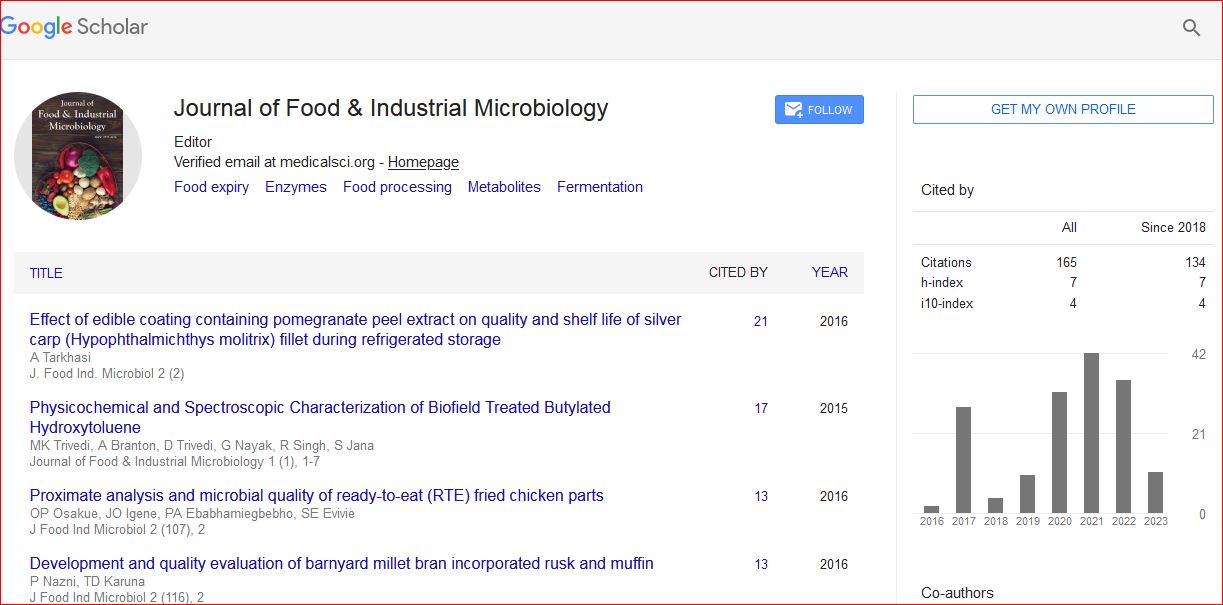
Journal of Food & Industrial Microbiology received 160 citations as per Google Scholar report