Commentary - (2025) Volume 11, Issue 4
Received: 01-Jul-2025, Manuscript No. jfim-26-178568;
Editor assigned: 03-Jul-2025, Pre QC No. P-178568;
Reviewed: 17-Jul-2025, QC No. Q-178568;
Revised: 22-Jul-2025, Manuscript No. R-178568;
Published:
29-Jul-2025
, DOI: 10.37421/2572-4134.2025.11.354
Citation: El-Sayed, Ahmed T.. ”Industrial Microbiology: Enhancing Ethnic Fermented Foods.” J Food Ind Microbiol 11 (2025):354.
Copyright: © 2025 El-Sayed T. Ahmed This is an open-access article distributed under the terms of the Creative Commons Attribution License, which permits unrestricted use, distribution and reproduction in any medium, provided the original author and source are credited.
The field of industrial microbiology has witnessed significant advancements, particularly in its application to the production of traditional and ethnic fermented foods. These foods, rich in cultural heritage, rely heavily on the intricate interplay of microbial communities to develop their unique sensory profiles and nutritional value [1].
Research has increasingly focused on understanding the specific roles of microorganisms in imparting desirable flavors, textures, and health benefits to these culturally significant food products [1].
Modern approaches are being employed to optimize fermentation processes, ensuring both quality and safety in industrial settings [1].
Lactic acid bacteria (LAB) are central to many ethnic fermented foods, and current research is exploring their metabolic pathways and potential for genetic engineering. Understanding the genomics and proteomics of LAB can lead to the development of advanced starter cultures with enhanced functionalities, including improved probiotic properties, flavor generation, and preservation capabilities, opening avenues for innovative industrial applications [2].
Yeasts and molds play a crucial role in shaping the sensory characteristics of various ethnic fermented products through their enzymatic activities. Enzymes such as proteases, lipases, and amylases are vital for breaking down complex macromolecules, contributing to the distinctive aromas, tastes, and textures of these foods [3].
Controlling undesirable enzymatic reactions is also a key aspect of ensuring product quality and safety [3].
High-throughput sequencing technologies, including metagenomics and metatranscriptomics, are revolutionizing the characterization of microbial communities in ethnic fermented foods. These advanced techniques offer unprecedented insights into the complex interactions between microbial species and their functions within the fermentation process, aiding in the identification of critical microbes and the development of standardized industrial protocols [4].
Traditional methods for fermenting specific ethnic foods, such as pickles and dairy products, are being meticulously analyzed to understand the microbial consortia involved. Industrial microbiology aims to standardize and scale up these processes while preserving the authentic characteristics and health benefits, like improved digestibility and the generation of functional compounds, that are embedded in traditional knowledge [5].
Bacteriocins produced by lactic acid bacteria in ethnic fermented foods are gaining attention as natural preservatives. These antimicrobial peptides act against spoilage and pathogenic bacteria, showing potential for extending the shelf life and enhancing the safety of fermented products in industrial applications [6].
Strategies for optimizing bacteriocin production are an active area of research [6].
The development of biosensors for the rapid detection and quantification of key microorganisms and metabolites in the industrial fermentation of ethnic foods is a significant technological advancement. These biosensing technologies enable real-time monitoring of fermentation parameters, ensuring consistent quality, safety, and authenticity, while improving process control and reducing production costs [7].
Optimizing fermentation conditions, including temperature, pH, and substrate composition, is critical for the growth and metabolic activity of industrially relevant microorganisms in ethnic fermented foods. Research in this area focuses on enhancing the production of desired flavor compounds, textural properties, and nutritional value, leading to more efficient and controlled industrial fermentation processes [8].
Starter cultures are fundamental to the industrial production of ethnic fermented foods, playing a pivotal role in controlling fermentation processes and ensuring consistent product quality. The careful selection and application of specific microbial consortia are essential for achieving desired sensory attributes, safety, and shelf-life, effectively bridging traditional practices with modern industrial microbiology [9].
Fermented foods offer potential health benefits attributed to the microbial metabolites and bioactive compounds produced during fermentation. Industrial microbiology can further enhance these benefits by optimizing fermentation processes to increase the bioavailability and yield of beneficial compounds such as probiotics, prebiotics, and antioxidants [10].
The advancements in industrial microbiology are profoundly impacting the production of traditional and ethnic fermented foods. This domain focuses on harnessing the power of microorganisms to enhance flavor, texture, and nutritional profiles, while also ensuring safety and quality in large-scale production [1].
Specific microbial roles are being elucidated, providing a deeper understanding of their contribution to the unique characteristics of these foods [1].
Lactic acid bacteria (LAB) are a major focus of research within ethnic fermented food production, with an emphasis on metabolic engineering and genetic modification. The goal is to develop starter cultures with superior functionality, including improved probiotic qualities and enhanced flavor generation, facilitating novel industrial applications and product development [2].
The enzymatic contributions of yeasts and molds to the sensory attributes of ethnic fermented products are under scrutiny. Investigations into enzymes like proteases, lipases, and amylases are crucial for understanding how these microorganisms break down macromolecules, influencing aroma, taste, and texture, and how to manage undesirable enzymatic activities for optimal results [3].
High-throughput sequencing technologies, specifically metagenomics and metatranscriptomics, are providing unprecedented insights into the complex microbial ecosystems of ethnic fermented foods. This allows for a detailed understanding of microbial interactions and their roles in fermentation, which is essential for identifying key functional microbes and establishing robust industrial fermentation protocols [4].
Traditional fermentation techniques for ethnic foods are being analyzed through the lens of industrial microbiology. The objective is to standardize and scale up these processes, ensuring that the authentic characteristics and health benefits, such as improved digestibility and the creation of functional compounds, are maintained and even enhanced [5].
Bacteriocins produced by lactic acid bacteria in ethnic fermented foods are being explored for their potential as natural antimicrobial agents. Research highlights their efficacy against spoilage and pathogenic bacteria, offering a path towards extending product shelf life and improving food safety in industrial settings through optimized bacteriocin production [6].
Biosensor technology is emerging as a critical tool for quality control in the industrial fermentation of ethnic foods. These sensors facilitate rapid detection of microorganisms and metabolites, enabling real-time monitoring of fermentation parameters to ensure consistent quality, safety, and authenticity, thereby optimizing process control and reducing costs [7].
The optimization of fermentation parameters, such as temperature, pH, and substrate composition, is vital for maximizing the production of desirable compounds in ethnic fermented foods. This research aims to fine-tune these conditions to enhance flavor, texture, and nutritional value, leading to more efficient and controlled industrial fermentation processes [8].
Starter cultures are indispensable for the industrial production and quality control of ethnic fermented foods. Their ability to direct fermentation processes and guarantee consistent product attributes is crucial. The strategic selection and application of microbial consortia are key to achieving desired sensory qualities, safety, and extended shelf-life, effectively integrating traditional methods with modern industrial practices [9].
The health benefits associated with ethnic fermented foods are being further explored through the lens of industrial microbiology. By optimizing fermentation processes, the goal is to enhance the production and bioavailability of beneficial compounds, such as probiotics, prebiotics, and antioxidants, thereby maximizing their positive impact on human health [10].
This collection of research highlights the critical role of industrial microbiology in the production and enhancement of traditional and ethnic fermented foods. Advances in understanding microbial diversity, metabolic pathways, and enzymatic activities are leading to improved flavor, texture, and nutritional profiles. High-throughput sequencing technologies enable detailed characterization of microbial ecosystems, while metabolic engineering of lactic acid bacteria and the utilization of bacteriocins offer new avenues for starter culture development and natural preservation. Biosensor technology aids in real-time quality control and process optimization. Furthermore, research is focused on optimizing fermentation parameters and harnessing starter cultures to ensure consistent product quality and safety. The potential health benefits of these foods are also being explored and enhanced through optimized industrial fermentation processes. Overall, these studies bridge traditional knowledge with modern scientific approaches to promote the production and consumption of safe, high-quality ethnic fermented foods.
None
None
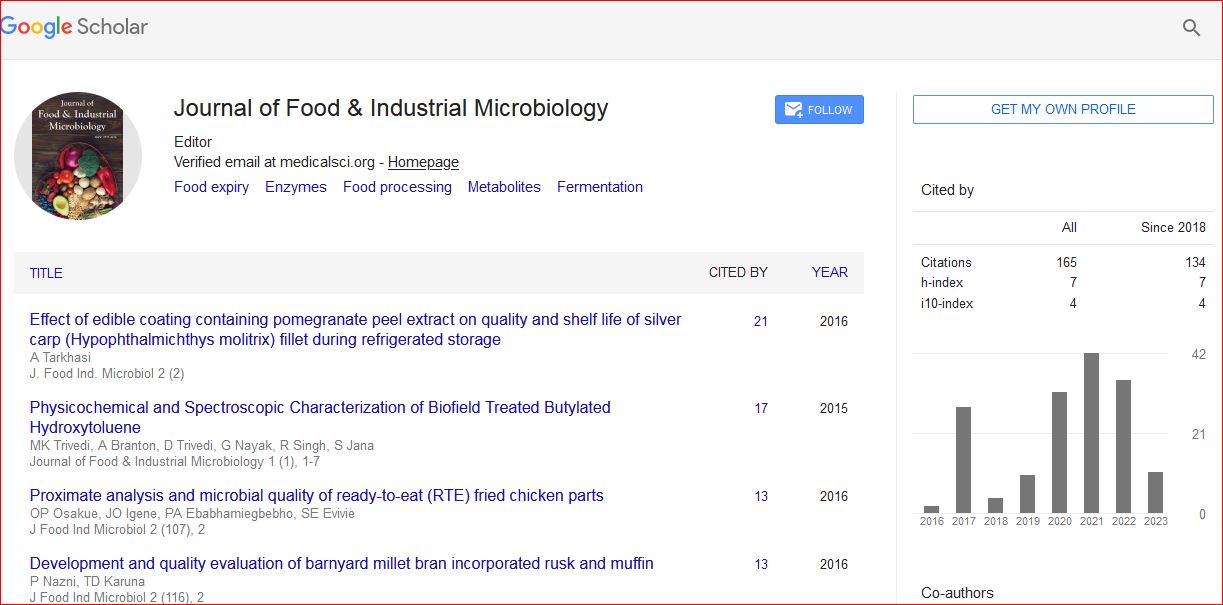
Journal of Food & Industrial Microbiology received 160 citations as per Google Scholar report