Short Communication - (2025) Volume 10, Issue 2
Received: 02-Jun-2025, Manuscript No. jib-25-175263;
Editor assigned: 04-Jun-2025, Pre QC No. P-175263;
Reviewed: 18-Jun-2025, QC No. Q-175263;
Revised: 23-Jun-2025, Manuscript No. R-175263;
Published:
30-Jun-2025
, DOI: 10.37421/2476-1966.2025.10.279
Citation: Greystone, Samuel. ”Dendritic Cells: Diverse Immunity, Therapeutic Targets.” J Immuno Biol 10 (2025):279.
Copyright: © 2025 Greystone S. This is an open-access article distributed under the terms of the Creative Commons Attribution License, which permits unrestricted use, distribution and reproduction in any medium, provided the original author and source are credited.
Dendritic cells (DCs) are crucial components of the immune system, acting as sentinels that detect threats and orchestrate immune responses. Recent research highlights their remarkable diversity and context-dependent functions across various tissues. For instance, a single-cell atlas of human skin reveals new dendritic cell states, showing how their roles shift depending on the tissue environment. What this really means is, the dendritic cells in our skin aren't a uniform group; they're diverse, with different subsets performing specialized functions, adapting to their surroundings. Understanding this heterogeneity is crucial for skin immunity and developing targeted therapies for skin diseases [1].
Beyond the skin, these cells exhibit profound heterogeneity within the tumor microenvironment, significantly impacting both cancer immunity and the effectiveness of immunotherapies. Here's the thing, different types of dendritic cells play distinct roles in either promoting or hindering anti-tumor responses, making their precise characterization vital for designing more effective cancer treatments [2].
Building on this, while dendritic cell vaccines for cancer have faced challenges, advances in our understanding of dendritic cell biology and improved antigen delivery methods are opening doors for more potent and specific anti-cancer therapies. What this really means is, this paper gives us an updated look at dendritic cell vaccines for cancer, discussing their current standing and new opportunities [3].
The influence of dendritic cells extends to autoimmune diseases, where their improper activation or dysregulation can mistakenly present self-antigens, leading the immune system to attack the body's own tissues. Let's break it down: understanding these mechanisms is essential for finding ways to re-educate the immune system and treat autoimmune conditions [4].
Similarly, dendritic cells play diverse roles in our response to viral infections. The thing is, they are central figures, not just in detecting viruses but also in shaping the subsequent antiviral immune response, sometimes driving protection and other times contributing to pathology. This dual capacity makes them critical targets for antiviral therapies and vaccine development [5].
The intricate pathways of dendritic cell development and differentiation are also being mapped out, detailing how progenitor cells give rise to specialized DC subsets. What this really means is, the journey from a stem cell to a fully functional dendritic cell is tightly regulated, and understanding these developmental checkpoints can help us manipulate DC populations for therapeutic benefit in conditions ranging from cancer to autoimmunity [6].
This developmental journey contributes to their remarkable plasticity, showing how they can adapt their function and phenotype in response to environmental cues. Here's the thing, DCs aren't static; their ability to change and take on different roles depending on the inflammatory context or tissue type is crucial for maintaining immune balance, making them adaptable players in health and disease [7].
Their role in maintaining immune balance is particularly evident in the gut, where they constantly sense signals from the trillions of microbes living there. What this really means is, this interplay between dendritic cells, the gut microbiome, and overall gut immunity is critical for distinguishing friend from foe, maintaining gut homeostasis, and preventing inflammatory bowel diseases [8].
To further unravel these complexities, advanced single-cell RNA sequencing is uncovering novel insights into dendritic cell biology. Let's break it down: by looking at gene expression in individual dendritic cells, scientists can identify subtle differences between cell types and states that were previously undetectable, leading to a much more granular understanding of their functions in various tissues and diseases [9].
Ultimately, this deepening knowledge positions dendritic cells as key therapeutic targets, going beyond traditional vaccine approaches. Here's the thing, manipulating dendritic cell function, for example by targeting specific receptors or signaling pathways, holds immense potential for treating a wide array of diseases, from chronic infections to inflammatory disorders, by finely tuning immune responses [10].
Dendritic cells (DCs) are indispensable components of the immune system, renowned for their ability to initiate and modulate immune responses against pathogens and abnormal cells. Recent groundbreaking research has illuminated the profound heterogeneity within DC populations, revealing that these cells are not a monolithic entity but rather comprise diverse subsets with specialized functions [1]. For example, a detailed single-cell atlas of human skin has unveiled novel dendritic cell states, demonstrating how their roles dynamically shift based on the specific tissue context. This means DCs in our skin adapt their functions to their immediate environment, a critical insight for understanding skin immunity and developing targeted treatments for dermatological conditions [1, 9]. Advanced techniques like single-cell RNA sequencing are instrumental in identifying subtle, previously undetectable differences between DC types and states, providing a more granular understanding of their varied roles in health and disease [9].
The diverse nature of dendritic cells plays a significant role in critical health challenges, notably in cancer immunity and the efficacy of immunotherapies. Different DC types can either bolster or impede anti-tumor responses, making their precise identification crucial for advancing cancer treatments [2]. This understanding is pivotal for developing therapeutic strategies, including dendritic cell vaccines for cancer. While these vaccines have faced obstacles, ongoing advancements in DC biology and improved antigen delivery methods are creating new opportunities for more potent and targeted anti-cancer interventions [3]. The ability to finely tune these responses is a major focus of current research, aiming to harness the full potential of DCs in oncology.
Beyond cancer, dendritic cells are central to the pathogenesis of autoimmune diseases. When dysregulated or improperly activated, DCs can mistakenly present self-antigens, prompting the immune system to attack the body's own tissues [4]. Elucidating these mechanisms is fundamental for devising strategies to re-educate the immune system and effectively manage autoimmune conditions. Similarly, DCs are key players in the body's response to viral infections. They are central figures in both detecting viruses and shaping the subsequent antiviral immune response, sometimes providing protection and at other times contributing to disease pathology. This dual capacity underscores their importance as targets for antiviral therapies and vaccine development [5].
The journey of a dendritic cell from its progenitor stage to a fully differentiated, specialized subset is a tightly regulated process [6]. Understanding these intricate developmental checkpoints is vital, as it offers avenues to manipulate DC populations for therapeutic benefits across a spectrum of diseases, from cancer to autoimmunity. Adding to this complexity is the remarkable plasticity of dendritic cells. They are not static but possess the ability to adapt their function and phenotype in response to environmental cues, such as inflammatory contexts or tissue types [7]. This inherent flexibility is crucial for maintaining immune balance and highlights their adaptable nature in both healthy and diseased states.
Furthermore, dendritic cells play a pivotal role in maintaining gut immunity and homeostasis, constantly interacting with the vast and diverse gut microbiota [8]. This continuous sensing of microbial signals is essential for distinguishing beneficial microbes from harmful ones, thus preventing inflammatory bowel diseases. The insights gained from studies on DC development, plasticity, and interaction with the microbiome collectively emphasize their versatile and dynamic nature within the immune landscape.
Ultimately, the comprehensive understanding of dendritic cell biology positions them as prime therapeutic targets [10]. Moving beyond traditional vaccine approaches, manipulating specific DC functionsâ??for instance, by targeting particular receptors or signaling pathwaysâ??holds immense potential. Such interventions could precisely tune immune responses, offering new treatment paradigms for a wide array of conditions, from chronic infections to inflammatory disorders, by modulating the immune system with unprecedented specificity [10].
Dendritic cells (DCs) are incredibly diverse immune cells, crucial for orchestrating responses against various threats. Recent research emphasizes their heterogeneity, with specialized subsets adapting their functions based on tissue context, such as in the skin [1, 9]. In cancer, distinct DC types influence anti-tumor immunity and immunotherapy effectiveness, driving efforts to develop more potent DC-based vaccines [2, 3]. DCs are also implicated in autoimmune diseases, where their dysregulation can lead to self-tissue attack, and in viral infections, where they can either protect or contribute to pathology [4, 5]. The intricate development and differentiation of DCs from progenitor cells are tightly regulated, offering therapeutic manipulation potential [6]. Their remarkable plasticity allows them to adapt their function in response to environmental cues, maintaining immune balance in various contexts [7]. In the gut, DCs interact with the microbiome, essential for distinguishing beneficial from harmful microbes and preventing inflammatory conditions [8]. Single-cell analysis is providing deeper insights into these complexities [9]. Ultimately, this comprehensive understanding positions dendritic cells as key therapeutic targets, allowing for precise manipulation of immune responses to treat a wide array of diseases beyond traditional vaccine approaches [10].
None
None
Zihao Z, Mingang M, Minghui L. "Single-cell atlas of human skin reveals novel dendritic cell states and their context-dependent functions".Nat Immunol 23 (2022 Sep):1447-1460.
Indexed at, Google Scholar, Crossref
Zeyuan D, Mingqi T, Liangjun J. "Dendritic cell heterogeneity in cancer immunity and immunotherapy".Immunity 54 (2021 Jun 8):1093-1108.
Indexed at, Google Scholar, Crossref
Annemiek A, Jasper VdB, Stefaan VG. "Dendritic cell vaccines for cancer: updated status and novel opportunities".Nat Rev Clin Oncol 18 (2021 Dec):731-748.
Indexed at, Google Scholar, Crossref
Jessica ESJ, Matthew ER, Mark HK. "Dendritic Cells in Autoimmune Disease".J Immunol 206 (2021 Mar 1):1199-1207.
Indexed at, Google Scholar, Crossref
Elodie S, Dushan B, Nicolas LA. "Dendritic Cells in Viral Infection".Cell Res 32 (2022 Feb):255-267.
Indexed at, Google Scholar, Crossref
Kenneth BK, Justin JK, Adam WK. "Dendritic Cell Development and Differentiation".Front Immunol 13 (2022 Feb 21):834516.
Indexed at, Google Scholar, Crossref
Christoph HLR, Alexander LR, Marina SR. "Plasticity of Dendritic Cells".Curr Opin Immunol 62 (2019 Feb):59-65.
Indexed at, Google Scholar, Crossref
Laura AD, Richard LD, Michael DD. "Dendritic cells and the intestinal microbiota in health and disease".Immunol Cell Biol 98 (2020 Jul):428-442.
Indexed at, Google Scholar, Crossref
Florent G, Michel CN, Brian DB. "Dendritic cells at the crossroads of immunity and tolerance: insights from single-cell analysis".Nat Immunol 20 (2019 Oct):1243-1250.
Indexed at, Google Scholar, Crossref
Caetano ReS, Paul SK, Douglas GD. "Dendritic Cells as Therapeutic Targets".Cell 184 (2021 Jul 22):4101-4115.
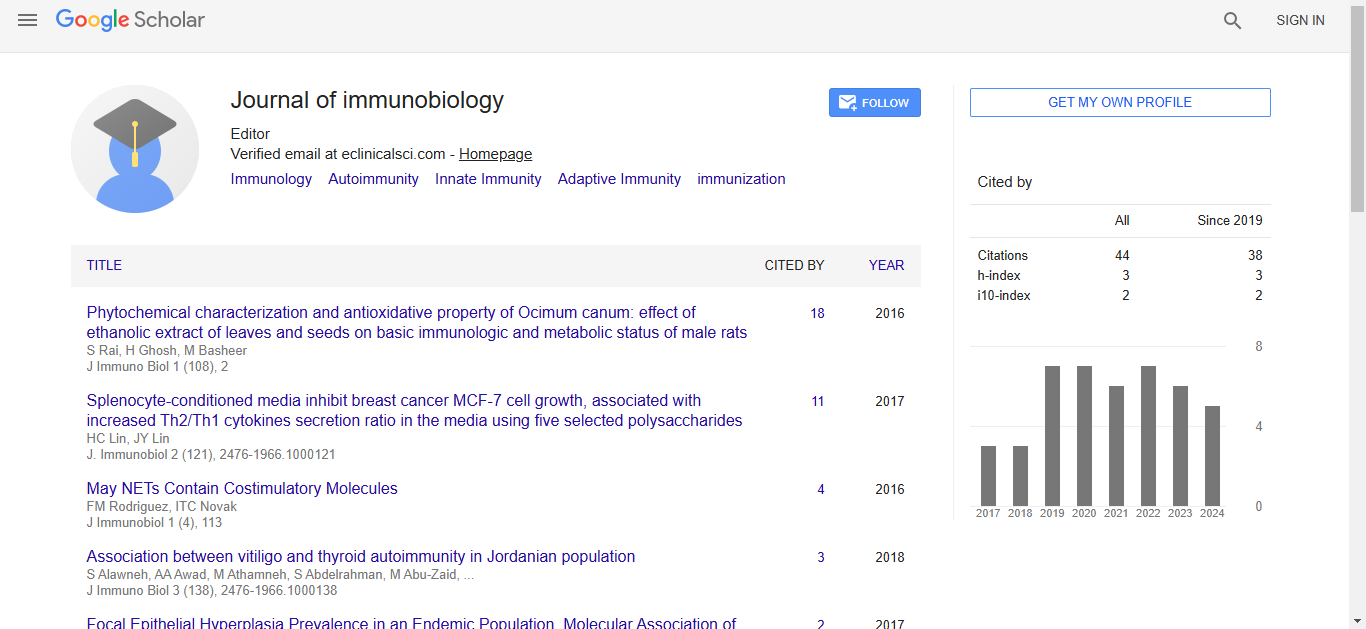
Journal of Immunobiology received 34 citations as per Google Scholar report