Perspective - (2025) Volume 11, Issue 4
Received: 01-Jul-2025, Manuscript No. jefc-26-188287;
Editor assigned: 03-Jul-2025, Pre QC No. P-188287;
Reviewed: 17-Jul-2025, QC No. Q-188287;
Revised: 22-Jul-2025, Manuscript No. R-188287;
Published:
29-Jul-2025
, DOI: 10.37421/2472-0542.2025.11.555
Citation: Tanaka, Hiroshi. ”Chromatographic Techniques: Unraveling Food Flavor’s Complexities.” J Exp Food Chem 11 (2025):555.
Copyright: © 2025 Tanaka H. This is an open-access article distributed under the terms of the Creative Commons Attribution License, which permits unrestricted use, distribution and reproduction in any medium, provided the original author and source are credited.
The intricate world of food flavor is governed by a complex interplay of volatile and semi-volatile compounds, making their identification and quantification a cornerstone of modern food science. Chromatographic techniques, particularly gas chromatography-mass spectrometry (GC-MS) and high-performance liquid chromatography (HPLC), have emerged as indispensable tools for dissecting these flavor profiles. These methods, often enhanced by sophisticated sample preparation techniques like solid-phase microextraction (SPME), offer profound insights into the chemical underpinnings of aroma and taste, thereby guiding product development and quality control measures [1].
Fermented dairy products, with their diverse and characteristic aromas, present a compelling area for detailed volatile compound analysis. Research employing GC-MS and gas chromatography-flame ionization detection (GC-FID) has been instrumental in characterizing these complex aroma profiles. Such studies not only identify key flavor-contributing molecules but also illuminate how processing parameters, especially fermentation conditions, influence their formation and presence, thereby aiding in authenticity assessment and process optimization [2].
The impact of food processing on inherent flavor compounds is a critical consideration for preserving product quality. For instance, various drying methods applied to herbs can significantly alter their volatile organic compound (VOC) profiles. GC-MS analysis is vital in quantitatively assessing these changes, correlating specific compound losses or formations with perceived aroma quality, and informing strategies to optimize drying processes for maximum flavor retention [3].
Beyond volatile compounds, non-volatile components like sugars, organic acids, and phenolic compounds play a crucial role in the overall taste and mouthfeel of many food products, particularly fruit juices. Techniques such as HPLC with diode-array detection (HPLC-DAD) and liquid chromatography-tandem mass spectrometry (LC-MS/MS) are adept at analyzing these less volatile constituents. They enable accurate determination of their concentrations and contributions to flavor, as well as the detection of trace-level components for comprehensive quality assessment [4].
Analyzing highly complex food matrices, such as roasted coffee, poses significant challenges for flavor profiling. The optimization of extraction methods, like SPME, in conjunction with GC-MS parameters is crucial for achieving reliable and reproducible identification of aroma compounds. Such optimization efforts are essential for understanding the nuanced flavor profiles of these products and for developing targeted analytical strategies [5].
For an even more profound level of detail in complex food systems like olive oil, advanced chromatographic techniques are employed. Two-dimensional gas chromatography (GCÃ?GC) coupled with time-of-flight mass spectrometry (TOF-MS) offers superior separation capabilities compared to conventional GC. This enhanced resolution allows for the detection and characterization of trace flavor compounds and previously unidentifiable aroma constituents, leading to more comprehensive flavor profiling [6].
The Maillard reaction, a fundamental process in the development of flavor in cooked foods, generates a multitude of complex compounds. Liquid chromatography-mass spectrometry (LC-MS/MS) is particularly well-suited for the extraction and identification of these often polar and intricate molecules. Understanding the chemical pathways involved in Maillard reactions is key to controlling desirable flavor development and mitigating the formation of undesirable byproducts during thermal processing [7].
Processed meat products undergo significant chemical transformations during processing and storage, impacting their volatile profiles and, consequently, their sensory qualities. Headspace GC-MS is a powerful tool for identifying key aroma-active compounds that are either formed or degraded during these stages. This analysis is critical for maintaining the characteristic flavors and extending the shelf-life of processed meat products [8].
Understanding the perception of flavor involves not only identifying the chemical compounds present but also determining which ones are primarily responsible for specific aroma notes. Gas chromatography-olfactometry (GC-O), when used in conjunction with GC-MS, allows researchers to combine instrumental analysis with human sensory evaluation. This synergy helps pinpoint key odorants and quantify their impact on the overall aroma complexity of products like fruit purees [9].
Vegetable oils, a staple in many cuisines, contain a diverse array of non-volatile flavor metabolites that contribute to their quality and taste. Ultra-high-performance liquid chromatography (UHPLC) coupled with tandem mass spectrometry (MS/MS) offers a rapid and sensitive method for their analysis. UHPLC's efficiency in reducing analysis time and improving separation is vital for the comprehensive profiling of these compounds and for assessing oil quality [10].
The analysis of flavor compounds in food is a multidisciplinary endeavor, critically dependent on advanced analytical instrumentation and methodologies. Gas chromatography-mass spectrometry (GC-MS) and high-performance liquid chromatography (HPLC) stand as primary techniques for the identification and quantification of volatile and semi-volatile flavor constituents across a wide spectrum of food matrices. These chromatographic methods are frequently augmented by sample preparation strategies, such as solid-phase microextraction (SPME), to enhance sensitivity and efficiency. The insights gleaned from these analyses are fundamental for ensuring product quality, driving innovation in product development, and understanding the chemical basis of flavor degradation during food processing and storage. Examples range from the analysis of esters and terpenes in fruits to aldehydes in baked goods, underscoring the broad applicability of chromatographic techniques in food science [1].
The characterization of aroma profiles in fermented dairy products is crucial for understanding their unique sensory attributes. Techniques like GC-MS and GC-FID are widely utilized to identify the key volatile compounds responsible for the distinctive aromas of products such as yogurt and cheese. Research in this area focuses on elucidating how specific processing parameters, particularly those related to fermentation, influence the formation and distribution of these aroma compounds. This detailed chemical profiling aids in differentiating products, ensuring authenticity, and optimizing fermentation processes. Despite the power of these techniques, the analysis of complex dairy matrices can present specific challenges that require careful method development [2].
The choice of drying method significantly impacts the flavor profile of food ingredients, especially herbs, which are valued for their aromatic qualities. Studies employing GC-MS have investigated the quantitative changes in volatile organic compounds (VOCs) resulting from different drying techniques, such as freeze-drying and air-drying. By correlating these chemical alterations with perceived aroma quality, these investigations provide essential guidance for food manufacturers. The findings highlight the loss of labile aroma compounds under harsh drying conditions, emphasizing the need for optimized processes to preserve desirable flavors [3].
Non-volatile flavor compounds, including sugars, organic acids, and phenolic compounds, are critical determinants of the taste and mouthfeel of many food products, particularly fruit juices. High-performance liquid chromatography (HPLC) coupled with diode-array detection (HPLC-DAD) and tandem mass spectrometry (LC-MS/MS) are employed for their accurate analysis. These methods facilitate detailed sample preparation and chromatographic separation, allowing for the precise quantification of these components. The capability of these techniques to detect even trace amounts of compounds makes them invaluable for comprehensive quality assessment and authentication of fruit juices [4].
Investigating the aroma composition of complex foods like roasted coffee requires careful optimization of analytical methods. Solid-phase microextraction (SPME) is often coupled with GC-MS to efficiently extract and identify aroma compounds. Research in this area focuses on optimizing various SPME fibers and GC-MS parameters to overcome the challenges associated with analyzing highly complex mixtures. Achieving reliable and reproducible results hinges on the meticulous optimization of both extraction conditions and chromatographic separation protocols, providing practical guidance for researchers [5].
For an enhanced understanding of volatile compounds in intricate food matrices, such as olive oil, advanced chromatographic techniques are indispensable. Two-dimensional gas chromatography (GCÃ?GC) coupled with time-of-flight mass spectrometry (TOF-MS) provides significantly improved separation resolution compared to conventional one-dimensional GC. This superior separation power enables the detection and identification of trace flavor compounds and previously uncharacterized aroma constituents, contributing to a more comprehensive flavor profiling of the oil [6].
The flavor of cooked foods is heavily influenced by the products of the Maillard reaction, a complex series of chemical transformations. Liquid chromatography-tandem mass spectrometry (LC-MS/MS) has proven effective for the extraction and identification of these diverse and often polar compounds. Research in this domain focuses on elucidating the chemical pathways that lead to the formation of desirable flavors and, concurrently, identifying any potentially undesirable compounds that may arise during thermal processing [7].
Processed meat products undergo substantial changes in their volatile composition during manufacturing and storage, impacting their overall aroma and quality. Headspace GC-MS is a key technique used to monitor these changes by identifying aroma-active compounds that are either generated or degraded. Understanding these chemical dynamics is crucial for maintaining the desired sensory attributes and ensuring the shelf-life of processed meats. This analytical approach provides essential insights into the chemical basis of flavor changes in these products [8].
The identification of aroma-active compounds responsible for specific flavor notes requires a synergistic approach that combines instrumental analysis with sensory perception. Gas chromatography-olfactometry (GC-O), often utilized alongside GC-MS, allows researchers to pinpoint key odorants in products like fruit purees. By correlating instrumental data with human sensory evaluation, this methodology provides a deeper understanding of how individual compounds contribute to the overall aroma complexity and perceived flavor [9].
Non-volatile metabolites in vegetable oils play a significant role in their flavor and quality. Ultra-high-performance liquid chromatography (UHPLC) coupled with tandem mass spectrometry (MS/MS) has emerged as a powerful tool for their rapid and sensitive analysis. UHPLC offers advantages in terms of reduced analysis time and enhanced separation efficiency, enabling the comprehensive profiling of a broad range of flavor-contributing compounds. This technique is vital for assessing the quality and understanding the flavor profiles of various vegetable oils [10].
This collection of research highlights the critical role of advanced chromatographic techniques, primarily GC-MS and HPLC, in unraveling the complexities of food flavor. These methods are essential for identifying and quantifying volatile and non-volatile compounds that dictate aroma and taste. Studies explore diverse food matrices, including fruits, dairy products, herbs, coffee, olive oil, processed meats, and vegetable oils. The research demonstrates how these analytical tools aid in quality control, product development, process optimization (e.g., drying, fermentation), and understanding flavor changes during processing and storage. Advanced techniques like GCÃ?GC and LC-MS/MS offer enhanced separation and detection capabilities for intricate food systems. Furthermore, the integration of olfactometry provides a sensory dimension to instrumental analysis, pinpointing key odorants.
None
None
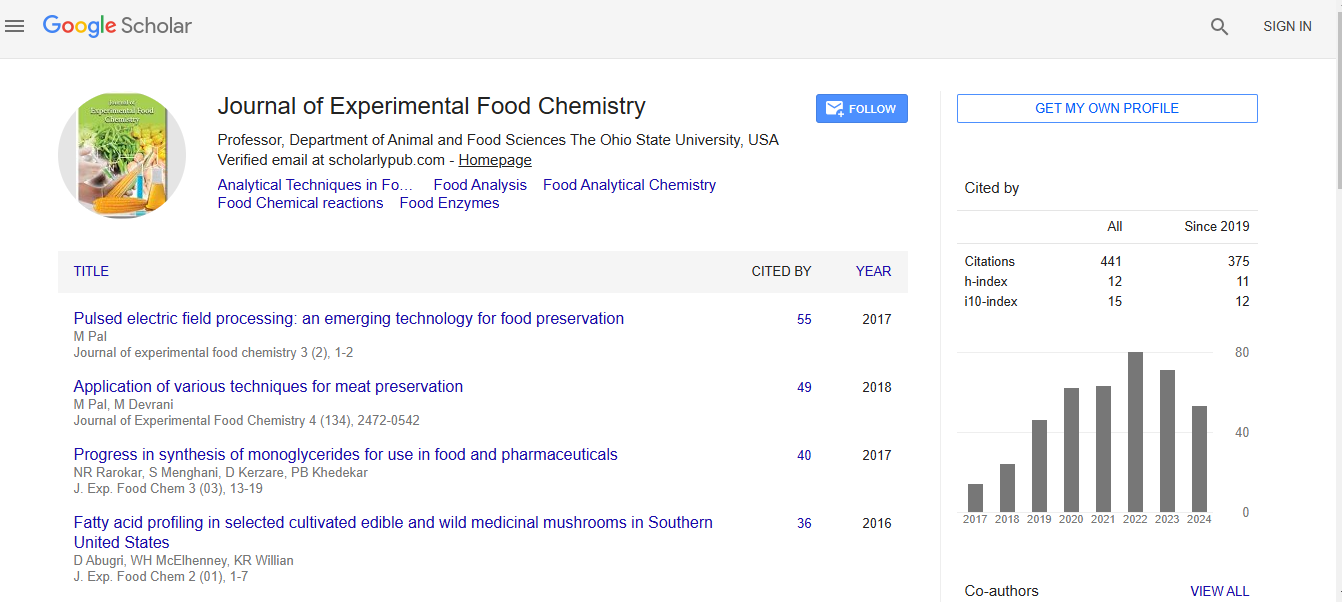
Journal of Experimental Food Chemistry received 389 citations as per Google Scholar report