Terpenes are derived biosynthetically from units of isopentenyl pyrophosphate. Although the structures of terpenoids are rationalized as derivatives of isoprene (2-methyl-1,3-butadiene), isoprene is not involved in the biosynthesis. The biogenetic isoprene rule or the C5 rule was described in 1953, by Leopold Ruži�ka, who explained that terpinoids can be visualized as the result of linking isoprene units "head to tail" to form chains, which can be arranged to form rings.
Research Article: Journal of Biodiversity & Endangered Species
Research Article: Journal of Biodiversity & Endangered Species
Editorial: Journal of Biodiversity & Endangered Species
Editorial: Journal of Biodiversity & Endangered Species
Review Article: Journal of Biodiversity & Endangered Species
Review Article: Journal of Biodiversity & Endangered Species
Research Article: Journal of Biodiversity & Endangered Species
Research Article: Journal of Biodiversity & Endangered Species
Research Article: Journal of Biodiversity & Endangered Species
Research Article: Journal of Biodiversity & Endangered Species
Posters & Accepted Abstracts: Advances in Recycling & Waste Management
Posters & Accepted Abstracts: Advances in Recycling & Waste Management
Scientific Tracks Abstracts: Journal of Biometrics & Biostatistics
Scientific Tracks Abstracts: Journal of Biometrics & Biostatistics
Scientific Tracks Abstracts: Journal of Applied & Computational Mathematics
Scientific Tracks Abstracts: Journal of Applied & Computational Mathematics
Scientific Tracks Abstracts: Journal of Mass Communication & Journalism
Scientific Tracks Abstracts: Journal of Mass Communication & Journalism
Accepted Abstracts: Journal of Biometrics & Biostatistics
Accepted Abstracts: Journal of Biometrics & Biostatistics
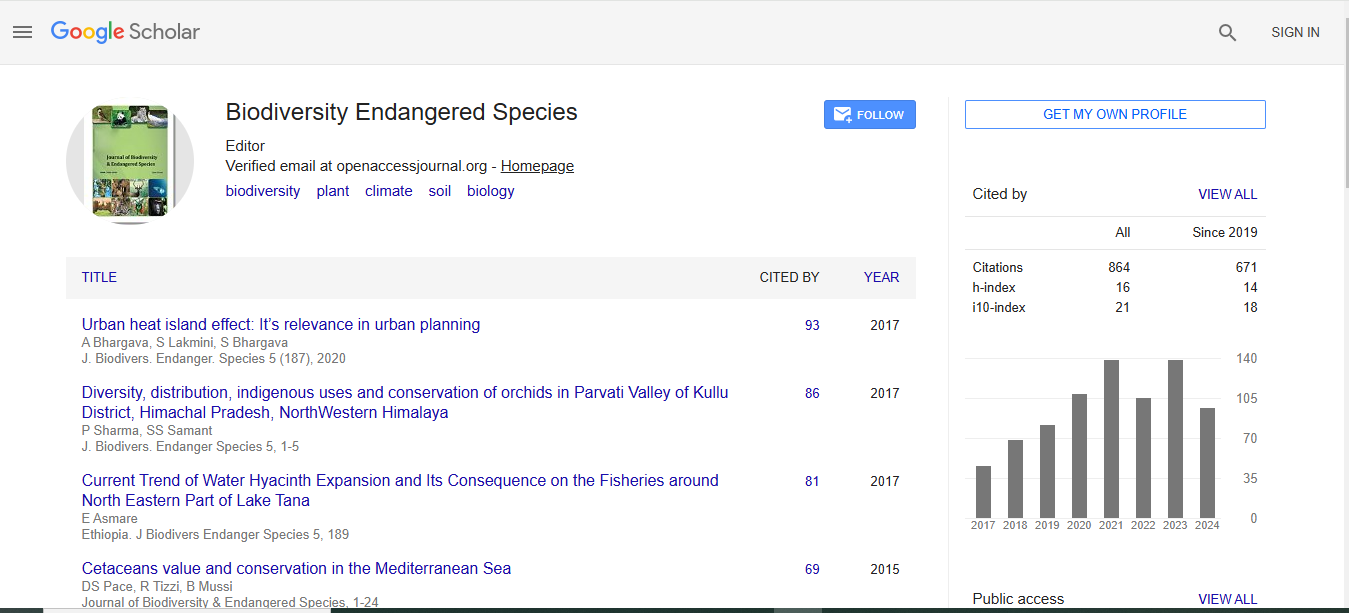
Journal of Biodiversity & Endangered Species received 624 citations as per Google Scholar report


 Spanish
 Chinese
 Russian
 German
 French
 Japanese
 Portuguese
 Hindi
