Opinion - (2025) Volume 10, Issue 2
Received: 02-Jun-2025, Manuscript No. jib-25-175245;
Editor assigned: 04-Jun-2025, Pre QC No. P-175245;
Reviewed: 18-Jun-2025, QC No. Q-175245;
Revised: 23-Jun-2025, Manuscript No. R-175245;
Published:
30-Jun-2025
, DOI: 10.37421/2476-1966.2025.10.273
Citation: D’Alessio, Matteo. ”Antigen Presentation: Immunity, Disease, Therapeutics.” J Immuno Biol 10 (2025):273.
Copyright: © 2025 D’Alessio M. This is an open-access article distributed under the terms of the Creative Commons Attribution License, which permits unrestricted use, distribution and reproduction in any medium, provided the original author and source are credited.
The immune system's ability to distinguish between self and non-self relies heavily on antigen presentation, a fundamental process where cells display molecular fragments to T lymphocytes. This complex mechanism is central to initiating and modulating adaptive immune responses, playing critical roles in disease and health. Targeting antigen presentation, particularly focusing on MHC class II molecules, offers strategies for therapeutic intervention in autoimmune diseases. Understanding the intricate mechanisms controlling MHC class II loading and trafficking promises novel treatments aimed at re-establishing immune tolerance in self-reactive conditions [1].
A vital pathway for activating CD8+ T cells involves cross-presentation, where exogenous antigens are channeled onto MHC class I molecules. This process is crucial for effective antiviral and antitumor immune responses, involving diverse cellular components and pathways [2].
The direct influence of antigen presentation on T cell activation is particularly significant in cancer. Various strategies aim to optimize this process, enhancing the efficacy of cancer immunotherapies, including advancements in vaccine development and checkpoint blockade, essentially making tumors more visible to the immune system [3].
Dendritic cells, often referred to as DCs, are recognized for their extensive roles as professional antigen-presenting cells. They possess the capacity to initiate potent T cell responses against pathogens and tumors. Beyond activation, DCs also function in inducing immunological tolerance, which is key in preventing autoimmunity, illustrating their balanced role in immune regulation [4].
Conversely, viruses employ sophisticated mechanisms to evade MHC class I antigen presentation, a critical pathway for the host's antiviral immunity. These viral evasion strategies carry significant implications for designing effective immunotherapies against viral infections, presenting both challenges and opportunities [5].
B cells, while well-known for antibody production, also serve as professional antigen-presenting cells. Their capacity to present antigens to T cells and significantly influence immune responses is often underestimated. Viewing B cells as more than just antibody factories provides an integrated perspective on their role in immunity [6].
In many cases, aberrant antigen presentation is a core contributor to the development and progression of various autoimmune diseases. This disruption involves specific autoantigens and mechanisms where self-tolerance, the immune systemâ??s ability to avoid attacking its own tissues, is compromised, leading to autoimmune conditions [7].
The intricate regulatory mechanisms governing intracellular antigen processing are also crucial for understanding immune surveillance. This involves peptide generation and subsequent loading onto MHC class I molecules, controlled at multiple levels to ensure precise presentation of endogenous antigens to T cells, which is essential for recognizing infected or cancerous cells [8].
Innovative strategies are currently boosting the effectiveness of mRNA vaccines by refining antigen presentation. Specifically, targeting dendritic cells significantly improves the quality and magnitude of the immune response generated by these advanced vaccine platforms, making them more potent against pathogens and diseases [9].
Beyond classical MHC molecules, CD1 molecules, a family of non-classical MHC-like proteins, present lipid and glycolipid antigens to specialized subsets of T cells. Their critical roles span immune responses against infections and autoimmunity, with emerging potential for therapeutic applications in various diseases [10].
Taken together, these studies underscore the multifaceted nature of antigen presentation, its central role in both maintaining immune health and contributing to disease pathogenesis, and its immense potential as a target for novel therapeutic interventions.
Antigen presentation forms the bedrock of adaptive immunity, enabling the immune system to recognize and respond to foreign or aberrant self-components. This intricate process involves presenting processed antigen fragments on cell surface molecules to T lymphocytes. The Major Histocompatibility Complex (MHC) plays a central role here. For instance, modulating antigen presentation, specifically through MHC class II molecules, presents a promising avenue for therapeutic intervention in autoimmune diseases. Fine-tuning these mechanisms, including MHC class II loading and trafficking, can potentially re-establish immune tolerance in self-reactive conditions [1]. Complementing this, the process known as cross-presentation is crucial, where exogenous antigens are efficiently channeled onto MHC class I molecules. This pathway is vital for activating CD8+ T cells, underpinning robust antiviral and antitumor immune responses by detailing the various cellular components and pathways involved [2]. Furthermore, the meticulous regulatory mechanisms governing intracellular antigen processing are essential, ensuring precise peptide generation and subsequent loading onto MHC class I molecules. Understanding these controls is critical for the recognition of infected or cancerous cells by the immune system [8].
Professional antigen-presenting cells (APCs) are central to orchestrating these immune responses. Dendritic cells, or DCs, stand out for their multifaceted roles. They are highly effective in initiating potent T cell responses against pathogens and tumors. Yet, their equally important, though sometimes less understood, function involves inducing immunological tolerance, a critical mechanism for preventing autoimmunity. DCs thus balance both activation and regulation within the immune system [4]. Moreover, while B cells are primarily recognized for their antibody production, their capacity as professional APCs is significant and often underestimated. They can present antigens to T cells and substantially influence overall immune responses, suggesting they are far more than just antibody factories [6]. The strategic targeting of dendritic cells is also proving invaluable for optimizing antigen presentation in advanced vaccine platforms, particularly mRNA vaccines. This approach significantly enhances the quality and magnitude of the immune response, making these vaccines more potent against a range of diseases and pathogens [9].
The dysregulation of antigen presentation is a common thread in various disease pathologies. In the context of cancer, how antigens are presented directly impacts T cell activation, a key factor for improving immunotherapy efficacy. Strategies focused on optimizing this fundamental process include advancements in vaccine development and checkpoint blockade, all aimed at increasing the immune system's visibility to tumor cells [3]. On the flip side, aberrant antigen presentation is a significant contributor to the development and progression of autoimmune diseases. These conditions arise when specific autoantigens disrupt self-tolerance, leading the immune system to mistakenly attack its own tissues [7]. Thus, understanding these precise mechanisms of presentation in both cancerous and autoimmune settings is paramount for developing effective treatments.
Challenging facets of antigen presentation are also critical to address. Viruses, for example, have evolved sophisticated mechanisms to evade MHC class I antigen presentation, thereby thwarting the host's antiviral immunity. The implications of these viral evasion strategies are substantial for designing and implementing effective immunotherapies against viral infections, highlighting both the obstacles and opportunities in this field [5]. Beyond the classical MHC pathways, a distinct family of non-classical MHC-like proteins, known as CD1 molecules, plays a crucial role. These molecules specialize in presenting lipid and glycolipid antigens to unique subsets of T cells. Their involvement extends to immune responses against infections and autoimmunity, and their emerging potential for therapeutic applications in various diseases is a growing area of interest [10]. The depth and breadth of antigen presentation research continues to unveil complex interactions, reinforcing its central role in both pathology and therapeutic innovation across diverse medical fields.
This comprehensive understanding of antigen presentation mechanisms, from MHC class I and II to the roles of various APCs and non-classical pathways, informs the development of targeted interventions. Whether itâ??s re-establishing tolerance in autoimmunity, boosting anti-tumor immunity, or improving vaccine efficacy, manipulating how antigens are displayed to the immune system remains a frontier in biomedical research. Each mechanism, from antigen processing to presentation, offers specific points of intervention that can be harnessed for improved patient outcomes.
Antigen presentation is a fundamental process dictating immune responses, with MHC class I and II molecules at its core. Modulating MHC class II is crucial for therapeutic intervention in autoimmune diseases by re-establishing immune tolerance. Cross-presentation, involving MHC class I, is vital for activating CD8+ T cells against viruses and tumors. The efficacy of cancer immunotherapies, including vaccines and checkpoint blockade, heavily relies on optimizing antigen presentation to enhance T cell activation. Dendritic Cells (DCs) are professional Antigen-Presenting Cells (APCs) capable of initiating potent T cell responses against pathogens and tumors, while also inducing immunological tolerance. This role is further explored in optimizing mRNA vaccine effectiveness through DC targeting. Viruses often evade MHC class I presentation, posing significant challenges for antiviral immunotherapies. B cells, beyond antibody production, also function as important APCs, influencing T cell responses. Aberrant antigen presentation is a key factor in the development of autoimmune diseases by disrupting self-tolerance. Understanding the intricate regulation of intracellular antigen processing for MHC class I is essential for recognizing infected or cancerous cells. Additionally, non-classical CD1 molecules present lipid antigens to specialized T cells, playing roles in infections and autoimmunity, with emerging therapeutic implications. Collectively, these studies highlight the diverse mechanisms and critical importance of antigen presentation in immunity and disease, offering broad avenues for therapeutic development.
None
None
Aitor Z, Norimitsu T, Hidde LP. "Targeting antigen presentation in autoimmune diseases".Nat Rev Immunol 22 (2022):683-698.
Indexed at, Google Scholar, Crossref
Euan J, Erika G, Matthias T. "Cross-presentation of exogenous antigens by MHC class I molecules".Immunity 55 (2022):398-412.
Indexed at, Google Scholar, Crossref
Peng Z, Chao L, Xi F. "Antigen Presentation and T Cell Activation: Enhancing Cancer Immunotherapy".Cancers (Basel) 15 (2023):951.
Indexed at, Google Scholar, Crossref
Susana KW, Javier A, Elena L. "Dendritic Cells and the Control of T-Cell Immunity: From Antigen Presentation to Immunological Tolerance".Int J Mol Sci 22 (2021):5826.
Indexed at, Google Scholar, Crossref
Heng S, Yang L, Zhigang W. "Viral Evasion of MHC-I Antigen Presentation Pathways: Implications for Immunotherapy".Front Immunol 13 (2022):871072.
Indexed at, Google Scholar, Crossref
Mark JS, Thomas TM, Mani L. "B cells as professional antigen-presenting cells: an integrated view of their role in immunity".Cell Mol Immunol 18 (2021):2345-2357.
Indexed at, Google Scholar, Crossref
Nabeel M, David MW, Ivaylo D. "Antigen Presentation in Autoimmune Diseases".Front Immunol 12 (2021):699039.
Indexed at, Google Scholar, Crossref
Manickam DV, Vanessa R, Ewa K. "The multiple layers of regulation of antigen processing for MHC class I".FEBS Lett 594 (2020):3129-3142.
Indexed at, Google Scholar, Crossref
Isabella Z, Manuel S, Stephanie S. "Optimizing Antigen Presentation in mRNA Vaccines: A Focus on Dendritic Cell Targeting".Vaccines (Basel) 11 (2023):1260.
Indexed at, Google Scholar, Crossref
Michael B, Jean EG, Ildiko VR. "How CD1 molecules present lipid antigens to T cells: recent insights and therapeutic implications".Curr Opin Immunol 83 (2023):102353.
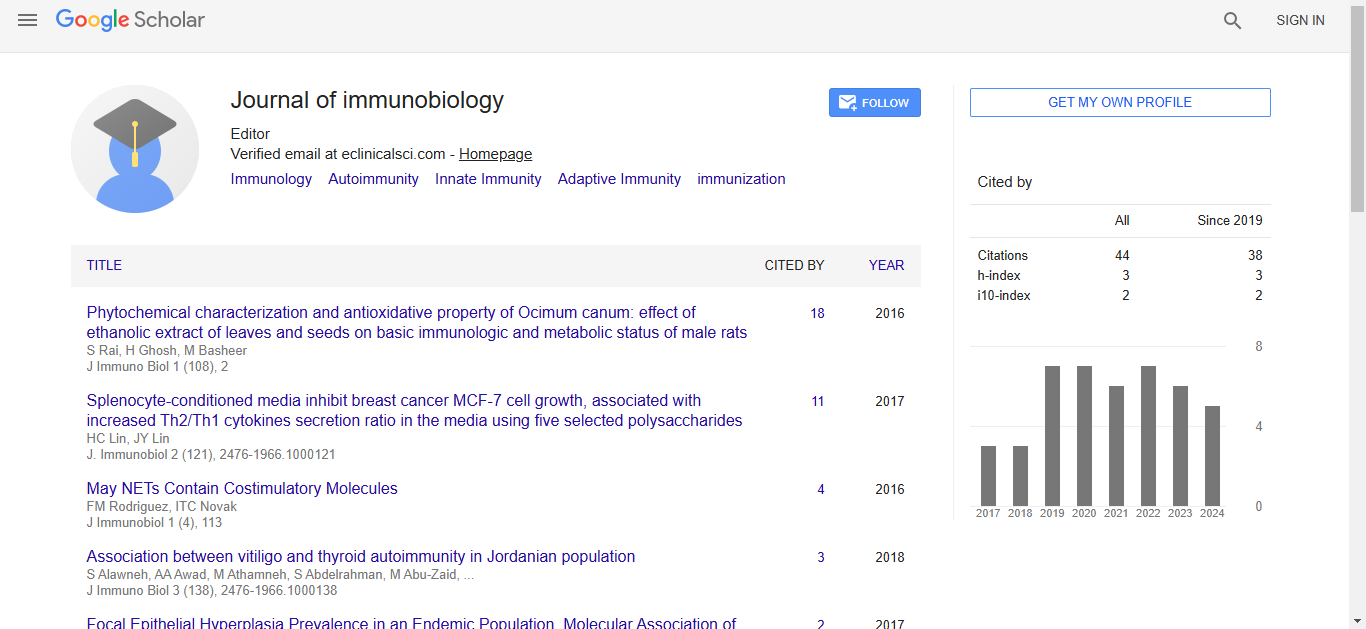
Journal of Immunobiology received 34 citations as per Google Scholar report