Opinion - (2025) Volume 11, Issue 5
Received: 01-Sep-2025, Manuscript No. jefc-26-188304;
Editor assigned: 03-Sep-2025, Pre QC No. P-188304;
Reviewed: 17-Sep-2025, QC No. Q-188304;
Revised: 22-Sep-2025, Manuscript No. R-188304;
Published:
29-Sep-2025
, DOI: 10.37421/2472-0542.2025.11.564
Citation: Muller, Thomas. ”Advanced Analytical Techniques for Food Safety.” J Exp Food Chem 11 (2025):564.
Copyright: © 2025 Muller T. This is an open-access article distributed under the terms of the Creative Commons Attribution License, which permits unrestricted use, distribution and reproduction in any medium, provided the original author and source are credited.
The intricate landscape of food safety is continuously shaped by advancements in analytical chemistry, providing the essential tools to identify and mitigate potential hazards within the global food supply. The relentless pursuit of ensuring consumer well-being necessitates rigorous scientific investigation into contaminants, residues, and undesirable compounds that may inadvertently enter our food. This field is dynamic, driven by the need to detect substances at increasingly lower concentrations and to understand their origins and impacts. One significant area of focus involves the detection and quantification of common food contaminants using sophisticated analytical techniques. These methods are crucial for ensuring that food products meet stringent regulatory standards and are safe for consumption. The development and application of these techniques directly contribute to public health by preventing the circulation of contaminated food items. The migration of chemicals from food packaging materials into food is another critical concern addressed by scientific research. Substances like bisphenol A (BPA) and its analogues have garnered attention due to their potential endocrine-disrupting properties. Understanding the extent of migration under various conditions is vital for assessing risks and for guiding the development of safer packaging alternatives. Concerns regarding antimicrobial resistance have propelled research into the presence of residual antibiotics in food products, particularly those of animal origin. Effective monitoring protocols are essential to ensure that these residues remain below permissible levels. This oversight plays a direct role in safeguarding public health by preventing the proliferation of antibiotic-resistant bacteria. The formation of undesirable compounds during food processing also presents a significant challenge. Acrylamide, a potential carcinogen, can form in starchy foods subjected to high-temperature cooking. Research in this area aims to elucidate the mechanisms of formation and to develop strategies for its reduction, thereby enhancing the safety of frequently consumed products. The ubiquitous presence of heavy metals in the environment poses a risk to food safety, especially in seafood, which can bioaccumulate these toxic elements. Accurate quantification of heavy metals in seafood is imperative for assessing dietary exposure and potential health implications for consumers who rely on these products as a significant food source. The deliberate adulteration of food with synthetic dyes or the undeclared use of such additives is a form of food fraud that directly impacts consumer safety. The development of robust analytical methods capable of identifying and quantifying these substances is crucial for regulatory bodies and the industry to maintain market integrity and protect consumers. Another class of compounds of concern in processed foods are polycyclic aromatic hydrocarbons (PAHs), often formed during smoking or high-temperature cooking processes. These compounds have been linked to various health risks. Understanding their formation pathways and levels in different food products allows for informed decisions regarding processing methods and risk management. The presence of N-nitrosamines in processed foods, particularly cured and processed meats, is a persistent issue due to their carcinogenic potential. Research focuses on identifying the precursors and controlling the processing conditions that lead to their formation. This is vital for implementing effective strategies to minimize exposure. Finally, the emergence of novel contaminants like per- and polyfluoroalkyl substances (PFAS) in food and food contact materials presents new challenges. These persistent chemicals are found in a wide range of products, and their widespread presence necessitates sensitive analytical techniques for detection and risk assessment within the food supply chain.
The analysis of food contaminants is a cornerstone of modern food safety, employing a diverse array of sophisticated analytical techniques to ensure the integrity and safety of the food supply chain. High-Performance Liquid Chromatography coupled with Mass Spectrometry (HPLC-MS) has emerged as a powerful tool for the sensitive and specific detection of trace levels of mycotoxins and pesticide residues in food matrices. This technique allows for precise identification and quantification, which are critical for risk assessment and regulatory compliance, thereby upholding enhanced food safety standards [1].
Investigating the potential for chemical migration from food packaging into food is a critical aspect of food safety research. Studies have focused on substances such as bisphenol A (BPA) and its analogues, utilizing Gas Chromatography-Mass Spectrometry (GC-MS) to quantify migration levels under varied conditions of temperature and time. The findings highlight the importance of selecting appropriate packaging materials to minimize exposure to potentially harmful substances and advocate for the development and adoption of safer alternatives [2].
The presence of residual antibiotics in animal-derived food products is a significant concern due to the potential for contributing to antimicrobial resistance. Research has focused on developing and validating multi-residue methods, often employing Enzyme-Linked Immunosorbent Assay (ELISA) combined with Liquid Chromatography-Mass Spectrometry/Mass Spectrometry (LC-MS/MS) for accurate detection and quantification. These validated protocols are essential for monitoring compliance with maximum residue limits and safeguarding public health [3].
Understanding the formation and levels of potentially harmful compounds during food processing is vital for consumer safety. Acrylamide, formed in heat-processed starchy foods, has been studied using techniques like capillary electrophoresis coupled with UV detection (CE-UV). This research investigates the impact of processing parameters on acrylamide formation and explores strategies for mitigation, aiming to reduce consumer exposure to this compound [4].
Seafood is a valuable source of nutrients but can also be a route for exposure to heavy metals. Studies have employed Atomic Absorption Spectrometry (AAS) to accurately determine the concentrations of metals such as lead, cadmium, and mercury in commercially important seafood species. The data generated are crucial for assessing dietary exposure risks and informing public health advisories regarding seafood consumption [5].
Ensuring the chemical safety of food additives, particularly synthetic dyes, is a continuous effort to prevent fraudulent practices and protect consumers. Analytical methods such as UV-Vis spectrophotometry and Thin-Layer Chromatography (TLC) are utilized to identify and quantify illegal or undeclared dyes in processed foods. The efficacy of these methods supports regulatory oversight and ensures that food products are safe and accurately labeled [6].
Polycyclic aromatic hydrocarbons (PAHs) are compounds of concern that can be formed during the smoking or high-temperature cooking of foods, especially meats. Gas Chromatography with Flame Ionization Detection (GC-FID) is a key technique for analyzing PAH profiles and levels in smoked meat products. This research helps to identify specific PAHs contributing to health concerns and informs strategies to minimize their formation during processing [7].
N-nitrosamines are a group of potentially carcinogenic compounds that can form in processed foods. Liquid Chromatography-Mass Spectrometry (LC-MS) is employed for their sensitive quantification in various food categories, including cured meats and baby foods. The study emphasizes the critical need for strict control over precursor ingredients and processing conditions to effectively minimize the formation of these undesirable compounds [8].
The distinction between organic and conventionally grown produce in terms of pesticide residue levels is a subject of ongoing research. Advanced analytical techniques, including GC-MS/MS and LC-MS/MS, are used to compare residue levels, providing empirical evidence for the benefits of organic farming practices. This comparative analysis contributes to consumer confidence and informed food choices by demonstrating reduced pesticide contamination [9].
Emerging contaminants, such as per- and polyfluoroalkyl substances (PFAS), are increasingly being detected in food and food contact materials. Inductively Coupled Plasma Mass Spectrometry (ICP-MS) offers the sensitivity required for the detection and quantification of these persistent chemicals. This research addresses the challenges in assessing and managing the risks associated with the widespread presence of PFAS in the food supply chain [10].
This collection of research explores critical aspects of food safety through advanced analytical techniques. Studies investigate the detection of common food contaminants like mycotoxins and pesticide residues using HPLC-MS. The migration of chemicals such as bisphenol A from food packaging is examined with GC-MS. The presence of antibiotic residues in animal products is monitored via ELISA and LC-MS/MS, while acrylamide formation in processed foods is analyzed using CE-UV. Heavy metal contamination in seafood is quantified using AAS, and synthetic food dyes are identified with UV-Vis spectrophotometry and TLC. Polycyclic aromatic hydrocarbons in smoked meats are analyzed by GC-FID, and N-nitrosamines in processed foods are quantified by LC-MS. A comparative analysis of pesticide residues in organic versus conventional produce uses GC-MS/MS and LC-MS/MS. Finally, emerging contaminants like PFAS in food packaging are determined using ICP-MS. These studies collectively contribute to enhanced food safety by providing data for risk assessment, regulatory compliance, and the development of mitigation strategies.
None
None
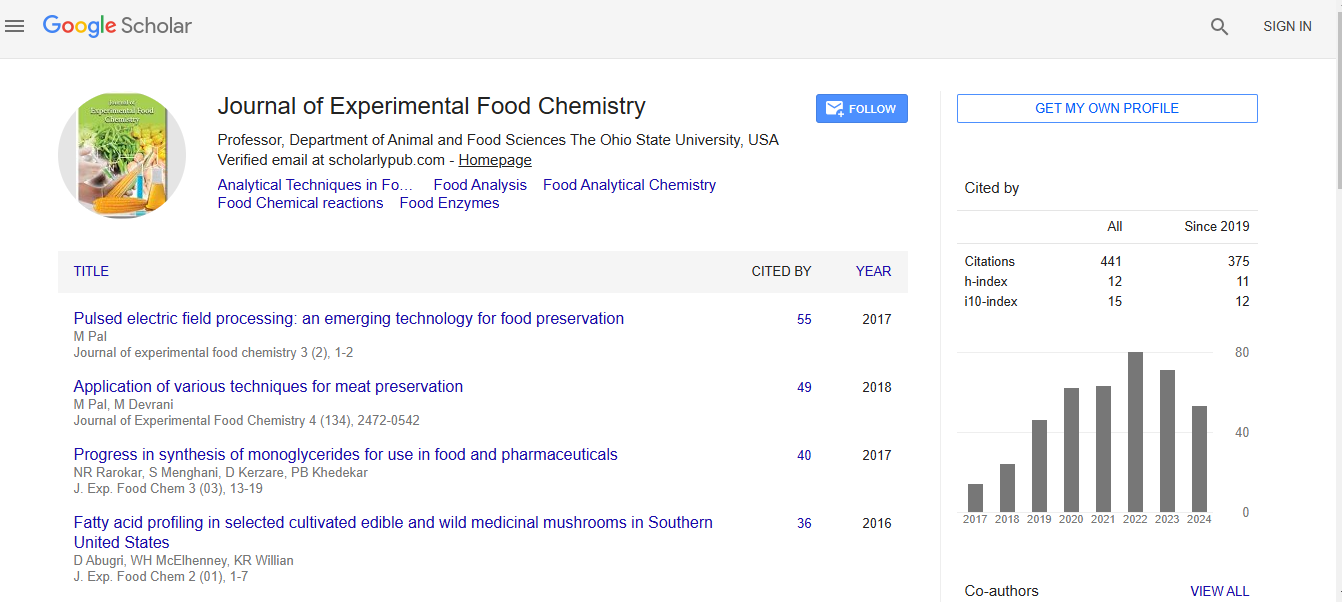
Journal of Experimental Food Chemistry received 389 citations as per Google Scholar report