Brief Report - (2025) Volume 11, Issue 3
Received: 01-May-2025, Manuscript No. jefc-26-188214;
Editor assigned: 05-May-2025, Pre QC No. P-188214;
Reviewed: 19-May-2025, QC No. Q-188214;
Revised: 22-May-2025, Manuscript No. R-188214;
Published:
29-May-2025
, DOI: 10.37421/2472-0542.2025.11.541
Citation: Zhang, Li Wei. ”Oxidation in Edible Oils: Factors, Mitigation, and Stability.” J Exp Food Chem 11 (2025):541.
Copyright: © 2025 Zhang W. Li This is an open-access article distributed under the terms of the Creative Commons Attribution License, which permits unrestricted use, distribution and reproduction in any medium, provided the original author and source are credited.
The oxidative stability of edible oils is a critical aspect of food quality and safety, directly influencing their shelf life and sensory attributes. Lipid oxidation, a complex process involving the degradation of fatty acids, can lead to the formation of undesirable compounds that impart off-flavors and aromas, as well as potentially harmful byproducts. Understanding the factors that contribute to and mitigate this degradation is paramount for the food industry and consumers alike. The impact of various storage conditions on lipid oxidation in common edible oils has been a significant area of research. Key findings highlight that elevated temperatures, exposure to light, and the presence of oxygen significantly accelerate the formation of primary and secondary oxidation products, leading to undesirable changes in oil quality and potential health concerns. Antioxidant activity was found to be crucial in mitigating these effects, with specific natural and synthetic antioxidants demonstrating varying degrees of efficacy [1].
The research has also delved into the specific mechanisms of lipid oxidation in different classes of edible oils, including monounsaturated, polyunsaturated, and saturated fatty acids. It identifies critical factors influencing the rate and pathways of oxidation, such as the fatty acid profile, the presence of pro-oxidants like transition metals, and the effectiveness of endogenous or added antioxidants. The study emphasizes the need for tailored storage strategies based on the oil's susceptibility to oxidation [2].
Furthermore, the role of packaging materials in protecting edible oils from oxidative degradation during storage has been examined. Various materials, including different types of plastics, glass, and metal cans, with or without barrier properties, influence the ingress of oxygen and light, thereby affecting the rate of lipid oxidation. The study suggests that advanced barrier packaging technologies can significantly extend the shelf-life of sensitive oils [3].
In parallel, the effectiveness of natural antioxidants in retarding lipid oxidation in oils like olive oil during prolonged storage has been investigated. Results indicate that the concentration and synergistic interactions of these compounds play a critical role in their protective effect. The research supports the use of natural extracts as a sustainable approach to enhance the oxidative stability of edible oils [4].
The formation of volatile oxidation products in oils such as soybean oil under different simulated storage conditions, including variations in temperature and oxygen availability, has also been explored. Gas chromatography-mass spectrometry (GC-MS) analysis has identified key aldehydes and ketones responsible for off-flavors, providing insights into predicting sensory quality deterioration based on volatile oxidation profiles [5].
The specific effect of light exposure on the oxidative stability of oils like sunflower oil has been a focus of study. Different light sources (UV, visible) and intensities have been investigated, revealing that shorter wavelengths (UV) are particularly detrimental, inducing rapid formation of hydroperoxides and secondary oxidation products. Protective measures, such as opaque packaging, are highlighted as essential for preserving oil quality [6].
The influence of different temperatures on the oxidation kinetics of oils such as canola oil has been assessed. Accelerated shelf-life tests conducted at elevated temperatures, coupled with the use of the Arrhenius equation to predict degradation rates at ambient storage conditions, provide a scientific basis for establishing optimal storage temperature ranges to minimize oxidation [7].
Additionally, the effectiveness of novel antioxidant systems, such as rosemary extract and vitamin E in combination, on the oxidative stability of refined palm oil during storage has been evaluated. Spectrophotometric and chromatographic methods monitor the formation of oxidation products, demonstrating a significant improvement in the shelf-life of palm oil when these synergistic antioxidant blends are employed [8].
Finally, the influence of metal ions, specifically iron and copper, as pro-oxidants on the lipid oxidation of oils like corn oil under various storage conditions has been examined. The presence of these metal ions significantly accelerates oxidation, as indicated by increased peroxide values and thiobarbiturate reactive substances. Chelating agents have been found to mitigate this pro-oxidant effect [9].
The investigation into the impact of storage conditions on lipid oxidation in edible oils reveals a complex interplay of environmental factors and inherent oil properties. Elevated temperatures, light exposure, and oxygen availability are identified as primary accelerators of lipid degradation, leading to the formation of detrimental oxidation products. The efficacy of antioxidants, both natural and synthetic, in counteracting these effects is well-documented, with varying degrees of success depending on the specific compounds and their concentrations [1].
Further research has elucidated the specific mechanisms of lipid oxidation across different classes of fatty acids. The fatty acid profile of an oil is a crucial determinant of its susceptibility to oxidation, alongside the presence of pro-oxidants like transition metals. The effectiveness of naturally occurring or added antioxidants plays a vital role in determining the overall oxidative stability. Consequently, the need for storage strategies tailored to the unique characteristics of each oil type is emphasized [2].
Packaging solutions are also integral to preserving the oxidative integrity of edible oils. The study of various packaging materials, including plastics, glass, and metal cans, with a focus on their barrier properties against oxygen and light, demonstrates their direct influence on the rate of lipid oxidation. Advanced barrier packaging technologies are presented as a means to significantly extend the shelf-life of oils prone to oxidative damage [3].
The role of natural antioxidants, such as tocopherols and polyphenols, in retarding lipid oxidation has been specifically examined in the context of olive oil. The concentration and synergistic interactions of these compounds are highlighted as key factors in their protective capabilities, supporting the use of natural extracts as a sustainable method for enhancing oxidative stability [4].
Research into the formation of volatile oxidation products in oils like soybean oil provides insights into the sensory consequences of oxidation. Under simulated storage conditions, variations in temperature and oxygen levels were correlated with the generation of aldehydes and ketones that contribute to off-flavors. This work facilitates the prediction of sensory quality deterioration based on volatile profiles [5].
The detrimental effect of light exposure on the oxidative stability of oils like sunflower oil has been quantified. The study differentiates the impact of UV and visible light, with UV radiation being particularly damaging, leading to rapid hydroperoxide formation. The necessity of protective measures, such as opaque packaging, to prevent such degradation is underscored [6].
Kinetic studies of oil oxidation, specifically applied to canola oil, have utilized elevated temperatures to accelerate degradation and the Arrhenius equation to predict oxidation rates at ambient conditions. These findings are instrumental in establishing optimal storage temperature ranges to minimize oxidative processes [7].
The synergistic effects of combined antioxidant systems, exemplified by rosemary extract and vitamin E in refined palm oil, have shown significant promise in enhancing oxidative stability. Monitoring oxidation products through various analytical methods confirms the extended shelf-life achieved with these blended antioxidants [8].
In exploring the pro-oxidant activity of metal ions, the study on corn oil demonstrates that iron and copper significantly accelerate lipid oxidation. The increase in peroxide values and thiobarbiturate reactive substances serves as a marker for this accelerated degradation. The potential of chelating agents to counteract these pro-oxidant effects is also presented [9].
Finally, the examination of virgin coconut oil's response to storage time and temperature reveals that while inherently stable, prolonged storage at elevated temperatures leads to increased oxidative deterioration. Sensory evaluation and chemical analyses, including peroxide value and fatty acid profiling, corroborate these findings, providing a comprehensive understanding of quality changes over time [10].
Edible oils are susceptible to lipid oxidation, a process accelerated by factors like heat, light, and oxygen, leading to quality degradation and potential health concerns. Research highlights the crucial role of antioxidants in mitigating these effects. Different oil types exhibit varying susceptibilities based on their fatty acid profiles and the presence of pro-oxidants. Packaging plays a significant role in protecting oils from external factors. Natural antioxidants and synergistic blends show promise in enhancing oxidative stability. Volatile compounds are key indicators of off-flavors, and light, particularly UV, is highly detrimental. Kinetic studies help establish optimal storage temperatures. Metal ions act as pro-oxidants, while chelating agents can counteract them. Even relatively stable oils like virgin coconut oil can degrade under prolonged storage at elevated temperatures.
None
None
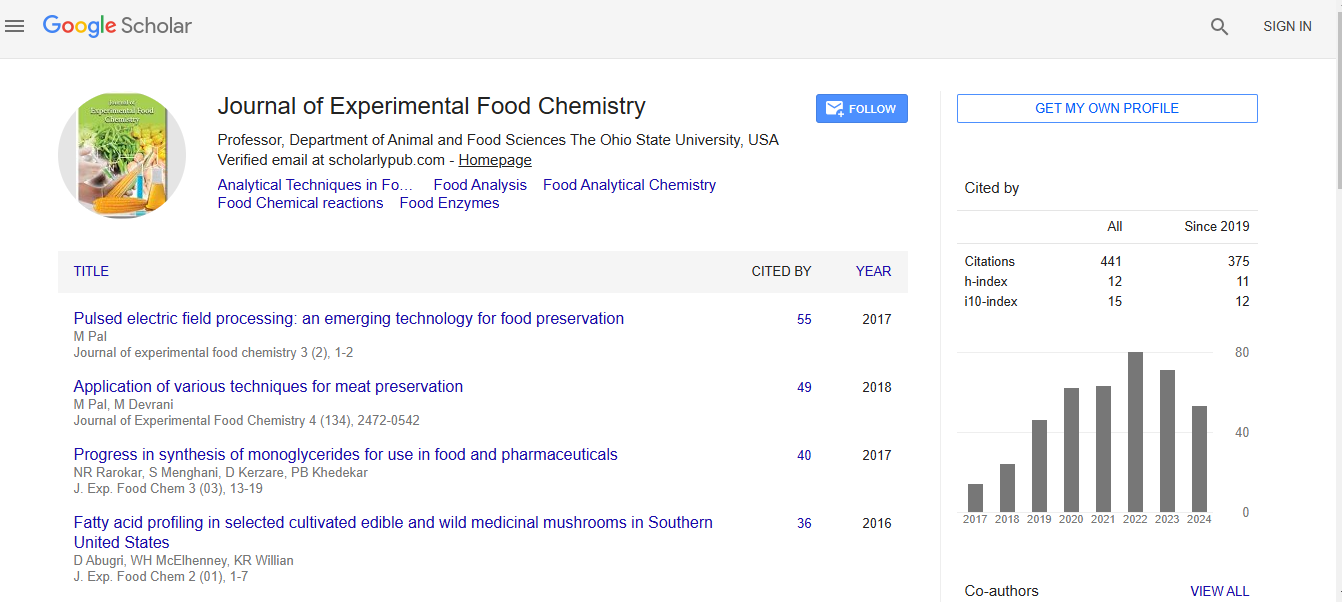
Journal of Experimental Food Chemistry received 389 citations as per Google Scholar report