Brief Report - (2025) Volume 11, Issue 6
Received: 01-Nov-2025, Manuscript No. jefc-26-188334;
Editor assigned: 03-Nov-2025, Pre QC No. P-188334;
Reviewed: 17-Nov-2025, QC No. Q-188334;
Revised: 24-Nov-2025, Manuscript No. R-188334;
Published:
29-Nov-2025
, DOI: 10.37421/2472-0542.2025.11.577
Citation: Papadopoulos, George. ”Nutraceutical Stability: Processing, Storage, and Preservation Strategies.” J Exp Food Chem 11 (2025):577.
Copyright: 2025 Papadopoulos G. This is an open-access article distributed under the terms of the Creative Commons Attribution License, which permits unrestricted use, distribution and reproduction in any medium, provided the original author and source are credited.
The stability of nutraceutical compounds within various food matrices is a subject of considerable scientific interest, given its direct implications for the nutritional quality and health benefits of functional foods. Understanding the complex interplay of processing conditions and storage environments is paramount to preserving the integrity of these valuable bioactive substances. Factors such as heat, pH, and oxidative stress can significantly influence degradation pathways, leading to a reduction in both efficacy and bioavailability. This introductory overview aims to synthesize current research findings that illuminate these critical aspects, providing a foundation for optimizing food formulation and processing strategies to enhance nutraceutical retention. The research delves into the intricate factors influencing the chemical stability of key nutraceutical compounds within diverse food matrices. It highlights how processing conditions, such as heat and pH, alongside storage environments, significantly impact the degradation pathways of compounds like polyphenols and carotenoids. The research emphasizes the critical need for understanding these interactions to optimize food formulation and processing for enhanced nutraceutical retention and bioavailability. [1] Exploring the encapsulation of phenolic compounds using different carrier systems is a promising avenue for enhancing their stability and controlled release. This approach assesses their effectiveness in protecting against degradation during food processing and shelf life. Results indicate that specific encapsulation methods, particularly those involving liposomes and solid lipid nanoparticles, significantly improve the stability and controlled release of phenolics, thereby enhancing their functional properties in beverages. [2] Research investigating the stability of carotenoids, specifically lutein and zeaxanthin, in fortified dairy products under various storage conditions has revealed critical degradation factors. It has been observed that oxidation and light exposure are primary culprits in carotenoid loss. Consequently, the study suggests that incorporating antioxidants and utilizing opaque packaging can significantly mitigate carotenoid loss, thereby preserving their nutritional value. [3] The effect of different drying techniques on the stability of anthocyanins in berry extracts has been thoroughly examined. Freeze-drying demonstrated the highest retention of anthocyanins due to minimized thermal stress. Spray-drying, while more cost-effective, resulted in moderate losses, and oven-drying led to significant degradation, underscoring the importance of processing method selection. [4] The stability of omega-3 fatty acids in microencapsulated forms when incorporated into common food products like yogurt and bread has been investigated. It was found that microencapsulation significantly protects omega-3s from oxidation, especially under refrigerated storage. The study also evaluated the sensory impact of these microcapsules on the final food product. [5] An assessment of the impact of different pH levels and temperatures on the degradation kinetics of vitamin C in fruit juices has established crucial relationships. It was determined that lower pH and lower temperatures significantly improve vitamin C stability. Kinetic modeling was employed to predict shelf-life under various conditions, providing valuable insights for juice manufacturers. [6] The role of Maillard reactions in the degradation of amino acids and the formation of potentially harmful compounds during food processing is an area of ongoing investigation. It is emphasized that temperature, water activity, and the presence of reducing sugars significantly influence these complex reactions, impacting both nutritional quality and food safety. [7] Investigations into the stability of lycopene in tomato-based products subjected to pasteurization and UHT processing have yielded important findings. It was highlighted that while processing causes some loss, the formation of more bioavailable all-trans-lycopene isomers can occur. The study also examined the impact of fat content on lycopene retention and absorption. [8] An analysis of the stability of isoflavones in soy-based food products during storage has identified key degradation drivers. Oxygen, light, and temperature were pinpointed as the primary factors. The research suggests that modified atmosphere packaging and the addition of natural antioxidants can effectively improve isoflavone stability and extend product shelf life. [9] Finally, the influence of different emulsifiers on the stability of lutein in oil-in-water emulsions, a common system in functional foods, has been studied. It was observed that the type and concentration of emulsifier critically affect the physical and chemical stability of lutein by influencing droplet size, interfacial properties, and susceptibility to oxidation. [10]
The chemical stability of key nutraceutical compounds within diverse food matrices is a critical determinant of their functional efficacy, with processing conditions and storage environments playing pivotal roles in degradation pathways. Research has elucidated that factors such as heat and pH significantly impact compounds like polyphenols and carotenoids, underscoring the need for optimized food formulation and processing to ensure enhanced nutraceutical retention and bioavailability. [1] Encapsulation technologies offer a viable strategy to protect valuable phenolic compounds from degradation during food processing and throughout shelf life. Studies have demonstrated that specific encapsulation methods, including the use of liposomes and solid lipid nanoparticles, markedly enhance the stability and facilitate the controlled release of phenolics, thereby augmenting their functional properties in various food systems, particularly beverages. [2] Carotenoids, such as lutein and zeaxanthin, present unique stability challenges in fortified dairy products, with oxidation and light exposure identified as primary degradation agents. Effective mitigation strategies involve the incorporation of antioxidants and the utilization of opaque packaging materials to preserve the nutritional integrity and value of these compounds. [3] Drying techniques exert a considerable influence on the stability of bioactive compounds like anthocyanins. Comparative analyses have shown that freeze-drying preserves anthocyanins most effectively due to minimal thermal stress, while spray-drying offers a compromise, and oven-drying leads to substantial degradation, highlighting the importance of judicious selection of drying methods. [4] The incorporation of microencapsulated omega-3 fatty acids into food products like yogurt and bread has been shown to provide significant protection against oxidation, particularly during refrigerated storage. This encapsulation approach not only preserves the integrity of omega-3s but also allows for evaluation of any potential sensory impacts on the final food matrix. [5] Vitamin C stability in fruit juices is highly sensitive to environmental factors. Studies have established that maintaining a lower pH and lower temperatures are crucial for improving vitamin C stability. Kinetic modeling provides a powerful tool for predicting shelf-life under diverse conditions, offering practical guidance for product development and manufacturing. [6] Maillard reactions represent a complex biochemical process that can lead to the degradation of amino acids and the formation of various compounds during food processing. The extent and nature of these reactions are significantly influenced by parameters such as temperature, water activity, and the concentration of reducing sugars, impacting both the nutritional profile and safety of the food. [7] Processing methods like pasteurization and UHT treatment can affect the stability and bioaccessibility of lycopene in tomato-based products. While some degradation may occur, processing can also isomerize lycopene into more bioavailable forms. The fat content of the product also plays a role in lycopene retention and subsequent absorption. [8] Isoflavones, important phytonutrients found in soy-based products, are susceptible to degradation during storage. Key factors contributing to their loss include exposure to oxygen, light, and elevated temperatures. Strategies such as modified atmosphere packaging and the addition of natural antioxidants have been proposed to enhance their stability and extend the shelf life of these products. [9] In the context of oil-in-water emulsions, commonly found in functional foods, the stability of lutein is significantly influenced by the type and concentration of emulsifiers used. Emulsifiers play a critical role in determining droplet size, interfacial properties, and the overall susceptibility of lutein to oxidative degradation. [10]
This collection of research explores the stability of various nutraceutical compounds, including polyphenols, carotenoids, anthocyanins, omega-3 fatty acids, vitamin C, lycopene, and isoflavones, within different food matrices. Key factors influencing their degradation include processing conditions such as heat, pH, drying methods, and emulsifier types, as well as storage environments characterized by oxygen, light, and temperature. Strategies like encapsulation, antioxidant addition, opaque packaging, modified atmosphere packaging, and controlled pH and temperature are highlighted as effective methods for preserving the stability and bioavailability of these beneficial compounds. The research emphasizes the importance of understanding these interactions for optimizing food formulation and processing to deliver high-quality, nutrient-rich food products.
None
None
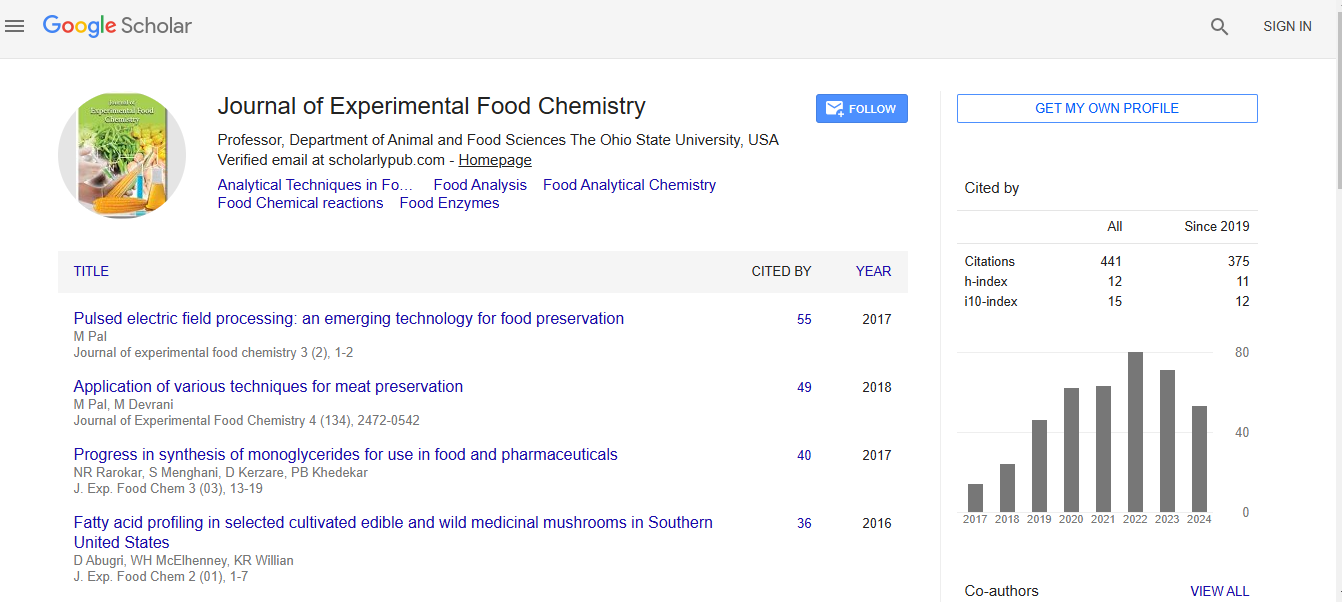
Journal of Experimental Food Chemistry received 389 citations as per Google Scholar report