Opinion - (2025) Volume 10, Issue 3
Received: 02-Jun-2025, Manuscript No. cgj-26-186516;
Editor assigned: 04-Jun-2025, Pre QC No. P-186516;
Reviewed: 18-Jun-2025, QC No. Q-186516;
Revised: 23-Jun-2025, Manuscript No. R-186516;
Published:
30-Jun-2025
, DOI: 10.37421/2952-8518.2025.10.312
Citation: Torres, Gabriel M.. ”Non-Invasive Liver Fibrosis Assessment and Emerging Therapies.” Clin Gastroenterol J 10 (2025):312.
Copyright: © 2025 Torres M. Gabriel This is an open-access article distributed under the terms of the Creative Commons Attribution License, which permits unrestricted use, distribution and reproduction in any medium, provided the original author and source are credited.
Recent advancements in liver fibrosis assessment have significantly improved our ability to diagnose and monitor liver disease. Non-invasive methods, particularly elastography (transient, acoustic radiation force impulse, and magnetic resonance elastography) and serum biomarkers (e.g., FibroScan, FibroTest, APRI, FIB-4), are increasingly replacing liver biopsy due to their safety, cost-effectiveness, and ability to provide serial assessments. Management strategies are evolving, focusing on treating underlying causes like viral hepatitis, metabolic dysfunction-associated steatotic liver disease (MASLD), and autoimmune conditions. Emerging therapies targeting fibrogenesis and fibrosis regression are showing promise in clinical trials, offering new hope for patients with advanced liver disease. [1] Metabolic dysfunction-associated steatotic liver disease (MASLD) is a growing global health concern. Current management focuses on lifestyle modifications, including weight loss, dietary changes, and exercise. Pharmacological interventions are being investigated, with several agents showing potential in clinical trials for improving liver histology and reducing fibrosis. The accurate staging of fibrosis in MASLD is crucial for identifying patients at higher risk of progression and liver-related complications. [2] The use of advanced imaging techniques, particularly magnetic resonance imaging (MRI) with diffusion-weighted imaging (DWI) and extracellular volume (ECV) mapping, is enhancing the non-invasive assessment of liver fibrosis. These techniques can provide quantitative measures of liver stiffness and tissue composition, offering a more comprehensive picture of fibrotic changes compared to conventional MRI. Their integration into clinical practice holds promise for improved diagnostic accuracy and monitoring of treatment response. [3] FibroScan (transient elastography) remains a cornerstone for non-invasive fibrosis assessment. Recent studies have validated its performance across various liver diseases, including viral hepatitis, MASLD, and autoimmune hepatitis. Innovations in FibroScan technology, such as controlled attenuation parameter (CAP) for steatosis assessment and improved probes, are further enhancing its utility in routine clinical practice for disease stratification and management guidance. [4] The management of advanced liver fibrosis, particularly cirrhosis, is shifting towards addressing the underlying cause and preventing decompensation. Therapies that target specific fibrotic pathways or promote fibrosis regression are under active investigation. For instance, antifibrotic agents are being explored for conditions like primary biliary cholangitis and idiopathic pulmonary fibrosis, with potential applications in liver fibrosis. [5] Serum-based fibrosis scores, such as FIB-4 and APRI, continue to be valuable tools for initial fibrosis screening and risk stratification in patients with MASLD and viral hepatitis. Their ease of use and accessibility make them ideal for widespread application in primary care and specialist settings. However, their accuracy can be limited in certain patient populations, necessitating confirmation with imaging-based methods. [6] The development of antifibrotic therapies is a key area of research. Strategies include targeting hepatic stellate cell activation, inhibiting extracellular matrix deposition, and promoting matrix remodeling. Several drug candidates are in various stages of clinical development, with the potential to reverse established liver fibrosis and improve outcomes for patients with chronic liver diseases. [7] Guidelines for the management of liver fibrosis continue to evolve, emphasizing the integration of non-invasive assessment methods into routine clinical practice. Early identification and management of the underlying cause are paramount. For patients with significant fibrosis or cirrhosis, regular monitoring for complications such as portal hypertension and hepatocellular carcinoma is essential. [8] The role of artificial intelligence (AI) in liver fibrosis assessment is an emerging area. AI algorithms are being developed to analyze imaging data and serum markers, aiming to improve diagnostic accuracy and predict disease progression. While still in its early stages, AI has the potential to revolutionize how we assess and manage liver fibrosis. [9] Understanding the extracellular matrix (ECM) dynamics is crucial for developing effective antifibrotic strategies. Research into the specific cellular and molecular mechanisms involved in ECM production, degradation, and remodeling in the liver is providing targets for novel therapeutic interventions aimed at reducing or reversing fibrosis. [10]
Recent advancements in liver fibrosis assessment have revolutionized the diagnostic and monitoring capabilities for liver diseases. Non-invasive techniques, including various elastography methods and serum biomarkers, are progressively supplanting liver biopsy due to their inherent safety, economic advantages, and suitability for serial assessments. Concurrently, management strategies are evolving to prioritize the treatment of underlying etiologies such as viral hepatitis, metabolic dysfunction-associated steatotic liver disease (MASLD), and autoimmune disorders, with emerging therapies for fibrogenesis and fibrosis regression demonstrating significant promise in clinical trials. [1] Metabolic dysfunction-associated steatotic liver disease (MASLD) has emerged as a significant global health challenge. Current therapeutic approaches primarily involve lifestyle modifications, encompassing weight reduction, dietary adjustments, and regular physical activity. The investigation into pharmacological interventions is ongoing, with several agents exhibiting potential in clinical trials to improve liver histology and mitigate fibrosis. Accurate fibrosis staging in MASLD patients is critical for identifying those at elevated risk of disease progression and its associated complications. [2] Advanced imaging modalities, notably magnetic resonance imaging (MRI) incorporating diffusion-weighted imaging (DWI) and extracellular volume (ECV) mapping, are significantly enhancing the non-invasive evaluation of liver fibrosis. These technologies provide quantitative insights into liver stiffness and tissue composition, offering a more detailed assessment of fibrotic changes than conventional MRI techniques. Their broader integration into clinical practice is anticipated to improve diagnostic precision and facilitate the monitoring of therapeutic responses. [3] Transient elastography, commercially known as FibroScan, continues to be a primary modality for non-invasive fibrosis assessment. Its efficacy has been recently validated across a spectrum of liver conditions, including viral hepatitis, MASLD, and autoimmune hepatitis. Technological enhancements to FibroScan, such as the controlled attenuation parameter (CAP) for steatosis evaluation and the development of improved probes, are further augmenting its utility in routine clinical settings for disease stratification and guiding management decisions. [4] The management paradigm for advanced liver fibrosis, particularly cirrhosis, is increasingly focused on addressing the root causes and proactively preventing disease decompensation. Investigational therapies targeting specific fibrotic pathways or designed to promote fibrosis regression are under intense research. Promising examples include antifibrotic agents being evaluated for conditions like primary biliary cholangitis and idiopathic pulmonary fibrosis, with the potential for broader application in liver fibrosis management. [5] Serum-based fibrosis indices, including FIB-4 and APRI, remain indispensable tools for initial fibrosis screening and risk stratification in patients afflicted with MASLD and viral hepatitis. Their simplicity and widespread availability make them highly suitable for broad application in both primary care and specialized medical environments. Nevertheless, their diagnostic precision can be limited in specific patient cohorts, often necessitating confirmation through imaging-based assessments. [6] The advancement of antifibrotic therapies represents a critical frontier in liver disease research. Current strategies are centered on modulating hepatic stellate cell activation, impeding extracellular matrix deposition, and fostering matrix remodeling. A variety of drug candidates are progressing through different phases of clinical development, holding substantial potential for the reversal of established liver fibrosis and the improvement of patient outcomes in chronic liver diseases. [7] Evolving guidelines for liver fibrosis management increasingly advocate for the seamless integration of non-invasive assessment methodologies into standard clinical practice. The prompt identification and management of the underlying disease etiology are of paramount importance. For individuals diagnosed with significant fibrosis or cirrhosis, consistent monitoring for potential complications, such as portal hypertension and hepatocellular carcinoma, is deemed essential. [8] The application of artificial intelligence (AI) in the field of liver fibrosis assessment is an emerging and promising area of development. AI algorithms are being engineered to analyze complex imaging data and serum marker profiles with the objective of enhancing diagnostic accuracy and predicting disease progression. Although still in its nascent stages, AI holds the potential to fundamentally transform the methodologies employed in the assessment and management of liver fibrosis. [9] A comprehensive understanding of extracellular matrix (ECM) dynamics is indispensable for the formulation of effective antifibrotic therapeutic strategies. Ongoing research into the intricate cellular and molecular mechanisms governing ECM production, degradation, and remodeling within the liver is instrumental in identifying novel therapeutic targets aimed at reducing or reversing established fibrotic processes. [10]
Liver fibrosis assessment is increasingly reliant on non-invasive methods like elastography and serum biomarkers, offering safer and more cost-effective alternatives to liver biopsy. Management strategies are focusing on treating underlying causes such as MASLD and viral hepatitis, with emerging therapies for fibrosis regression showing promise. Advanced imaging techniques and AI are enhancing diagnostic accuracy, while serum scores like FIB-4 and APRI remain valuable for initial screening. The development of antifibrotic therapies targeting ECM dynamics is a key research area, aiming to reverse fibrosis and improve patient outcomes in chronic liver diseases. Guidelines emphasize early identification, management of causes, and regular monitoring for complications.
None
None
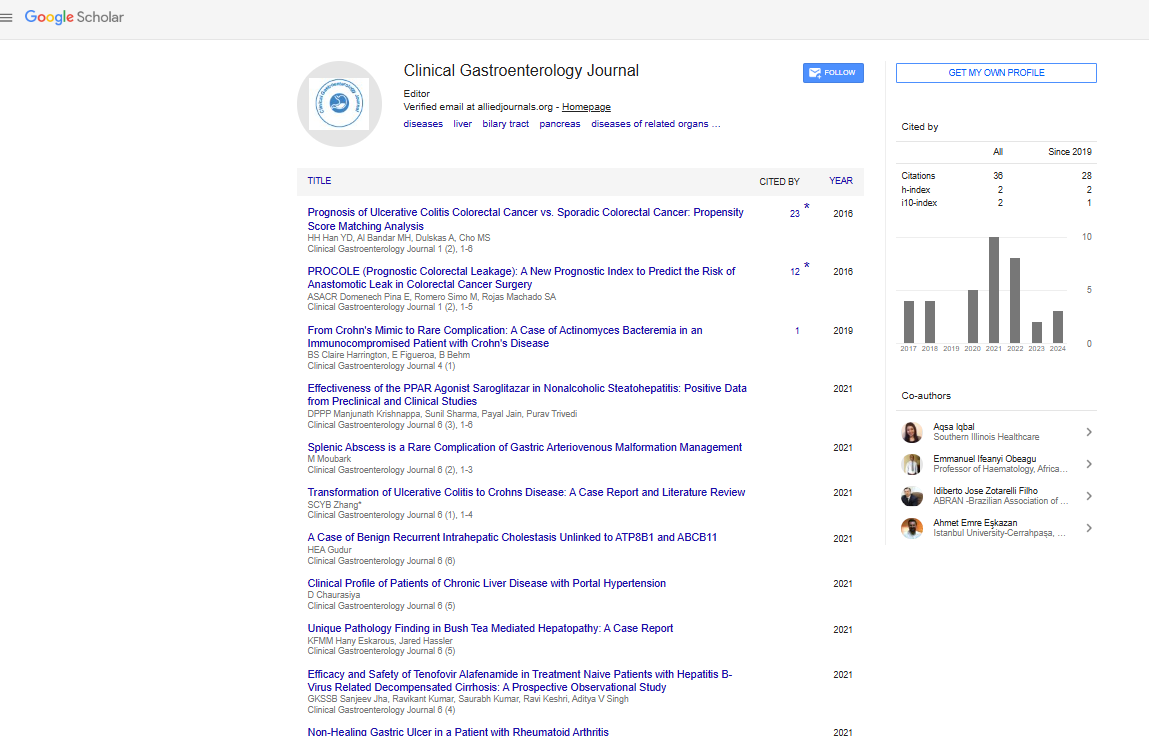
Clinical Gastroenterology Journal received 33 citations as per Google Scholar report