Brief Report - (2025) Volume 10, Issue 3
Received: 01-Sep-2025, Manuscript No. jib-25-175271;
Editor assigned: 03-Sep-2025, Pre QC No. P-175271;
Reviewed: 17-Sep-2025, QC No. Q-175271;
Revised: 22-Sep-2025, Manuscript No. R-175271;
Published:
29-Sep-2025
, DOI: 10.37421/2476-1966.2025.10.281
Citation: Weiss, Adrian. ”NK Cells: Biology, Therapies, and Challenges.” J Immuno Biol 10 (2025):281.
Copyright: © 2025 Weiss A. This is an open-access article distributed under the terms of the Creative Commons Attribution License, which permits unrestricted use, distribution and reproduction in any medium, provided the original author and source are credited.
This study challenges the conventional view of PD-1 expression as a marker of exhaustion in human natural killer (NK) cells within the tumor microenvironment. It suggests that PD-1 positive NK cells retain their cytotoxic function and responsiveness, implying that PD-1 blockade might not uniformly rejuvenate NK cell activity as it does for T cells. This finding provides crucial insights into NK cell biology in cancer and could influence immunotherapy strategies. [1].
This review highlights the rapid progress in developing Chimeric Antigen Receptor (CAR)-NK cell therapies for cancer. It discusses the advantages of CAR-NK cells over CAR-T cells, such as their allogeneic potential and lower risk of cytokine release syndrome and graft-versus-host disease, while also outlining current challenges and future directions for optimizing their therapeutic efficacy in various malignancies. [2].
This review delves into the complex process of human NK cell education, where NK cells acquire functional competence through interactions with self-MHC class I molecules. It explores how this education impacts NK cell activity, particularly in disease contexts like cancer and viral infections, and discusses the implications for therapeutic manipulation of NK cell responses. [3].
This review provides an in-depth analysis of the role of natural killer cells in SARS-CoV-2 infection and the pathogenesis of COVID-19. It highlights how NK cell function can be impaired or dysregulated during severe COVID-19, contributing to disease progression, and discusses the potential for NK cell-based therapies to modulate immune responses in viral infections. [4].
This article focuses on the critical role of metabolic fitness in determining the efficacy of natural killer cells in cancer immunotherapy. It discusses how nutrient availability and metabolic pathways influence NK cell activation, proliferation, and effector functions, suggesting that targeting NK cell metabolism could be a promising strategy to enhance anti-tumor immunity. [5].
This review explores the fascinating concept of memory-like natural killer cells, which exhibit enhanced and sustained anti-tumor responses after prior activation. It discusses their unique characteristics, mechanisms of generation, and significant potential for adoptive cell therapies, offering a novel avenue to improve the durability and effectiveness of NK cell-based immunotherapies against cancer. [6].
This article examines the age-related decline in natural killer cell function, termed 'immunosenescence,' and its implications for increased susceptibility to infections and cancer in the elderly. It discusses phenotypic and functional changes in NK cells with aging and explores potential interventions to bolster NK cell immunity in older individuals. [7].
This review summarizes recent findings on the intricate mechanisms governing natural killer cell activation and signal transduction. It highlights the balance between activating and inhibitory receptors, the downstream signaling pathways that orchestrate NK cell effector functions, and how a deeper understanding of these processes can inform strategies for therapeutic modulation. [8].
This comprehensive review explores the dualistic role of natural killer cells in autoimmune diseases, acting as both protectors and contributors to pathogenesis. It discusses how NK cell subsets, receptor expression, and functional dysregulation can influence disease progression in various autoimmune conditions, suggesting NK cells as potential therapeutic targets. [9].
This article examines the complex interplay between natural killer cells and the tumor microenvironment (TME), illustrating how the TME can either inhibit or promote NK cell anti-tumor functions. It highlights the challenges of overcoming TME-mediated NK cell suppression and discusses strategies to harness NK cells effectively for cancer immunotherapy by modifying the TME. [10].
Natural Killer (NK) cells play a pivotal role in the immune system, with their functional competence being meticulously acquired through a process known as education. This education involves critical interactions with self-MHC class I molecules, profoundly influencing NK cell activity in contexts ranging from cancer to viral infections [3]. Understanding these educational processes is crucial for therapeutic manipulation of NK cell responses. The fundamental activity of NK cells is orchestrated by intricate mechanisms governing their activation and signal transduction. There is a delicate balance between activating and inhibitory receptors, which, along with downstream signaling pathways, dictates NK cell effector functions. A deeper comprehension of these complex processes is essential for developing targeted strategies for therapeutic modulation of NK cell activity [8].
In the realm of cancer immunotherapy, NK cells represent a highly promising avenue. Recent studies challenge the conventional wisdom regarding PD-1 expression on human NK cells within the tumor microenvironment. It appears that PD-1 positive NK cells often retain their cytotoxic function and responsiveness, implying that PD-1 blockade strategies may not uniformly rejuvenate NK cell activity in the same manner as observed with T cells [1]. This provides crucial insights into NK cell biology in cancer and holds the potential to significantly influence future immunotherapy strategies. Moreover, the development of Chimeric Antigen Receptor (CAR)-NK cell therapies is advancing rapidly. These therapies offer distinct advantages over CAR-T cells, including their allogeneic potential and a reduced risk of cytokine release syndrome and graft-versus-host disease. While challenges remain, optimizing their therapeutic efficacy in various malignancies is a key focus for future directions [2]. Adding to this, the concept of memory-like NK cells is gaining attention for their enhanced and sustained anti-tumor responses following prior activation. Their unique characteristics and mechanisms of generation present significant potential for adoptive cell therapies, offering a novel approach to improve the durability and effectiveness of NK cell-based immunotherapies against cancer [6].
The efficacy of natural killer cells in cancer immunotherapy is critically dependent on their metabolic fitness. Nutrient availability and specific metabolic pathways directly influence NK cell activation, proliferation, and effector functions. This highlights that targeting NK cell metabolism could be a promising strategy to enhance anti-tumor immunity [5]. However, the complex interplay between NK cells and the tumor microenvironment (TME) presents a double-edged sword for cancer immunotherapy. The TME can either inhibit or promote NK cell anti-tumor functions, creating significant challenges. Overcoming TME-mediated NK cell suppression requires innovative strategies aimed at modifying the microenvironment to effectively harness NK cells for therapeutic benefit [10].
Beyond cancer, NK cells demonstrate critical roles in managing infectious diseases. For instance, they are deeply involved in SARS-CoV-2 infection and the pathogenesis of COVID-19. Research indicates that NK cell function can be impaired or dysregulated during severe COVID-19, contributing significantly to disease progression. This area of research also explores the potential for NK cell-based therapies to modulate immune responses during viral infections [4]. Furthermore, NK cells exhibit a dualistic role in autoimmune diseases, acting as both protectors and, in some cases, contributors to pathogenesis. The influence of NK cell subsets, receptor expression, and functional dysregulation on disease progression across various autoimmune conditions suggests NK cells as potential therapeutic targets for these diseases [9].
Another critical aspect of NK cell biology is their age-related decline, known as 'immunosenescence'. This decline in NK cell function has profound implications, leading to increased susceptibility to infections and cancer in the elderly. Understanding the phenotypic and functional changes in NK cells with aging is vital for exploring potential interventions aimed at bolstering NK cell immunity in older individuals [7].
The multifaceted roles of Natural Killer (NK) cells in human health and disease are increasingly understood. These immune cells are vital for surveillance against cancer and viral infections. Their functional competence is shaped through a process known as education, where interactions with self-MHC class I molecules determine their activity in various pathological settings. NK cell activation itself is a finely tuned process, governed by a delicate balance of activating and inhibitory receptors and complex signaling pathways. In the realm of cancer immunotherapy, NK cells are proving to be dynamic. Contrary to long-held beliefs, PD-1 expression on NK cells within tumors does not always signify exhaustion; instead, these cells often maintain their cytotoxic capabilities, suggesting different therapeutic strategies for PD-1 blockade in NK cell-based treatments. Chimeric Antigen Receptor (CAR)-NK cell therapies are emerging as a powerful approach, offering advantages over CAR-T cells due to their allogeneic potential and reduced side effects. Furthermore, the discovery of memory-like NK cells, which exhibit sustained anti-tumor responses, holds promise for more durable immunotherapies. The efficacy of these anti-cancer responses is also significantly influenced by the metabolic fitness of NK cells, suggesting metabolic pathway modulation as a strategy to boost anti-tumor immunity. However, NK cell function is not without its challenges. The tumor microenvironment can either hinder or enhance their anti-tumor actions, necessitating targeted modifications to optimize NK cell-based therapies. Beyond cancer, NK cells play complex roles in viral infections, such as SARS-CoV-2, where their dysregulation can worsen COVID-19. They also show a dual role in autoimmune diseases, sometimes protective, other times contributing to pathogenesis. Compounding these issues, NK cell function naturally declines with age, a process called immunosenescence, which increases vulnerability to infections and cancer in older populations, prompting research into strategies to rejuvenate NK cell immunity.
None
None
Andrea MH, Stephanie MTvdS, Kim HEGB. "PD-1 expression on human NK cells in cancer is not associated with an exhausted phenotype.".J Immunother Cancer 11 (2023):e006240.
Indexed at, Google Scholar, Crossref
Qian-Hui H, Xiao-Jie L, Ya-Ping G. "Recent Advances in Chimeric Antigen Receptor (CAR)-NK Cell-Based Immunotherapy for Cancer.".Front Immunol 12 (2021):748154.
Indexed at, Google Scholar, Crossref
Sophie HCvdM, Lisa GEvdS, Bianca SdG. "Human NK Cell Education: Lessons Learnt and New Challenges.".Front Immunol 12 (2021):654992.
Indexed at, Google Scholar, Crossref
Ana IO, Ricardo SPP, Pedro R. "Natural killer cells in SARS-CoV-2 infection and COVID-19: A comprehensive review.".Viral Immunol 34 (2021):471-483.
Indexed at, Google Scholar, Crossref
Junhong Y, Jennifer AWWY, Todd AAW. "The metabolic fitness of natural killer cells for immunotherapy.".Cancer Discov 10 (2020):1629-1647.
Indexed at, Google Scholar, Crossref
Zhaoli Z, Fengyan L, Wei-Lei C. "The emerging role of memory-like NK cells in cancer immunotherapy.".Cell Mol Biol Lett 28 (2023):68.
Indexed at, Google Scholar, Crossref
Julia CC, Mark CML, Rosemary AL. "Natural Killer Cell Function in the Elderly: Impact on Cancer and Infection.".Aging Dis 11 (2020):148-161.
Indexed at, Google Scholar, Crossref
Yun-Han L, Yu-Ying L, Cheng-Hsueh H. "Recent Advances in Natural Killer Cell Activation and Signal Transduction.".Biomedicines 10 (2022):2060.
Indexed at, Google Scholar, Crossref
Xue-Li L, Gui-Lin L, Li-Feng L. "The role of natural killer cells in autoimmune diseases: a comprehensive review.".Front Immunol 14 (2023):1146755.
Indexed at, Google Scholar, Crossref
Jian-Xin Y, Zhi-Yi W, Zhi-Ming H. "Natural killer cell modulation in the tumor microenvironment: a double-edged sword for cancer immunotherapy.".Cancer Commun (Lond) 42 (2022):1157-1175.
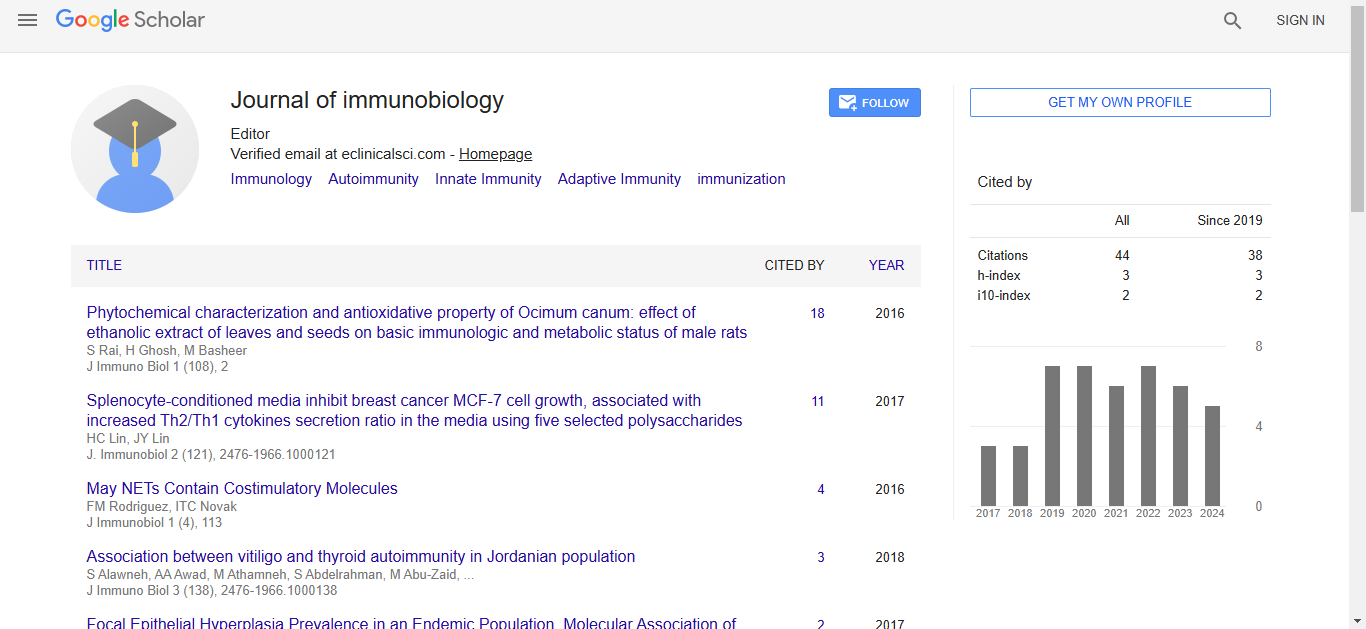
Journal of Immunobiology received 34 citations as per Google Scholar report