Commentary - (2025) Volume 11, Issue 3
Received: 01-May-2025, Manuscript No. jfim-26-178558;
Editor assigned: 03-May-2025, Pre QC No. P-178558;
Reviewed: 17-May-2025, QC No. Q-178558;
Revised: 24-May-2025, Manuscript No. R-178558;
Published:
31-May-2025
, DOI: 10.37421/2572-4134.2025.11.344
Citation: Schneider, Elisabeth. ”Microbial Stress Responses: Food Safety and Preservation.” J Food Ind Microbiol 11 (2025):344.
Copyright: © 2025 Schneider E. This is an open-access article distributed under the terms of the Creative Commons Attribution License, which permits unrestricted use, distribution and reproduction in any medium, provided the original author and source are credited.
The intricate field of food microbiology continuously explores the multifaceted challenges faced by microorganisms within food processing and storage environments. A fundamental aspect of this exploration is understanding how various stresses impact microbial viability and trigger adaptive physiological responses. These stresses, ranging from thermal treatments and pH fluctuations to osmotic pressure and chemical sanitizers, are critical factors influencing microbial behavior and ultimately, food safety. The adaptive mechanisms employed by microbes, such as the formation of stress granules and the upregulation of protective proteins, are central to their survival and proliferation under adverse conditions. Osmotic stress, a prevalent condition in high-sugar or high-salt food products like jams and cured meats, poses a significant challenge to bacterial survival. Microorganisms have evolved sophisticated molecular mechanisms to counteract the dehydrating effects of high solute concentrations, including the intracellular accumulation of compatible solutes to maintain turgor pressure. This inherent resilience underscores the effectiveness of osmotic stress as a hurdle technology in food preservation. Thermal processing, a cornerstone of food preservation, also induces significant stress on microbial cells. Studies on pasteurization, for instance, reveal that even sub-lethal heat treatments can activate specific heat shock proteins and transcriptional regulators within bacteria like Listeria monocytogenes. Crucially, this exposure can lead to a phenomenon known as thermal cross-protection, enhancing resistance to subsequent higher temperatures, which has profound implications for inactivation efficacy. Acidic conditions, frequently encountered in fruit juices and fermented products, represent another major environmental stressor for microorganisms in the food industry. Bacteria like Escherichia coli have developed robust acid resistance mechanisms, primarily focused on maintaining cytoplasmic pH homeostasis through proton pumps and intricate regulatory pathways. Understanding these adaptations is vital for predicting microbial behavior in acidic food matrices and during transit through the gastrointestinal tract. Beyond single stress factors, microorganisms in food environments often encounter multiple stressors simultaneously. Research into the synergistic effects of combined stresses, such as mild heat and antimicrobial compounds during baking, demonstrates that prior exposure to sublethal conditions can significantly alter a yeast's metabolic state and enhance its survival. This highlights the complexity of microbial control and its impact on product quality. Sanitization procedures, essential for maintaining hygiene in food processing facilities, also exert considerable stress on microorganisms. The use of chemical sanitizers, such as quaternary ammonium compounds (QACs), can lead to the development of tolerance in bacteria like Staphylococcus aureus. The underlying resistance mechanisms, often involving efflux pumps and alterations in cell membrane composition, are critical for assessing the efficacy of cleaning protocols. Bacterial spores, known for their extreme resilience, present a unique challenge in food preservation, particularly in products like dairy. Studies investigating the survival of spores under combined stresses, such as heat and mechanical shear during dairy processing, reveal complex germination pathways activated under suboptimal conditions. This resilience necessitates a thorough understanding for ensuring microbiological safety. Oxidative stress, often induced by sanitizers like peracetic acid, triggers specific adaptive responses in foodborne pathogens. Research examining the effects of these sanitizers on bacteria like Salmonella demonstrates the activation of antioxidant defense systems. This phenomenon is crucial for understanding how sanitizers, while intended for microbial inactivation, can paradoxically induce stress responses that influence their overall efficacy. Modern food packaging technologies, such as vacuum packaging and modified atmosphere packaging (MAP), introduce unique environmental stresses that influence microbial physiology. Studies investigating psychrotrophic bacteria in meat products reveal how altered oxygen levels and reduced water activity induce specific stress responses that impact growth and spoilage. These technologies can be strategically employed to manage microbial populations. Novel food processing techniques, including high hydrostatic pressure (HHP), impose significant physiological challenges on microorganisms. Research on bacteria like Lactobacillus plantarum under HHP conditions elucidates mechanisms of pressure adaptation, such as changes in membrane fluidity. Understanding these responses is key to leveraging HHP as an effective non-thermal preservation method.
The comprehensive impact of various processing and storage stresses on microbial viability and physiological responses is a central theme in food microbiology. Heat, pH shifts, osmotic pressure, and sanitizing chemicals are key environmental factors that influence microbial behavior. Microbes employ adaptive strategies, including stress granule formation and increased expression of heat shock proteins, to survive these challenges, which is crucial for predicting their behavior and developing effective preservation techniques [1].
Osmotic stress, particularly relevant in high-solute foods like jams and cured meats, profoundly affects bacterial physiology. Bacteria respond by accumulating compatible solutes to maintain osmotic balance and turgor pressure, enabling survival. This adaptive capacity highlights the role of osmotic stress as a critical hurdle in food preservation and the potential for increased microbial tolerance over time [2].
Thermal processing, such as pasteurization, induces a heat shock response in bacteria, activating specific proteins and regulatory pathways. Sub-lethal heat treatments can confer cross-protection, enhancing resistance to subsequent higher temperatures. This phenomenon is vital for predicting microbial inactivation during thermal processing and designing robust validation strategies [3].
Acidic environments in foods like fruit juices and fermented products trigger acid resistance mechanisms in bacteria like Escherichia coli. These mechanisms focus on maintaining cytoplasmic pH homeostasis through proton pumps and other regulatory pathways. Acid adaptation can also influence virulence and survival in the gastrointestinal tract, impacting overall microbial behavior in food systems [4].
The combined effects of multiple stressors are of significant interest, particularly in complex processes like baking. Yeast, for example, can enhance its survival in challenging baking conditions through prior exposure to sublethal stresses, such as mild heat or antimicrobial compounds. Considering these synergistic effects is essential for effective microbial control and maintaining product quality [5].
Sanitization procedures, a critical aspect of food hygiene, expose bacteria to chemical agents like quaternary ammonium compounds (QACs). This can lead to the development of QAC tolerance in pathogens like Staphylococcus aureus, mediated by mechanisms such as efflux pumps and changes in cell membrane composition. Understanding these adaptations is crucial for ensuring the effectiveness of disinfection protocols [6].
Bacterial spores, like those of Bacillus cereus, exhibit remarkable resilience to processing stresses, including heat and mechanical shear encountered in dairy production. These spores can activate germination pathways even under suboptimal conditions, underscoring their persistence and the need for careful control to ensure the safety of heat-treated dairy products [7].
Sanitizers can also induce adaptive stress responses in microorganisms. For instance, exposure to peracetic acid, a common sanitizer, can activate antioxidant defense systems in Salmonella. This adaptive response can influence bacterial viability and potentially affect the overall efficacy of sanitization protocols [8].
Packaging technologies play a role in modulating microbial stress. Vacuum and modified atmosphere packaging (MAP) create altered atmospheric conditions and reduce water activity, inducing specific stress responses in psychrotrophic bacteria in meat products. These responses impact growth and spoilage, allowing for strategic utilization of packaging to extend shelf-life [9].
Novel processing methods like high hydrostatic pressure (HHP) impose significant stress on microbial cells. Lactobacillus plantarum, for example, exhibits pressure adaptation mechanisms, including alterations in membrane fluidity and protein structures. Understanding these responses is key to optimizing HHP for food preservation [10].
Microorganisms in food processing and storage face various stresses including heat, pH changes, osmotic pressure, and sanitizers. They adapt through mechanisms like stress granule formation and upregulation of protective proteins, impacting microbial viability and food safety. Osmotic stress in high-solute foods induces compatible solute accumulation for survival. Thermal processing activates heat shock responses and cross-protection. Acidic conditions trigger pH homeostasis mechanisms. Combined stressors can enhance microbial survival, and sanitizers may lead to tolerance. Bacterial spores exhibit extreme resilience, and packaging technologies can modulate microbial stress. Novel processing methods like high hydrostatic pressure induce adaptation mechanisms. Understanding these microbial stress responses is crucial for developing effective preservation strategies and ensuring food safety.
None
None
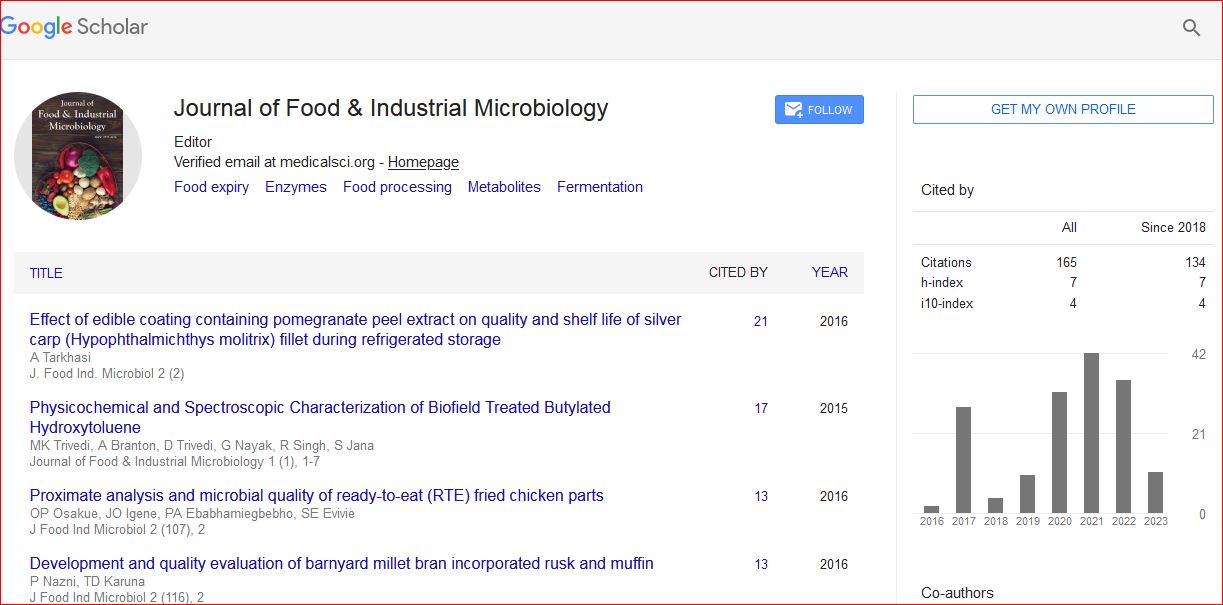
Journal of Food & Industrial Microbiology received 160 citations as per Google Scholar report