Opinion - (2025) Volume 11, Issue 2
Received: 01-Mar-2025, Manuscript No. jfim-26-178551;
Editor assigned: 03-Mar-2025, Pre QC No. P-178551;
Reviewed: 17-Mar-2025, QC No. Q-178551;
Revised: 24-Mar-2025, Manuscript No. R-178551;
Published:
31-Mar-2025
, DOI: 10.37421/2572-4134.2025.11.337
Citation: Menon, Priya S.. ”Microbial Spoilage In Processed Foods: Mechanisms And Preservation.” J Food Ind Microbiol 11 (2025):337.
Copyright: © 2025 Menon S. Priya This is an open-access article distributed under the terms of the Creative Commons Attribution License, which permits unrestricted use, distribution and reproduction in any medium, provided the original author and source are credited.
Microbial spoilage in processed foods represents a significant challenge to food safety and extends the shelf life of various products [1].
This complex issue is driven by a multitude of mechanisms, including the enzymatic activity inherent to food matrices, the metabolic byproducts of microbial growth, and intricate interactions among different microbial populations [1].
Understanding these mechanisms is paramount for developing robust preservation strategies [1].
These strategies encompass approaches such as hurdle technology, which combines multiple inhibitory factors, controlled atmosphere packaging to modify the gaseous environment, and the exploration of novel antimicrobial agents to effectively inhibit microbial proliferation and spoilage processes [1].
Specific bacterial enzymes play a critical role in the degradation of food components, leading to undesirable sensory attributes [2].
Proteases and lipases, in particular, are identified as key culprits in the spoilage of ready-to-eat meals, contributing to alterations in texture and flavor even under refrigerated storage conditions [2].
Consequently, controlling initial microbial contamination and implementing effective thermal processing to inactivate these enzymes are crucial for extending the shelf life of such products [2].
The emergence of spoilage yeasts, such as *Candida* and *Saccharomyces*, poses a growing concern in fermented dairy products [3].
These yeasts produce metabolic byproducts, including ethanol and volatile organic compounds, which contribute to off-odors and overall spoilage [3].
To address this, research suggests the utilization of natural antimicrobial compounds derived from plants as a sustainable approach to inhibit yeast growth and mitigate spoilage [3].
In vacuum-packaged meat, synergistic interactions between bacterial species like *Pseudomonas* and *Staphylococcus* can accelerate spoilage [4].
These bacteria are known to produce proteases and lipases that degrade meat proteins and fats, leading to rancidity and undesirable off-flavors [4].
Mitigating this combined threat necessitates improved hygiene practices and precise temperature control throughout processing and storage [4].
The application of modified atmosphere packaging (MAP) significantly influences the microbial communities present in fresh produce, thereby affecting spoilage profiles [5].
While MAP can inhibit certain spoilage organisms, it may also favor others, leading to different spoilage characteristics [5].
Therefore, optimizing MAP conditions based on the specific produce and its associated microflora is essential for effective preservation [5].
Psychrotrophic bacteria are primary contributors to the spoilage of refrigerated dairy products, especially milk [6].
Key species such as *Pseudomonas fluorescens* produce lipases and proteases that degrade milk components, resulting in undesirable flavor and texture changes [6].
Strategies to control these organisms include rapid cooling and stringent hygiene measures during milk production and processing [6].
Lactic acid bacteria can contribute to the spoilage of cured meat products through the formation of biogenic amines [7].
Specific bacterial strains and their associated enzymes are responsible for the decarboxylation of amino acids, leading to the production of compounds like histamine and tyramine, which can have adverse health effects [7].
The use of starter cultures with a low potential for biogenic amine production is recommended to mitigate this risk [7].
Spoilage fungi, including *Aspergillus* and *Penicillium*, pose a threat to bakery products by producing mycotoxins and enzymes that degrade carbohydrates and lipids [8].
This enzymatic activity results in off-flavors, staling, and visible mold growth [8].
Controlling moisture and water activity in bakery items is therefore crucial for preventing fungal spoilage [8].
Hurdle technology offers a valuable approach for extending the shelf life of minimally processed fruits and vegetables [9].
By combining multiple preservation factors, such as mild heat treatment, low pH, and modified atmosphere, microbial growth and enzymatic activity can be effectively inhibited, leading to reduced spoilage and the retention of quality attributes [9].
Bacteriocins represent a promising class of natural antimicrobials for food preservation [10].
These compounds exert their effects through specific mechanisms, such as membrane disruption, and have demonstrated effectiveness in inhibiting the growth of spoilage organisms in various food systems, including dairy and meat products [10].
Their application offers a viable alternative to conventional chemical preservatives [10].
Microbial spoilage in processed foods is a multifaceted phenomenon driven by various intrinsic and extrinsic factors, necessitating comprehensive understanding for effective mitigation [1].
The intricate mechanisms involved include the action of indigenous food enzymes, the metabolic activities of microorganisms leading to the production of undesirable compounds, and complex inter-species microbial interactions [1].
Developing efficacious preservation strategies is therefore critically important [1].
These strategies encompass hurdle technology, a combinatorial approach employing multiple inhibitory factors, modified atmosphere packaging (MAP) to control the gaseous environment, and the development and application of novel antimicrobial agents aimed at inhibiting microbial proliferation and enhancing food safety and shelf life [1].
Enzymatic activity originating from microorganisms is a primary driver of spoilage in certain food products, notably ready-to-eat meals [2].
Specific bacterial enzymes, such as proteases and lipases, have been identified as major contributors to undesirable changes in texture and flavor, even when products are stored under refrigeration [2].
To combat this, it is essential to rigorously control initial microbial contamination and implement effective thermal processing steps designed to inactivate these enzymes, thereby significantly extending the usable life of these food items [2].
The proliferation of spoilage yeasts, exemplified by *Candida* and *Saccharomyces*, presents an increasing challenge in the preservation of fermented dairy products [3].
These yeasts metabolize food components, producing byproducts like ethanol and volatile organic compounds that are directly responsible for imparting off-odors and driving spoilage [3].
A sustainable approach to counteracting this involves the application of natural antimicrobial compounds derived from botanical sources, which can effectively inhibit yeast growth [3].
Synergistic microbial activity can accelerate spoilage in packaged foods, as observed in vacuum-packaged meat where *Pseudomonas* and *Staphylococcus* species cooperate [4].
Their combined enzymatic action, through the production of proteases and lipases, leads to the degradation of meat proteins and fats, resulting in rancidity and the development of off-flavors [4].
Preventative measures should therefore focus on stringent hygiene protocols and precise temperature management throughout the processing and storage chain to counteract this dual threat [4].
The efficacy of modified atmosphere packaging (MAP) in extending the shelf life of fresh produce is dependent on its impact on microbial communities [5].
MAP can be designed to inhibit the growth of undesirable spoilage organisms, but it may inadvertently create conditions favorable for others, leading to distinct spoilage patterns [5].
Thus, tailoring MAP parameters to the specific type of produce and its native microflora is a critical aspect of optimizing its application [5].
Refrigerated dairy products, particularly milk, are susceptible to spoilage by psychrotrophic bacteria, which are adapted to cold temperatures [6].
Prominent spoilage culprits, such as *Pseudomonas fluorescens*, secrete lipases and proteases that break down milk constituents, leading to undesirable alterations in flavor and texture [6].
Effective control strategies include rapid cooling of milk and the maintenance of strict hygienic standards throughout the supply chain [6].
In cured meat products, lactic acid bacteria can contribute to spoilage through the production of biogenic amines [7].
This process involves specific bacterial strains and their enzymes, which catalyze the decarboxylation of amino acids to form compounds like histamine and tyramine [7].
These amines can pose health risks, and their formation can be limited by utilizing starter cultures characterized by low biogenic amine production potential [7].
Bakery products are vulnerable to spoilage by fungi like *Aspergillus* and *Penicillium*, which not only cause visible mold growth but also produce mycotoxins and enzymes that degrade essential food components [8].
The degradation of carbohydrates and lipids results in off-flavors and accelerated staling [8].
Therefore, meticulous control of moisture content and water activity is paramount in preventing fungal spoilage in baked goods [8].
Hurdle technology has proven to be an effective strategy for enhancing the shelf life of minimally processed fruits and vegetables [9].
This approach leverages the synergistic effects of multiple mild preservation techniques, including controlled heat treatments, pH adjustment, and modified atmospheres, to inhibit microbial growth and enzymatic degradation [9].
This integrated approach effectively reduces spoilage and preserves the quality of the produce [9].
Bacteriocins represent a class of natural antimicrobial peptides with significant potential for food preservation [10].
They act through specific mechanisms, such as disrupting microbial cell membranes, and have demonstrated efficacy against a range of spoilage bacteria in dairy and meat products [10].
Their application offers a sustainable and health-conscious alternative to synthetic chemical preservatives [10].
Microbial spoilage in processed foods is a complex issue stemming from enzymatic activity, microbial metabolism, and inter-species interactions. Effective preservation strategies are crucial for food safety and shelf life extension. Key mechanisms include enzymatic degradation by bacteria like proteases and lipases, leading to texture and flavor changes in products such as ready-to-eat meals and meat. Spoilage yeasts and fungi, found in dairy and bakery products respectively, produce off-flavors and potentially harmful mycotoxins. Psychrotrophic bacteria are a concern in refrigerated dairy, while lactic acid bacteria can produce biogenic amines in cured meats. Technologies like modified atmosphere packaging and hurdle technology, which combines multiple preservation factors, are vital. Bacteriocins are emerging as natural antimicrobial agents to combat spoilage organisms, offering an alternative to chemical preservatives. Research from institutions like AIIMS, New Delhi, contributes to understanding these mechanisms and informing industrial practices.
None
None
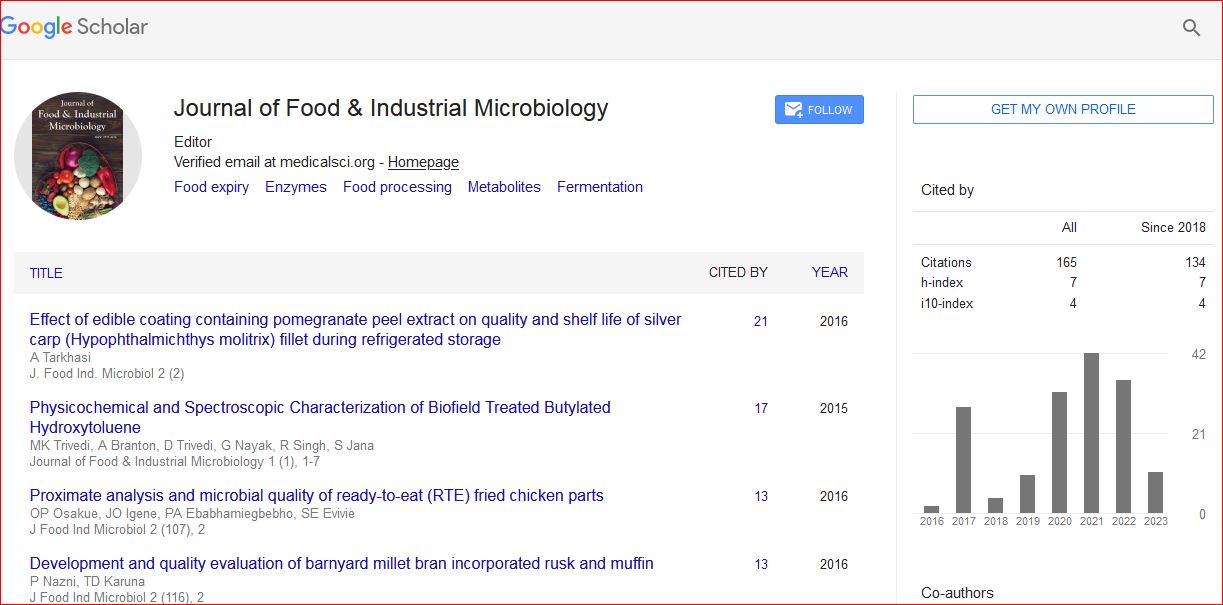
Journal of Food & Industrial Microbiology received 160 citations as per Google Scholar report