Opinion - (2025) Volume 11, Issue 5
Received: 01-Sep-2025, Manuscript No. jfim-26-178582;
Editor assigned: 03-Sep-2025, Pre QC No. P-178582;
Reviewed: 17-Sep-2025, QC No. Q-178582;
Revised: 22-Sep-2025, Manuscript No. R-178582;
Published:
29-Sep-2025
, DOI: 10.37421/2572-4134.2025.11.368
Citation: Torres, Juanita M.. ”Microbial Influence on Bakery and Cereal Product Quality.” J Food Ind Microbiol 11 (2025):368.
Copyright: © 2025 Torres M. Juanita This is an open-access article distributed under the terms of the Creative Commons Attribution License, which permits unrestricted use, distribution and reproduction in any medium, provided the original author and source are credited.
The field of industrial microbiology plays a pivotal role in ensuring the quality, safety, and stability of bakery and cereal products, a cornerstone of global food consumption [1].
Microorganisms, encompassing both beneficial and detrimental types, significantly influence the characteristics of these products, ranging from texture and flavor to their shelf-life and nutritional value [1].
Beneficial microbes, such as yeasts and lactic acid bacteria, are essential for processes like sourdough fermentation, contributing desirable sensory attributes and improving digestibility [1, 3]. Conversely, spoilage organisms can lead to rapid degradation, while pathogens pose significant health risks to consumers [1, 4]. Understanding the dynamics of yeast populations during industrial bread production is crucial for optimizing fermentation processes and achieving consistent product quality [2].
Different yeast strains and variations in process parameters can dramatically affect dough leavening, aroma development, and the overall textural profile of the final baked goods [2].
The metabolic activities of yeasts within the complex dough matrix are central to these outcomes, and effective management strategies are vital for predictable baking results [2].
Lactic acid bacteria (LAB) are particularly important in cereal-based products, especially in traditional sourdough fermentation where they contribute significantly to flavor development and acidification [3].
Their activity also enhances the shelf-life of products by inhibiting the growth of spoilage microorganisms, making them valuable for extending product longevity and improving food safety [3].
The careful selection of specific LAB starter cultures can further enhance the functional and technological properties of bread and other cereal goods [3].
Microbial spoilage remains a significant concern in the cereal-based product industry, necessitating the identification of common microorganisms responsible for degradation and a thorough understanding of their mechanisms [4].
Environmental factors and processing conditions play a crucial role in accelerating or retarding spoilage rates [4].
Consequently, effective strategies for extending shelf-life, including the utilization of natural antimicrobials and advanced packaging techniques, are continuously being explored and implemented [4].
Bacteriocins produced by lactic acid bacteria offer a promising avenue for natural food preservation in bakery products [5].
These antimicrobial peptides have demonstrated efficacy against a range of foodborne pathogens and spoilage organisms, providing a safer alternative to synthetic preservatives [5].
Research into specific bacteriocins and their impact on the sensory properties and shelf-life of bread and cakes is ongoing to harness their full potential as natural food preservatives [5].
Predictive microbiology has emerged as a powerful tool for the industrial baking sector, enabling the forecasting of microbial growth, survival, and inactivation under diverse processing and storage conditions [6].
By employing mathematical models, bakers can develop safer, more stable cereal products and optimize manufacturing processes through informed decision-making [6].
This approach is key to enhancing product quality and reducing waste [6].
The microbial ecology of traditional fermented cereal products showcases a rich diversity of microorganisms that contribute unique metabolic profiles to product characteristics like texture and flavor [7].
These traditional methods, often underpinned by generations of accumulated knowledge, offer valuable insights into the complex interactions between microbes and cereal substrates [7].
The potential for industrial application of these ancient fermentation techniques is also an area of growing interest [7].
High-pressure processing (HPP) represents an innovative non-thermal method for inactivating microbial contaminants in cereal-based food ingredients [8].
This technique effectively reduces the survival rates of common spoilage bacteria and yeasts while minimizing adverse effects on the physicochemical properties of the treated ingredients [8].
HPP offers a sustainable and effective approach to improving the microbial safety of food ingredients [8].
Gluten-free bakery products present distinct microbial safety challenges due to their altered ingredient compositions and unique processing methods [9].
Identifying potential microbial hazards, understanding their origins, and evaluating control strategies are paramount to ensuring the safety and health of consumers in this growing market segment [9].
Rigorous safety protocols are essential for maintaining consumer confidence [9].
The presence of mycotoxin-producing fungi in cereal grains poses a significant risk to the quality and safety of industrial baking operations [10].
These fungi can produce harmful mycotoxins, necessitating comprehensive strategies for mitigation [10].
Such strategies involve careful raw material selection, optimized processing techniques, and diligent analytical monitoring to minimize risks associated with mycotoxin contamination in the final products [10].
Industrial microbiology is intrinsically linked to the production of high-quality, safe, and stable bakery and cereal products, fundamental to the food industry [1].
The interplay between beneficial microorganisms, such as yeasts and lactic acid bacteria, and potentially harmful microbes dictates crucial product attributes like texture, flavor, and shelf-life [1].
Beneficial microbes are key players in fermentation processes, contributing to desirable sensory profiles and improved digestibility, as seen in sourdough production [1, 3]. In contrast, spoilage microorganisms can lead to product deterioration, while pathogenic microbes present serious health risks [1, 4]. Investigating the behavior of yeast populations during industrial bread making is essential for controlling fermentation and ensuring uniform product quality [2].
Factors such as the specific yeast strains employed and the variations in process parameters significantly influence dough fermentation dynamics, leading to alterations in aroma, texture, and overall bread quality [2].
A deep understanding of yeast metabolism within the dough matrix is critical for managing their performance and achieving consistent baking outcomes [2].
The role of lactic acid bacteria (LAB) in cereal-based products, particularly in sourdough fermentations, is multifaceted, contributing to complex flavor profiles and increased acidity [3].
LAB also play a vital role in extending product shelf-life by suppressing the growth of undesirable microorganisms [3].
The strategic selection and application of specific LAB starter cultures can further enhance the functional attributes and technological performance of various cereal goods, making them valuable for product development [3].
Addressing microbial spoilage in cereal-based products requires a detailed understanding of the common spoilage agents and their mechanisms of action [4].
The rate of spoilage is heavily influenced by external factors such as environmental conditions and the specific processing methods used [4].
Therefore, the development and implementation of effective strategies to extend shelf-life, including the use of natural antimicrobials and innovative packaging solutions, are of paramount importance [4].
Bacteriocins, produced by lactic acid bacteria, are gaining recognition as natural food preservatives, particularly in the bakery sector [5].
These compounds have shown significant effectiveness in inhibiting the growth of common foodborne pathogens and spoilage microorganisms, offering a natural alternative to synthetic preservatives [5].
Research continues to explore the application of specific bacteriocins to improve the sensory qualities and extend the shelf-life of products like bread and cakes [5].
Predictive microbiology offers advanced capabilities for the industrial baking industry by providing tools to forecast microbial behavior, including growth, survival, and inactivation under various processing and storage scenarios [6].
This foresight aids in the design of safer, more stable cereal products and facilitates the optimization of manufacturing processes, leading to improved efficiency and product integrity [6].
The microbial ecology of traditional fermented cereal products reveals a diverse community of microorganisms that contribute distinct metabolic products, shaping the unique textural and flavor characteristics of these foods [7].
These traditional production methods, often passed down through generations, highlight the intricate relationship between microbial consortia and cereal substrates [7].
There is growing interest in leveraging the principles of these traditional fermentations for modern industrial applications [7].
High-pressure processing (HPP) is an effective non-thermal technology for reducing microbial loads in cereal-based food ingredients [8].
This method significantly decreases the viability of common spoilage bacteria and yeasts without negatively impacting the physicochemical properties of the ingredients, offering a novel approach to food safety and ingredient preservation [8].
Ensuring the microbial safety of gluten-free bakery products presents unique challenges due to the inherent differences in their formulation and processing compared to conventional baked goods [9].
Identifying potential microbial hazards, understanding their sources, and implementing robust control measures are critical for guaranteeing product safety and protecting consumer health in this specialized market [9].
The impact of mycotoxin-producing fungi on cereal grains intended for industrial baking is a critical concern affecting product quality and safety [10].
The prevalence of these fungi and the potential for mycotoxin production necessitate rigorous risk mitigation strategies [10].
These strategies encompass careful selection of raw materials, optimization of processing parameters, and continuous analytical monitoring to control mycotoxin contamination throughout the supply chain [10].
Industrial microbiology is crucial for the quality, safety, and stability of bakery and cereal products, influencing characteristics through beneficial microbes like yeasts and lactic acid bacteria, and detrimental ones. Yeast dynamics in bread making affect fermentation and quality, while LAB contribute to flavor and shelf-life, especially in sourdough. Microbial spoilage remains a challenge, addressed by identifying spoilage agents and using natural antimicrobials like bacteriocins. Predictive microbiology models optimize safety and stability in baking. Traditional fermented cereals offer insights into microbial ecology with potential industrial applications. High-pressure processing is a non-thermal method for microbial inactivation in ingredients. Gluten-free products face specific microbial safety challenges. Mycotoxin-producing fungi in cereal grains are a significant risk, requiring strict mitigation strategies.
None
None
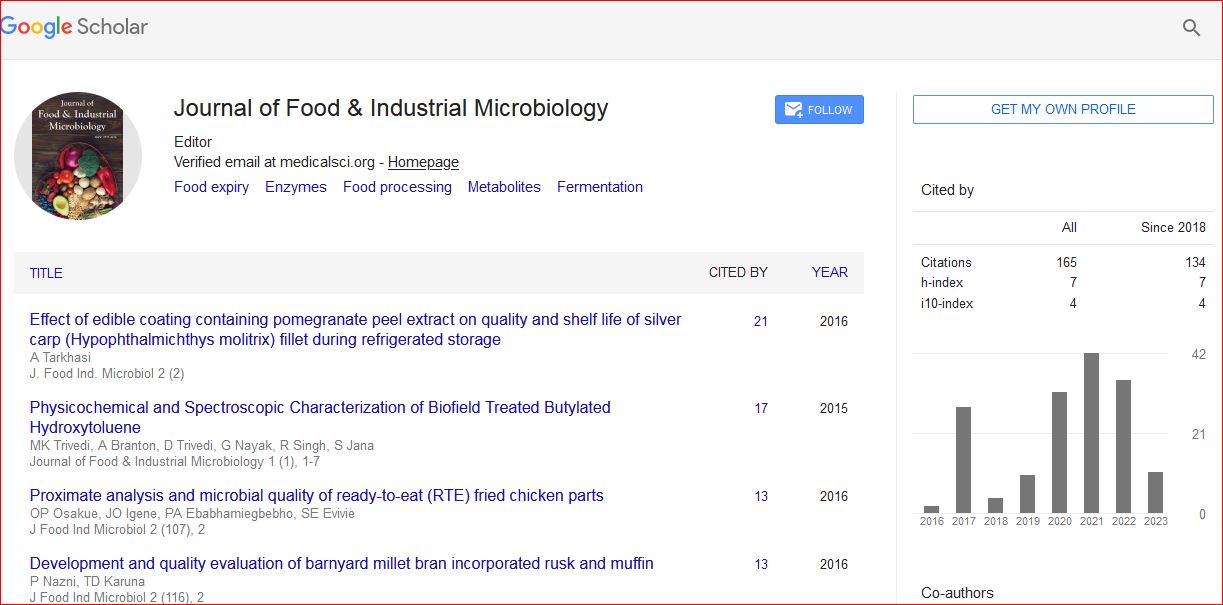
Journal of Food & Industrial Microbiology received 160 citations as per Google Scholar report