Short Communication - (2025) Volume 11, Issue 2
Received: 01-Mar-2025, Manuscript No. jfim-26-178556;
Editor assigned: 03-Mar-2025, Pre QC No. P-178556;
Reviewed: 17-Mar-2025, QC No. Q-178556;
Revised: 24-Mar-2025, Manuscript No. R-178556;
Published:
31-Mar-2025
, DOI: 10.37421/2572-4134.2025.11.342
Citation: Al‑Rahman, Omar. ”Microbial Enzymes: Enhancing Food Through Biotechnology.” J Food Ind Microbiol 11 (2025):342.
Copyright: © 2025 Al‑Rahman O. This is an open-access article distributed under the terms of the Creative Commons Attribution License, which permits unrestricted use, distribution and reproduction in any medium, provided the original author and source are credited.
The industrial production of enzymes for food applications is predominantly driven by microbial sources, with fungi and bacteria being the primary contributors due to their rapid growth and high enzyme secretion capabilities. These microorganisms are instrumental in producing essential enzymes such as amylases, proteases, lipases, cellulases, and pectinases, which significantly enhance food texture, flavor, processing efficiency, and nutritional value [1].
The optimization of fermentation processes is a critical factor for cost-effective and high-yield production. This includes careful control over media composition, pH, temperature, and aeration. Furthermore, effective downstream processing for enzyme purification and stabilization is equally vital for achieving desirable product characteristics [1].
Specific microbial strains are often targeted for the production of particular enzymes. For instance, Aspergillus niger is recognized for its capability in producing alpha-amylase, a key enzyme for starch processing. Research has focused on optimizing its submerged fermentation conditions, including the impact of carbon and nitrogen sources, as well as trace elements, to maximize enzyme yield [2].
Genetic and metabolic engineering approaches are increasingly being employed to enhance enzyme production and properties. For example, Bacillus subtilis has been genetically engineered to improve the production and characteristics of extracellular lipases, which are valuable for flavor development and fat modification in food products. Strategies like promoter and signal peptide engineering are used to boost secretion and tailor enzymatic functions [3].
Beyond submerged fermentation, solid-state fermentation (SSF) presents a viable alternative for certain enzyme productions. Studies on pectinolytic enzymes from Thermomyces lanuginosus have demonstrated that SSF can lead to higher enzyme concentrations and reduced wastewater generation, offering a more sustainable method for producing food-grade enzymes [4].
Effective downstream processing is paramount to ensure that microbial enzymes meet the stringent purity and activity requirements for industrial use. Techniques such as ultrafiltration, ion-exchange chromatography, and immobilization are employed for recovering and purifying enzymes, with economic feasibility being a key consideration in strategy selection [5].
Enzyme immobilization is a key technology that significantly impacts the industrial application of food enzymes. Various immobilization supports and methods, including adsorption, covalent binding, entrapment, and cross-linking, are utilized to improve enzyme stability, reusability, and activity, thereby benefiting continuous processing and product quality [6].
Microbial enzymes also play crucial roles in specific food sectors like baking. Xylanase produced from Penicillium chrysogenum, for instance, has shown potential in improving dough rheology and bread quality, enhancing texture and shelf-life of baked goods [7].
Thermostable enzymes are particularly valuable for applications in food processing industries that operate at elevated temperatures, such as dairy and meat processing. Proteases from thermophilic bacteria like Geobacillus thermodens are optimized for high-temperature stability, contributing to reduced processing times and energy consumption [8].
Recombinant DNA technology offers powerful tools for enhancing the production of enzymes like cellulases and hemicellulases. By genetically modifying microorganisms, high yields of enzymes with improved specific activities can be achieved for applications ranging from fruit juice clarification to biofuel production [9].
Industrial enzyme production for food applications relies heavily on microbial sources, primarily fungi and bacteria, due to their rapid growth and ability to secrete large quantities of enzymes. Key enzymes like amylases, proteases, lipases, cellulases, and pectinases are crucial for enhancing food texture, flavor, processing efficiency, and nutritional value [1].
Optimization of fermentation processes, including media composition, pH, temperature, and aeration, along with downstream processing for purification and stabilization, are critical for cost-effective and high-yield production [1].
Focusing on Aspergillus niger, this study details optimized submerged fermentation conditions for enhanced production of alpha-amylase, a vital enzyme for starch processing in the food industry. The research highlights the impact of carbon and nitrogen sources, as well as specific trace elements, on enzyme yield, underscoring the importance of precisely controlling fermentation parameters for maximizing productivity and reducing production costs [2].
This article explores the genetic engineering of Bacillus subtilis to improve the production and properties of extracellular lipases for food applications, particularly in flavor development and fat modification. Strategies like promoter engineering and signal peptide modification are discussed for achieving higher secretion levels and altered enzymatic characteristics, emphasizing the potential for creating tailored lipases with specific functionalities [3].
The paper investigates the use of solid-state fermentation (SSF) for the production of pectinolytic enzymes from Thermomyces lanuginosus, a promising alternative to submerged fermentation for certain applications. It highlights how SSF can lead to higher enzyme concentrations and reduced wastewater generation, making it a more sustainable approach for food-grade enzyme production, with a key focus on optimizing substrate composition and physical parameters for SSF [4].
This research focuses on the downstream processing of microbial enzymes for food applications, specifically the recovery and purification of phytase from Peniophora lycii. It examines various techniques, including ultrafiltration, ion-exchange chromatography, and immobilization, to achieve high purity and activity suitable for industrial use, also analyzing the economic feasibility of different purification strategies [5].
This review provides an overview of the latest advancements in enzyme immobilization techniques for industrial food enzyme applications. It covers different immobilization supports and methods (adsorption, covalent binding, entrapment, cross-linking) and their impact on enzyme stability, reusability, and activity, highlighting the benefits of immobilized enzymes for continuous processing and product quality [6].
This study explores the potential of using xylanase produced by a newly isolated strain of Penicillium chrysogenum for baking applications. The research details the optimization of fermentation parameters for xylanase production and evaluates its performance in improving dough rheology and bread quality, suggesting that microbial xylanases can significantly enhance the texture and shelf-life of baked goods [7].
The article examines the industrial production and characterization of protease from a thermophilic bacterium, Geobacillus thermodens. The study focuses on optimizing fermentation conditions and exploring the enzyme's stability at high temperatures, making it suitable for various food processing applications, such as in dairy and meat industries, highlighting its potential for reducing processing times and energy consumption [8].
This paper investigates the use of recombinant DNA technology to enhance the production of cell-wall degrading enzymes, such as cellulases and hemicellulases, from genetically modified microorganisms for applications in fruit juice clarification and ethanol production. The research focuses on optimizing expression systems and fermentation strategies to achieve high yields of industrially relevant enzymes with improved specific activities [9].
Microbial sources are vital for industrial enzyme production in the food sector, yielding enzymes like amylases, proteases, and lipases that enhance food properties. Fermentation optimization, including media and conditions, is crucial for high yields. Genetic and metabolic engineering are employed to improve enzyme activity and production. Solid-state fermentation offers a sustainable alternative. Downstream processing, purification, and immobilization are essential for industrial enzyme application. Specific enzymes like xylanase and thermostable proteases are being developed for applications in baking and high-temperature processing, respectively. Recombinant DNA technology aids in producing enzymes like cellulases and hemicellulases for various food and biofuel applications.
None
None
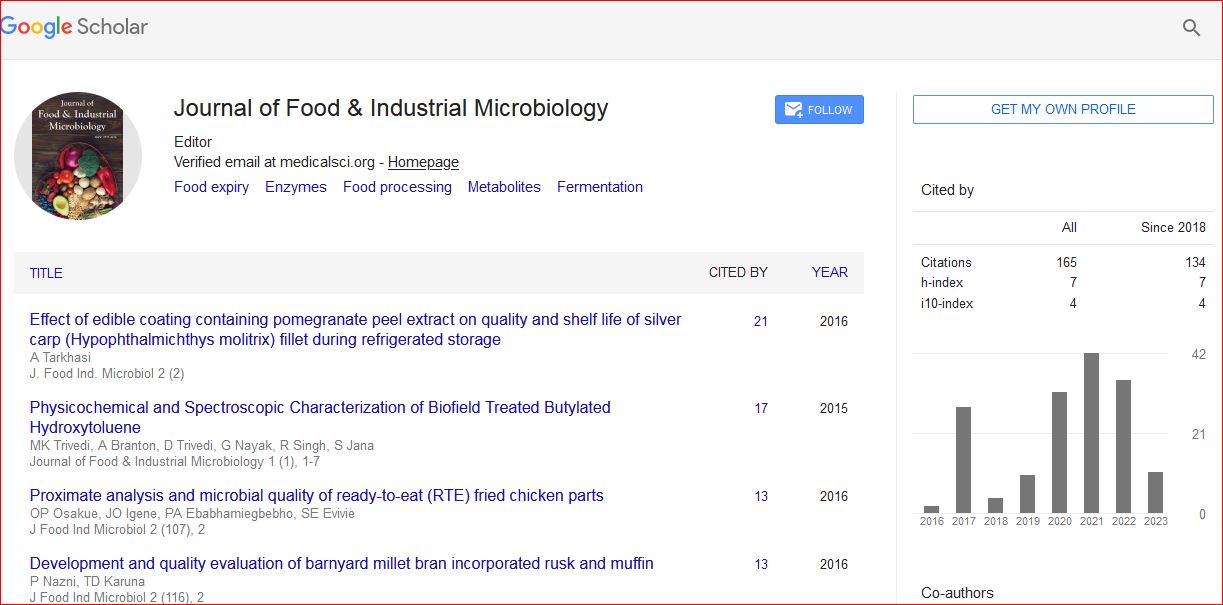
Journal of Food & Industrial Microbiology received 160 citations as per Google Scholar report