Commentary - (2025) Volume 11, Issue 6
Received: 01-Nov-2025, Manuscript No. jefc-26-188319;
Editor assigned: 03-Nov-2025, Pre QC No. P-188319;
Reviewed: 17-Nov-2025, QC No. Q-188319;
Revised: 24-Nov-2025, Manuscript No. R-188319;
Published:
29-Nov-2025
, DOI: : 10.37421/2472-0542.2025.11.569
Citation: Mahmoud, Rania. ”Chemical Reactions Shaping Food Texture: A Research Overview.” J Exp Food Chem 11 (2025):569.
Copyright: © 2025 Mahmoud R. This is an open-access article distributed under the terms of the Creative Commons Attribution License, which permits unrestricted use, distribution and reproduction in any medium, provided the original author and source are credited.
The intricate field of food science continually explores the myriad chemical transformations that govern the textural attributes of our food supply. Understanding these processes is paramount for developing novel food products, optimizing existing ones, and ensuring consumer satisfaction through desirable sensory experiences. Chemical reactions, ranging from enzymatic activities to non-enzymatic browning, play a pivotal role in altering the fundamental structure and perceived texture of food. This introduction will delve into various chemical reactions that profoundly influence food texture, drawing upon key research findings to illuminate their mechanisms and implications. Maillard reactions and enzymatic browning are fundamental to food quality, not only contributing to color development but also significantly impacting texture. These reactions lead to the formation of complex macromolecules such as melanoidins, which can alter viscosity and gelation properties, particularly in baked goods and dairy products. The interplay between these browning reactions and textural outcomes is a critical area of study [1].
Protein denaturation and aggregation represent another significant pathway through which food texture is modified. Factors like heat and pH changes can induce conformational changes in proteins, leading to alterations in water-holding capacity, gel strength, and elasticity. These phenomena are especially relevant in the processing of meat and the formulation of protein-based foods [2].
Lipid oxidation and hydrolysis are crucial reactions that affect the sensory properties and stability of foods, with a direct impact on texture and mouthfeel. The breakdown of lipids can lead to changes in emulsification, viscosity, and the development of off-flavors, thus influencing the overall consumer perception of products like dressings and snacks [3].
Carbohydrate structures undergo substantial modifications during food processing, with starch gelatinization and retrogradation being prime examples. These reactions dictate viscosity, gel formation, and mouthfeel in a wide array of products, including bread, pasta, and dairy desserts, underscoring the importance of controlled processing conditions [4].
Enzymes, such as proteases and amylases, are powerful tools in food modification, capable of precisely altering food structure and texture. Their controlled activity can be harnessed to tenderize meat, improve dough characteristics, and manage the texture of fermented foods, demanding a high degree of precision in their application [5].
Acid hydrolysis and fermentation represent chemical transformations that significantly influence the textural integrity of plant-based materials. These processes alter cell wall components and protein structures, leading to changes in tenderness and mouthfeel, particularly relevant for plant-based alternatives and purees [6].
Caramelization, a thermochemical process involving the browning of sugars, leads to the formation of chromophores and flavor compounds that also impact rheological properties. This reaction is responsible for the development of characteristic smooth or brittle textures in sugar-based confectionery [7].
The biochemical processes during fruit and vegetable ripening involve enzymatic reactions that break down cell walls and starch. These changes are directly linked to the softening of fruits like bananas and tomatoes, and the textural evolution of root vegetables [8].
Oxidation plays a detrimental role in the degradation of pigments and lipids, particularly in processed meats, resulting in undesirable textural changes such as increased toughness and reduced juiciness. Managing oxidation is therefore crucial for preserving desirable textural qualities [9].
Finally, the hydrolysis of polysaccharides like pectin and cellulose is a key factor in modifying the texture of dairy products. Whether induced by enzymes or acids, this process influences viscosity, mouthfeel, and overall structural integrity in yogurts and cheeses [10].
The profound influence of chemical reactions on food texture is a cornerstone of food science, impacting everything from product development to consumer acceptance. Understanding these reactions allows for the precise manipulation of food characteristics to achieve desired sensory attributes. This section will elaborate on the specific mechanisms and applications of various chemical processes that shape food texture. Maillard reactions and enzymatic browning are complex processes that contribute significantly to food's aesthetic and textural qualities. The formation of melanoidins, a diverse group of polymers produced during the Maillard reaction, not only imparts brown color but also influences the rheological properties of food systems. In baked goods, these macromolecules can affect dough viscosity and the final crumb structure, while in dairy products, they can influence gelation and texture. Similarly, enzymatic browning in fruits and vegetables, driven by polyphenol oxidases, leads to structural breakdown of cell walls and pigment generation, directly affecting firmness and overall texture [1].
Protein denaturation and aggregation are critical in modifying the texture of protein-rich foods. When proteins are subjected to heat or altered pH conditions, their three-dimensional structures unfold and can then associate with each other. This aggregation can lead to the formation of gels with varying strengths and elasticities, or it can result in a firmer, tougher texture. These mechanisms are fundamental to understanding the textural changes in cooked meats, as well as in products like cheese and yogurt [2].
Lipid oxidation and hydrolysis have a multifaceted impact on food texture. Lipid oxidation, often triggered by heat, light, or enzymes, can lead to the formation of volatile compounds that affect flavor but also alter the physical properties of lipids, influencing emulsification stability and mouthfeel. Lipid hydrolysis breaks down triglycerides into fatty acids and glycerol, which can change the viscosity and water-binding capacity of food matrices, impacting the perceived smoothness or greasiness of products like salad dressings and processed snacks [3].
Starch, a primary polysaccharide in many food staples, undergoes significant textural transformations through gelatinization and retrogradation. Gelatinization, the process where starch granules absorb water and swell upon heating, leads to thickening and gel formation. Retrogradation, occurring upon cooling and storage, involves the reassociation of starch molecules, which can cause staling in bread or a change in the texture of cooked pasta and dairy desserts, often leading to a firmer, less desirable texture [4].
Enzymes are biological catalysts that can be employed to specifically tailor food textures. Proteases, for instance, can break down proteins to tenderize meat or modify the texture of dairy products. Amylases can break down starch into simpler sugars, affecting viscosity and mouthfeel in products like bread and beverages. The judicious use of enzymes allows for precise control over textural development, enabling the creation of products with specific sensory profiles [5].
In plant-based foods, acid hydrolysis and fermentation play vital roles in modifying texture. Acid hydrolysis can break down complex carbohydrates and proteins in cell walls and matrices, leading to softening and increased tenderness in products like vegetable purees and soy-based alternatives. Fermentation, often involving microbial acids, also contributes to textural changes by altering protein structures and breaking down polysaccharides, influencing the overall mouthfeel and consistency of these foods [6].
Caramelization, the thermal degradation of sugars, is responsible for the characteristic brown color and distinct flavors of many confectionery and baked goods. Beyond flavor and color, the complex polymeric products formed during caramelization also influence the rheological properties of sugar-rich systems. These compounds can contribute to the viscosity of syrups and create the brittle or chewy textures found in candies and toffees [7].
The biochemical changes that occur during fruit and vegetable ripening are intrinsically linked to textural evolution. Enzymes like pectinases and cellulases degrade cell wall components, leading to the softening of fruits such as avocados and peaches. Similarly, the breakdown of starch into sugars contributes to the characteristic changes in texture and sweetness during ripening, transforming firm root vegetables into softer, more palatable forms [8].
Oxidation, particularly in processed meats, can negatively impact texture. The oxidation of lipids and proteins can lead to cross-linking or fragmentation of muscle fibers, resulting in increased toughness and a loss of juiciness. This degradation can significantly alter the eating quality of processed meat products, making strategies to inhibit oxidation, such as the use of antioxidants or controlled packaging, essential for maintaining desirable texture [9].
Lastly, the hydrolysis of polysaccharides is a critical determinant of texture in dairy products. Enzymes like lactases or acids can break down polysaccharides such as lactose or components of the milk matrix. This hydrolysis can alter the viscosity, mouthfeel, and overall structural integrity of products like yogurt, influencing their creaminess and stability. Similarly, in cheeses, enzymatic activity can lead to the breakdown of polysaccharides and proteins, affecting texture and aging [10].
This collection of research explores the diverse chemical reactions that significantly impact food texture. Maillard reactions and enzymatic browning alter food structure by forming complex macromolecules, influencing viscosity and gelation. Protein denaturation and aggregation, driven by heat or pH, affect water-holding capacity and elasticity. Lipid oxidation and hydrolysis modify mouthfeel and stability through changes in emulsification and viscosity. Carbohydrate modifications like starch gelatinization and retrogradation dictate texture in products such as bread and pasta. Enzymes such as proteases and amylases are utilized to precisely modify food structures for desired textures. Acid hydrolysis and fermentation transform plant-based materials, influencing tenderness. Caramelization of sugars affects rheology and texture in confectionery. Ripening processes involve enzymatic breakdown of cell walls and starch, leading to softening. Oxidation in processed meats can cause increased toughness. Polysaccharide hydrolysis is key to altering the texture of dairy products. Together, these studies highlight the chemical basis of food texture and its manipulation.
None
None
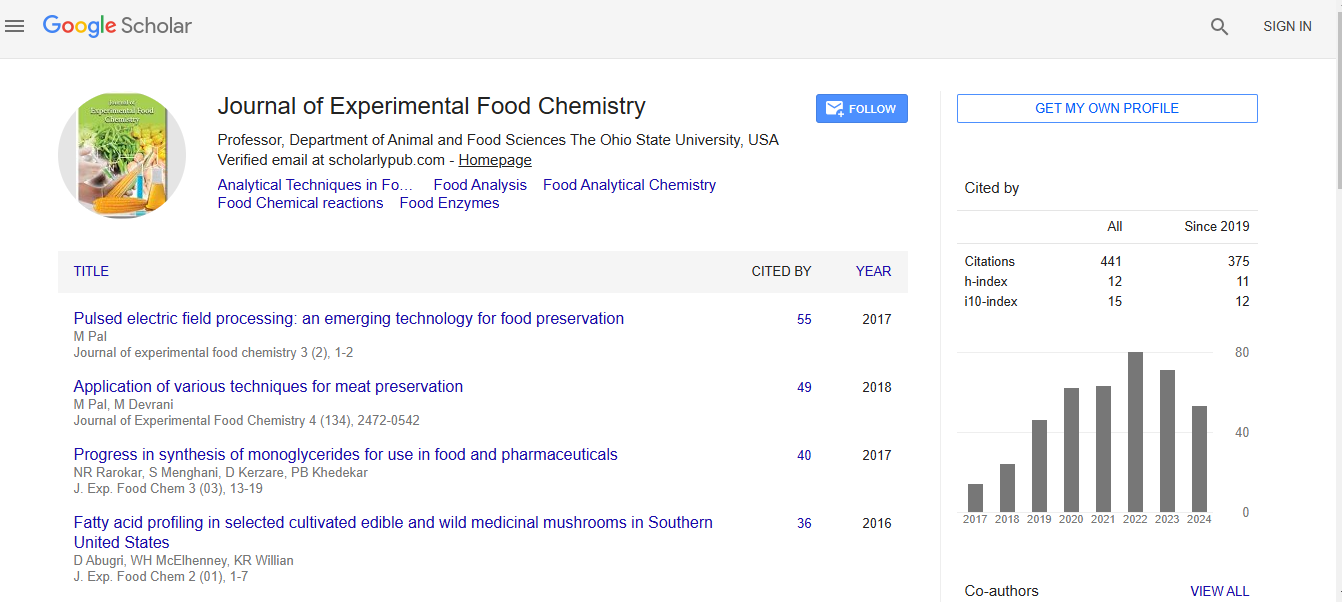
Journal of Experimental Food Chemistry received 389 citations as per Google Scholar report