Brief Report - (2025) Volume 10, Issue 3
Received: 01-Sep-2025, Manuscript No. jib-25-175270;
Editor assigned: 03-Sep-2025, Pre QC No. P-175270;
Reviewed: 17-Sep-2025, QC No. Q-175270;
Revised: 22-Sep-2025, Manuscript No. R-175270;
Published:
29-Sep-2025
, DOI: 10.37421/2476-1966.2025.10.280
Citation: Popescu, Mirela. ”Macrophages: Versatile Heterogeneity, Disease Roles, Therapy.” J Immuno Biol 10 (2025):280.
Copyright: © 2025 Popescu M. This is an open-access article distributed under the terms of the Creative Commons Attribution License, which permits unrestricted use, distribution and reproduction in any medium, provided the original author and source are credited.
Recent research reviews the intricate mechanisms underlying macrophage polarization into M1 and M2 phenotypes. This process is crucial in various diseases, including cancer, autoimmune disorders, and metabolic conditions. The article highlights key regulatory pathways and identifies potential therapeutic targets, emphasizing how modulating macrophage plasticity can achieve desired immune responses, offering new avenues for treatment [1].
Studies explore the significant heterogeneity of tissue-resident macrophages, noting their diverse developmental origins and specialized functions within specific organs. These macrophages play critical roles in maintaining tissue homeostasis, immunity, and disease progression. Understanding these diverse cell populations also opens up various therapeutic opportunities [2].
An overview highlights macrophage-based immunotherapeutic strategies specifically designed for cancer treatment. These strategies encompass macrophage repolarization, adoptive cell therapy, and sophisticated targeted delivery systems. The discussion addresses both the challenges and the promising opportunities for developing effective macrophage-centric approaches to overcome tumor immunosuppression and ultimately enhance anti-tumor responses in patients [3].
Research elucidates the multifaceted roles macrophages play in the pathogenesis and progression of several metabolic diseases, such as obesity, insulin resistance, and atherosclerosis. Their polarization state and unique secretory profiles significantly influence tissue inflammation and contribute to metabolic dysfunction. This understanding points towards potential therapeutic targets that could mitigate these conditions [4].
Insights delve into the complex origins and developmental pathways of macrophages, distinguishing distinct populations like embryonic-derived tissue-resident macrophages and bone marrow-derived inflammatory macrophages. This distinction is vital because their specific ontogeny profoundly dictates their roles in essential processes such as tissue repair, regeneration, and the pathology of various diseases [5].
Investigations examine the dual role macrophages play in the initiation, progression, and resolution of fibrosis, a critical process impacting various organs, including the liver, lung, and kidney. Their dynamic activation states, specifically M1 pro-inflammatory and M2 pro-fibrotic phenotypes, significantly contribute to tissue remodeling. This research also highlights therapeutic strategies focused on targeting macrophage function to mitigate fibrotic diseases [6].
Reports highlight the critical functions of macrophages in both controlling and, at times, contributing to the pathogenesis of various infectious diseases. Their roles span pathogen recognition, phagocytosis, antigen presentation, and cytokine production. It is also important to note how cunning pathogens can manipulate macrophage functions to ensure their own survival within the host [7].
Work distinguishes and clarifies the specific roles of resident microglia and peripheral macrophages in numerous neurological disorders characterized by neuroinflammation. The review discusses their dynamic interactions, diverse activation states, and their contributions to both neuroprotection and neurodegeneration. Emphasizing therapeutic strategies that specifically target these crucial immune cells is a key focus for future interventions [8].
The transformative impact of advanced single-cell sequencing and spatial transcriptomics technologies in unraveling the true heterogeneity and functional diversity of macrophage populations across various tissues and disease contexts is a major theme. These sophisticated methods are instrumental in revealing novel macrophage subsets and shedding light on their precise roles in disease pathogenesis, opening doors for personalized medicine [9].
Explorations detail the fundamental processes of phagocytosis and efferocytosis, which is the clearance of apoptotic cells, meticulously performed by macrophages. These studies describe the intricate molecular mechanisms involved in recognizing and engulfing cellular debris and pathogens. This research underscores the critical role these processes play in maintaining tissue homeostasis and effectively resolving inflammation, offering clear implications for future therapeutic interventions [10].
Macrophages are indispensable immune cells, characterized by their extraordinary plasticity and the significant heterogeneity they exhibit across various tissues and disease environments. Their capacity to polarize into distinct functional phenotypes, notably M1 (pro-inflammatory) and M2 (pro-resolving/pro-fibrotic), profoundly influences the initiation, progression, and resolution of disease. For instance, a deep understanding of the intricate mechanisms governing macrophage polarization is vital for addressing conditions ranging from aggressive cancers and complex autoimmune disorders to prevalent metabolic diseases. Modulating this macrophage plasticity represents a promising avenue for developing novel therapeutic interventions aimed at achieving desired immune responses [1]. Beyond just polarization, the studies underscore that tissue-resident macrophages, those stably residing in specific organs, possess diverse developmental origins and highly specialized functions. These cells are not merely bystanders; they play critical, often unique, roles in maintaining tissue homeostasis, orchestrating immune responses, and contributing to disease pathology within their particular microenvironments [2].
In the complex landscape of cancer, macrophage-based immunotherapeutic strategies are rapidly emerging and showing considerable promise. These innovative approaches encompass diverse methodologies such as macrophage repolarization to shift them from tumor-promoting to anti-tumor phenotypes, adoptive cell therapy where macrophages are engineered and reintroduced, and sophisticated targeted delivery systems. All these strategies are specifically designed to overcome the pervasive tumor immunosuppression that hinders conventional treatments and to significantly enhance anti-tumor responses within the patient's body [3]. Shifting focus, macrophages are also unequivocally identified as pivotal players in the pathogenesis and progression of various metabolic diseases, including chronic conditions like obesity, debilitating insulin resistance, and atherosclerosis. Their specific polarization state and unique secretory profiles directly impact tissue inflammation and contribute substantially to metabolic dysfunction. This understanding offers clear guidance for identifying specific therapeutic targets that could effectively mitigate these widespread metabolic conditions [4]. Furthermore, the dynamic involvement of macrophages extends to fibrotic diseases across vital organs, including the liver, lungs, and kidneys. Here, they exhibit a dual role, with their M1 pro-inflammatory and M2 pro-fibrotic activation states significantly contributing to undesirable tissue remodeling. Research in this area highlights the development of therapeutic strategies focused on targeting specific macrophage functions to prevent or reverse the progression of fibrotic diseases [6].
The intricate origins and developmental pathways of macrophages are fundamental to deciphering their diverse and specialized functions. A key distinction is drawn between embryonic-derived tissue-resident macrophages, which are self-renewing and long-lived within tissues, and bone marrow-derived inflammatory macrophages, recruited to sites of injury or infection. Understanding their distinct ontogeny is not merely academic; it profoundly dictates their specific roles in essential biological processes such as robust tissue repair, effective regeneration after injury, and the precise pathology of various diseases [5]. Moreover, the critical functions of macrophages are prominently displayed in infectious diseases, where they paradoxically both control pathogens and, under certain circumstances, contribute to pathogenesis. Their multifaceted roles include initiating pathogen recognition, performing crucial phagocytosis to engulf invaders, facilitating antigen presentation to activate adaptive immunity, and producing a wide array of cytokines that shape the immune response. It is also a significant challenge that cunning pathogens have evolved sophisticated mechanisms to manipulate macrophage functions, enabling their own survival and propagation within the host [7].
In the realm of neurological disorders, resident microglia, the brain's intrinsic macrophages, and peripheral macrophages that infiltrate the central nervous system, collectively act as vital sentinels of neuroinflammation. Distinguishing and clarifying their specific roles, dynamic interactions, and various activation states is paramount for comprehending their complex contributions to both beneficial neuroprotection and detrimental neurodegeneration. This nuanced understanding is essential for guiding the development of precisely targeted therapeutic strategies aimed at modulating these immune cells for neurological health [8]. Importantly, the landscape of macrophage research has been profoundly transformed by advanced technological innovations such, as single-cell sequencing and spatial transcriptomics. These cutting-edge methods are instrumental in unraveling the true heterogeneity and remarkable functional diversity of macrophage populations across various tissues and intricate disease contexts. By providing unprecedented detail, these technologies are revealing novel macrophage subsets and shedding crucial light on their precise roles in disease pathogenesis, paving the way for more granular and effective interventions [9].
At a fundamental cellular level, macrophages are renowned for their indispensable phagocytic capabilities, which include not only the engulfment of pathogens but also efferocytosisâ??the crucial process of clearing apoptotic, or dying, cells. Studies meticulously detail the intricate molecular mechanisms involved in the recognition and subsequent engulfment of cellular debris and invading pathogens. These processes are not merely basic cellular functions; they are critical for maintaining overall tissue homeostasis and for the effective and timely resolution of inflammation, preventing chronic inflammatory states. This deep understanding of phagocytosis and efferocytosis holds profound implications for developing future therapeutic interventions, particularly in the context of inflammatory diseases where these processes are often dysregulated [10].
Macrophages are highly versatile immune cells with critical roles in health and disease. They exhibit significant heterogeneity, stemming from diverse developmental origins and specialized functions across various tissues [2, 5]. Their ability to polarize into distinct phenotypes, such as M1 and M2, is central to their function, impacting conditions like cancer, autoimmune disorders, and metabolic diseases [1, 4]. Research highlights macrophage involvement in the pathogenesis and resolution of fibrosis in organs like the liver and lung [6], and their complex roles in controlling infectious diseases while also being manipulated by pathogens [7]. In the brain, resident microglia and peripheral macrophages are key players in neuroinflammation, contributing to both protection and degeneration [8]. Therapeutic strategies often target macrophage function, including repolarization for cancer immunotherapy [3] and modulating their roles in metabolic diseases [4] and fibrosis [6]. The fundamental processes of phagocytosis and efferocytosis, crucial for tissue homeostasis and inflammation resolution, also present significant therapeutic implications [10]. Advances in single-cell sequencing and spatial transcriptomics are further unraveling the true diversity of macrophage populations, revealing novel subsets and their specific contributions to disease pathogenesis [9]. This comprehensive understanding of macrophage biology, from their ontogeny and polarization to their roles in diverse pathologies and fundamental cellular processes, is crucial for developing targeted interventions across a wide spectrum of human diseases.
None
None
Yu W, Yanan F, Shanshan T. "Macrophage polarization in various diseases: regulation and potential therapeutic targets".Signal Transduct Target Ther 8 (2023):109.
Indexed at, Google Scholar, Crossref
Siddhartha A, Nils L, Stephan U. "Tissue-Resident Macrophages: Diverse Origins, Functions, and Therapeutic Opportunities".Cells 11 (2022):3308.
Indexed at, Google Scholar, Crossref
Xiang-Guang W, Yu-Ting H, Yong-Qi S. "Macrophage-based immunotherapy for cancer: Current landscape and future directions".Front Immunol 14 (2023):1316527.
Indexed at, Google Scholar, Crossref
Zhen G, Xin L, Ting Z. "Macrophages: Key players in metabolic diseases".Front Immunol 12 (2021):818411.
Indexed at, Google Scholar, Crossref
Min-Su K, Youngju K, Seoyoon P. "Understanding Macrophage Ontogeny and Implications for Tissue Repair and Regeneration".Biomedicines 10 (2022):3112.
Indexed at, Google Scholar, Crossref
Yang Y, Yiran F, Xiang S. "Macrophages in Organ Fibrosis".Biomedicines 11 (2023):704.
Indexed at, Google Scholar, Crossref
Yu M, Min-Su K, Jae KM. "Macrophages and Their Roles in Infectious Diseases".Cells 12 (2023):1381.
Indexed at, Google Scholar, Crossref
Eftychia S, Evelien DS, Bart DS. "Microglia and Macrophages: The Sentinels of Neuroinflammation".Trends Immunol 43 (2022):100-112.
Indexed at, Google Scholar, Crossref
Hui J, Ting Z, Songyuan H. "Spatially and functionally distinct macrophage populations revealed by single-cell technologies in disease".Front Immunol 14 (2023):1260667.
Indexed at, Google Scholar, Crossref
Yuanyuan H, Han J, Chunhui Q. "Mechanisms and therapeutic implications of efferocytosis in inflammatory diseases".Cell Death Dis 13 (2022):1.
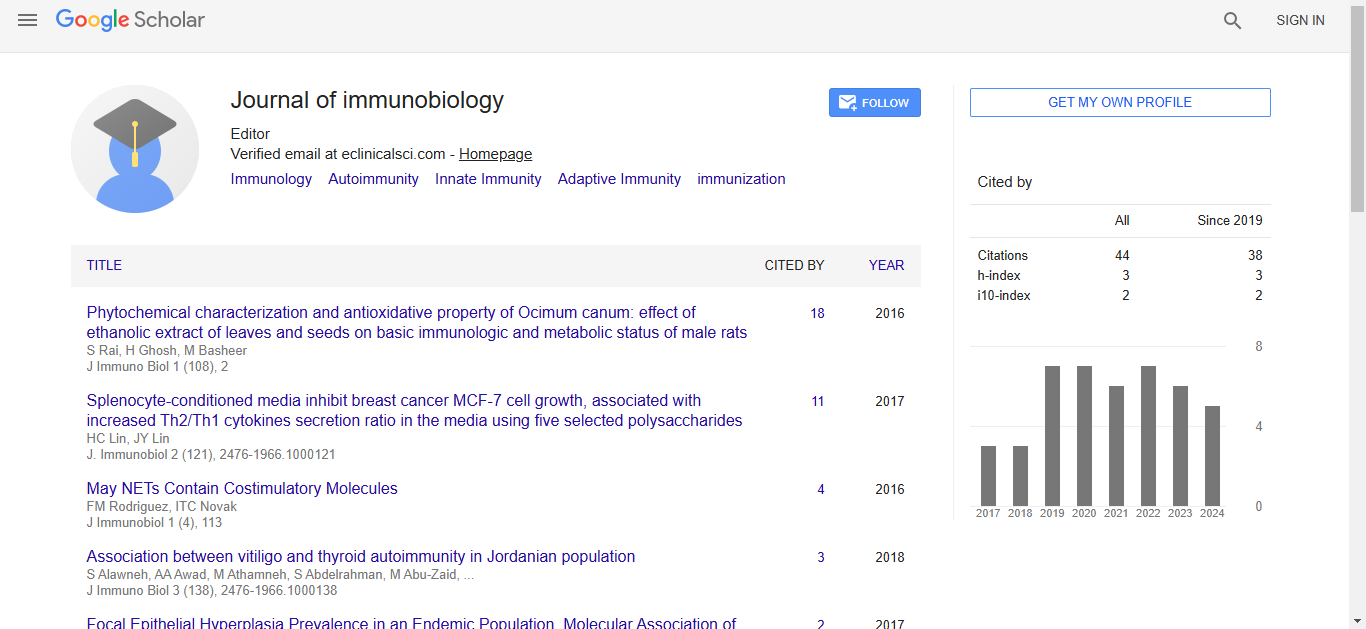
Journal of Immunobiology received 34 citations as per Google Scholar report