Brief Report - (2025) Volume 10, Issue 2
Received: 02-Jun-2025, Manuscript No. jib-25-175241;
Editor assigned: 04-Jun-2025, Pre QC No. P-175241;
Reviewed: 18-Jun-2025, QC No. Q-175241;
Revised: 23-Jun-2025, Manuscript No. R-175241;
Published:
30-Jun-2025
, DOI: 10.37421/2476-1966.2025.10.270
Citation: Mercer, Liana. ”Innate Immunity: Central to Health, Disease, Therapy.” J Immuno Biol 10 (2025):270.
Copyright: © 2025 Mercer L. This is an open-access article distributed under the terms of the Creative Commons Attribution License, which permits unrestricted use, distribution and reproduction in any medium, provided the original author and source are credited.
The innate immune system forms the body's first line of defense, playing a crucial role in maintaining health and driving disease pathogenesis across various physiological contexts. One key area where this defense mechanism is critically involved is in cardiovascular health, particularly in atherosclerosis. Here, innate immune cells like macrophages, dendritic cells, and neutrophils are central to both the initiation and progression of the disease. They respond to various stimuli through pattern recognition receptors, activate inflammasomes, and engage diverse signaling pathways, all contributing to the chronic inflammation characteristic of this condition. Understanding these mechanisms opens avenues for identifying potential therapeutic targets [1] . Beyond acute responses, the innate immune system exhibits a fascinating capacity for memory, a concept known as trained immunity. This phenomenon means that innate immune cells can develop a lasting memory of prior infections or stimuli. This leads to an enhanced and more robust response when they encounter subsequent challenges. This â??memoryâ? is not a simple recall but involves profound epigenetic reprogramming and metabolic changes within the cells. These alterations have significant long-term implications, shaping an individual's host defense capabilities and influencing their susceptibility to various diseases [2] . The innate immune system's vigilance is particularly evident in its fight against viral threats. For example, in the context of SARS-CoV-2 infection, the virus responsible for COVID-19, the innate immune response is paramount. Innate immune cells and their associated pathways are vital for detecting the virus and initiating effective antiviral responses. However, if this delicate system becomes dysregulated, it can lead to severe disease outcomes, including the dangerous â??cytokine stormâ? observed in critical COVID-19 cases. This highlights the double-edged sword of innate immunity: essential for protection, but potentially harmful if uncontrolled [3] . Similarly, a broad understanding of how the innate immune system detects and responds to viral infections is fundamental. This involves the crucial roles of pattern recognition receptors in sensing specific viral components. Following this detection, there is a subsequent activation of intricate signaling pathways, leading to a coordinated array of antiviral effector mechanisms that work to restrict viral replication and prevent its spread throughout the host [10] . The gut is another critical interface where innate immunity plays an indispensable role, especially in conditions like Inflammatory Bowel Disease (IBD). The complex interplay between the gut microbiota and the innate immune system dictates intestinal health. Disruptions in the delicate balance of microbial communities, often combined with genetic predispositions, can trigger dysregulated innate immune responses. This imbalance contributes directly to the chronic inflammation that characterizes IBD in the gut, underscoring the importance of microbial harmony for immune regulation [4] . Specific innate immune cells often take center stage in these processes. Neutrophils, for instance, are quintessential innate immune cells with multifaceted roles spanning both host defense and pathology. Their functions are diverse and critical, including phagocytosis, where they engulf pathogens; degranulation, releasing antimicrobial substances; and NETosis, forming Neutrophil Extracellular Traps to ensnare microbes. However, dysregulation of neutrophil activity can contribute significantly to various inflammatory and infectious diseases, highlighting their dual nature as protectors and potential drivers of pathology [8] . The liver, a vital organ constantly exposed to pathogens and toxins, also relies heavily on specialized innate immune responses. Within the liver, unique immune cells like Kupffer cells, hepatic Natural Killer (NK) cells, and sinusoidal endothelial cells work in concert. They are essential for maintaining liver homeostasis and mounting rapid responses to various insults. Understanding their specific roles is key to unraveling the pathogenesis of various liver diseases and developing targeted interventions [9] . Beyond specific organs and diseases, the innate immune system's function can be profoundly influenced by intrinsic biological factors such as sex. Significant sex differences are observed in innate immune responses, a phenomenon largely modulated by sex hormones like estrogen and androgens, as well as X-linked genes. These factors collectively influence the function of innate immune cells, leading to varied susceptibility and severity of both infectious diseases and autoimmune conditions between males and females. This underscores the need for sex-disaggregated approaches in immunology research [7] . Finally, the remarkable power of the innate immune system is being explored for therapeutic applications, particularly in cancer immunotherapy. Strategies are emerging that aim to leverage and enhance the innate immune system's capabilities to fight cancer. These approaches include boosting Natural Killer (NK) cell activity, activating macrophages more effectively, and modulating innate immune checkpoints. The goal is to develop more potent immunotherapies that can overcome the sophisticated immune evasion mechanisms employed by tumors, offering new hope in cancer treatment [5] . The central role of innate immunity also extends to neurological disorders, as seen in multiple sclerosis (MS). Here, various innate immune cells and their signaling pathways are identified as key contributors to neuroinflammation, demyelination, and neurodegeneration. Identifying these specific cellular and molecular players offers promising avenues for developing therapeutic interventions aimed at mitigating the progression and severity of MS [6] .
The provided research highlights the ubiquitous and multifaceted roles of the innate immune system across human health and disease. At its core, innate immunity represents the body's immediate, non-specific defense mechanism, crucial for recognizing and responding to threats ranging from pathogens to cellular dysfunction. For instance, in cardiovascular diseases like atherosclerosis, innate immune cells, including macrophages, dendritic cells, and neutrophils, are not just bystanders but active participants. They utilize pattern recognition receptors and inflammasomes, engaging complex signaling pathways that fuel the chronic inflammation central to atherosclerosis development, suggesting targets for future therapies [C001].
A fascinating aspect of innate immunity is its capacity for â??trained immunity,â? a form of immunological memory previously thought exclusive to adaptive immunity. This memory allows innate immune cells to respond more vigorously to subsequent challenges after an initial exposure, a phenomenon driven by epigenetic reprogramming and metabolic shifts. These long-term changes significantly impact host defense and disease susceptibility [C002]. The innate system's role in combating infectious agents is particularly pronounced, as demonstrated by its critical function in fighting SARS-CoV-2. Innate cells and pathways detect the virus and orchestrate antiviral responses, but their dysregulation can unfortunately lead to severe outcomes such as cytokine storms in COVID-19 patients [C003]. Expanding on this, a comprehensive understanding of how the innate immune system detects and counteracts viral infections involves the intricate processes of pattern recognition receptors sensing viral components. This leads to the activation of specific signaling pathways and the coordinated deployment of antiviral effector mechanisms, all designed to limit viral replication and spread [C010].
The interaction between the innate immune system and other biological systems is also a focal point. In Inflammatory Bowel Disease (IBD), the gut microbiota plays a pivotal role, with disruptions in microbial communities, often combined with genetic predispositions, leading to a dysregulated innate immune response. This imbalance perpetuates chronic inflammation within the gut, making the microbiota a key area for understanding and potentially treating IBD [C004]. Moreover, individual innate immune cell types exhibit specialized functions that are critical yet can also contribute to pathology. Neutrophils, for example, are essential for host defense through phagocytosis, degranulation, and NETosis. However, their dysregulation is implicated in numerous inflammatory and infectious diseases [C008]. Similarly, the liver, being a site of constant exposure to pathogens and toxins, relies on specialized innate immune cells like Kupffer cells, hepatic Natural Killer (NK) cells, and sinusoidal endothelial cells to maintain its homeostasis and respond to various insults, ultimately influencing the course of liver diseases [C009].
Intrinsic biological factors, such as sex, also profoundly influence innate immune responses. Sex hormones like estrogen and androgens, alongside X-linked genes, modulate the function of innate immune cells, leading to observable sex differences in susceptibility and severity of both infectious diseases and autoimmune conditions [C007]. Recognizing these differences is vital for personalized medicine. Beyond understanding disease mechanisms, researchers are actively exploring how to harness the innate immune system for therapeutic benefit, particularly in cancer. Strategies include enhancing Natural Killer (NK) cell activity, activating macrophages, and modulating innate immune checkpoints to overcome tumor immune evasion and develop more effective immunotherapies [C005]. This therapeutic potential also extends to neurological conditions, where innate immunity is recognized as a master orchestrator of disease pathogenesis in multiple sclerosis (MS). Here, various innate immune cells and their signaling pathways drive neuroinflammation, demyelination, and neurodegeneration, presenting specific targets for therapeutic intervention [C006]. Collectively, these insights paint a picture of an incredibly dynamic and adaptable innate immune system, central to both health maintenance and disease pathology, with immense potential for future therapeutic exploitation.
The innate immune system is a cornerstone of host defense, with diverse and critical roles spanning numerous physiological and pathological states. It is intimately involved in chronic inflammatory conditions like atherosclerosis, where cells such as macrophages and neutrophils drive disease progression through pattern recognition receptors and inflammasomes. The concept of trained immunity reveals that innate cells possess a form of memory, leading to enhanced responses to subsequent challenges via epigenetic and metabolic changes, influencing long-term host defense. Infections, particularly viral ones like SARS-CoV-2, heavily rely on innate immune cells for detection and antiviral responses, though dysregulation can lead to severe outcomes like cytokine storms. The gut microbiota's interplay with innate immunity is crucial in diseases such as Inflammatory Bowel Disease, where microbial imbalances contribute to chronic inflammation. Specific innate immune cells like neutrophils, with their phagocytic and degranulation capabilities, are vital in defense but can also contribute to disease when dysregulated. Similarly, the liver's specialized innate immune cells maintain homeostasis and respond to insults, impacting liver health. Furthermore, intrinsic factors like sex profoundly influence innate immune responses, with hormones and X-linked genes dictating differences in disease susceptibility. Importantly, the power of innate immunity is being harnessed for therapeutic innovations, notably in cancer immunotherapy, by enhancing NK cell activity and modulating immune checkpoints. The system also orchestrates neuroinflammation in conditions like multiple sclerosis. This collective body of research underscores the innate immune system's centrality in health, disease pathogenesis, and its potential as a target for novel therapies.
None
None
Shuxia M, Jörg R, Albert JM. "Innate Immunity in Atherosclerosis".Cells 12 (2023):1332.
Indexed at, Google Scholar, Crossref
Mihai GN, Leo ABJ, Reinout vdP. "Trained Immunity: The Epigenetic Memory of Innate Immune Cells".Cell Host Microbe 27 (2020):857-870.
Indexed at, Google Scholar, Crossref
Akiko I, Jenny PT, Katherine AF. "Innate immunity and its relevance for COVID-19".Immunity 54 (2021):189-202.
Indexed at, Google Scholar, Crossref
Sima E, Elaheh K, Seyyed ES. "The Interplay Between Innate Immunity and Microbiota in Inflammatory Bowel Disease".Front Immunol 13 (2022):953492.
Indexed at, Google Scholar, Crossref
Jessica LB, Emily MM, Jeffrey SM. "Harnessing innate immunity for cancer immunotherapy".Cancer Discov 10 (2020):1109-1122.
Indexed at, Google Scholar, Crossref
Sung-Jin O, Jae BP, Chan-Guk P. "Innate immunity in multiple sclerosis: A master orchestrator of disease pathogenesis".J Neuroinflammation 18 (2021):206.
Indexed at, Google Scholar, Crossref
Sarthak G, Natalie JMT, Jessica EM. "Sex differences in innate immunity: the roles of sex hormones and X-linked genes".F1000Res 10 (2021):821.
Indexed at, Google Scholar, Crossref
Jie L, Huifang L, Ying H. "Neutrophil-mediated innate immunity and their role in diseases".Int Immunopharmacol 112 (2022):109200.
Indexed at, Google Scholar, Crossref
Xiaohua X, Xiaoyang M, Yuling H. "Innate immunity in the liver: guardians of liver health and disease".J Gastroenterol Hepatol 38 (2023):24-34.
Indexed at, Google Scholar, Crossref
Andreas R, Benjamin KS, Russell EV. "Understanding Innate Immunity to Viruses: From Sensing to Control".Annu Rev Immunol 38 (2020):595-621.
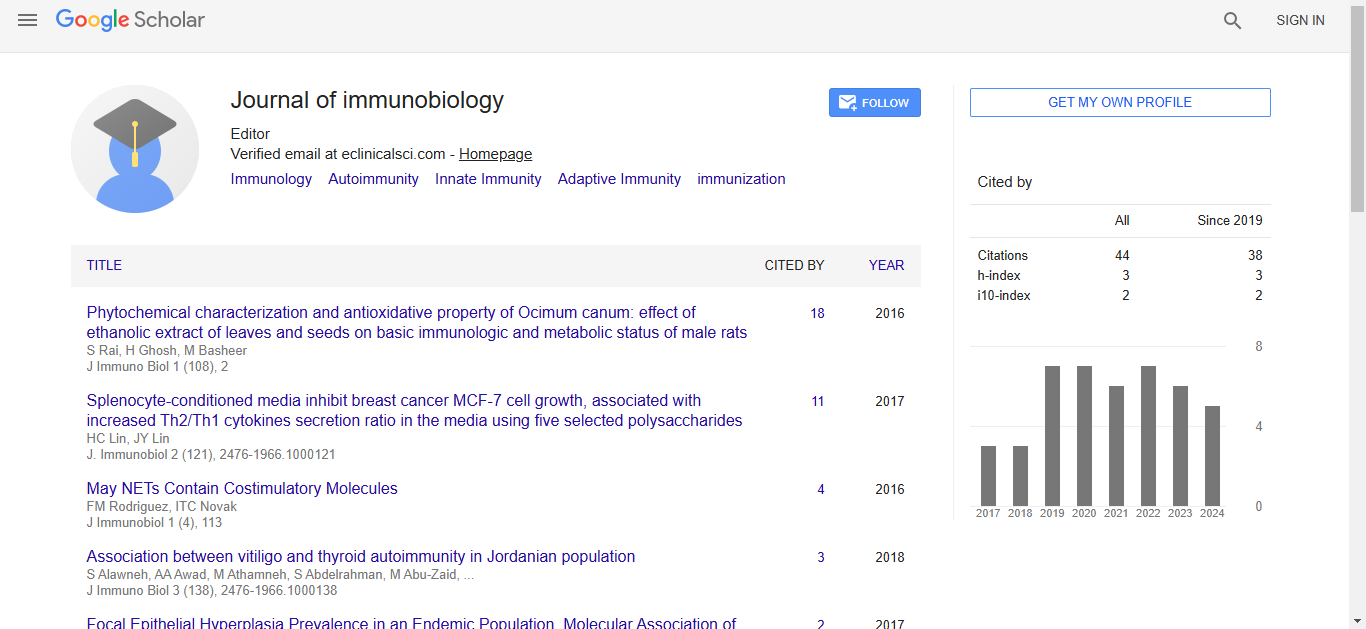
Journal of Immunobiology received 34 citations as per Google Scholar report